
Lieferung heute & morgen

Qualitätsgarantie

Willkommens-Angebote freischalten: KOSTENLOSE Lieferung | Bis zu 80 % RABATT | Kostenlose 30-Tage-JoyPlus-Testphase
App herunterladen
The number of electronic devices we use daily is constantly growing—from smartphones and tablets to laptops. Each device comes with its own power adapter, which quickly leads to cable clutter and occupied power strips. Furthermore, the included stock chargers are often not the fastest. A modern GaN charger can be an efficient solution. This article explains the underlying technology, provides practical tips for choosing the right one, and presents a selection of models for various use cases.
To find the right model for your needs, there are a few key technical features to consider.
A charger's total output is measured in watts (W) and determines how quickly your devices can charge. Modern laptops often require 65W or more, while 20–30W is usually sufficient for smartphones. A crucial standard is Power Delivery (PD). This protocol allows a Power Delivery charger to communicate with the connected device to provide the optimal charging voltage and current. Ensure the charger's output meets the needs of your most power-hungry devices.
A multi-port charger allows you to charge multiple devices simultaneously. The most common ports are USB-C and USB-A. A modern USB-C power adapter is often the more future-proof choice, as more and more devices are adopting this standard for fast charging. Consider how many and what types of devices you need to charge at the same time to select a model with the right port configuration.
One of the main advantages of GaN (Gallium Nitride) technology is its higher efficiency compared to traditional silicon-based chargers. This results in less heat generation and allows for a significantly more compact design. A compact travel charger saves valuable space in your luggage and is also more convenient for everyday use.
Here is a selection of GaN chargers, each with distinct features suited for different user profiles.

What makes this model stand out The Acefast A53 stands out with its integrated LCD display that shows the charging power in real time. This feature provides transparency about the charging process. Combined with its compact build and modern design, it's an interesting option for tech enthusiasts.
Pros
Who is it for? This charger is ideal for users who primarily want to fast-charge a single device, like a smartphone or tablet, and appreciate technical details such as the real-time power display.
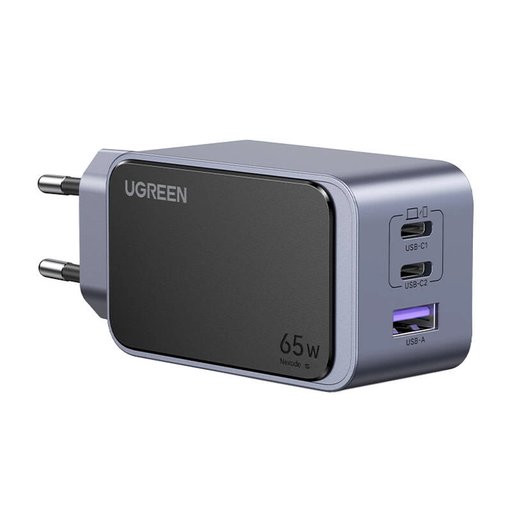
What makes this model stand out The Ugreen Nexode S offers a balanced combination of power, portability, and port variety. With 65 watts of total output and three ports, it can serve as your single charger for daily use or travel, powering a laptop and other devices.
Pros
Who is it for? This USB-C fast charger is a great choice for professionals, students, and travellers looking for an all-in-one solution to charge their laptop, smartphone, and another device simultaneously.
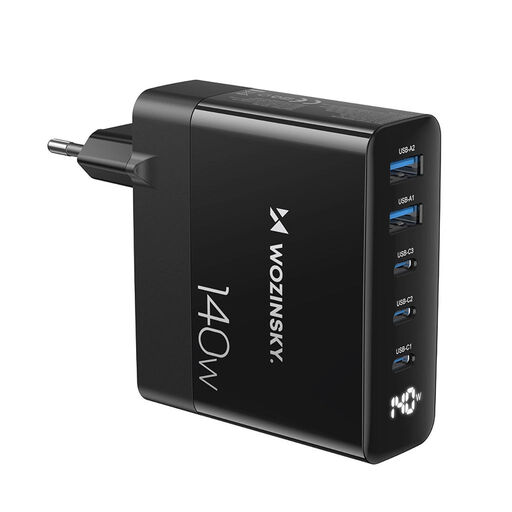
What makes this model stand out With an impressive total output of 140 watts and five ports, the Wozinsky CGWCB positions itself as a central charging station for power users. It can effortlessly power multiple high-performance devices at once, including high-end laptops.
Pros
Who is it for? This model is aimed at power users, families, or small offices where many devices need to be charged at the same time. It's the right choice if you need a powerful, centralised charging solution.
Didn't find the perfect fit among these models? There is a wide variety of other models with different power levels and port configurations. Explore a wider selection and find the perfect GaN charger for your specific needs.
A GaN charger uses gallium nitride instead of traditional silicon as its semiconductor material. Gallium nitride can withstand higher voltages and temperatures and conducts electricity more efficiently. The main advantages are a more compact form factor, less heat generation, and greater energy efficiency compared to conventional chargers of the same wattage.
Yes, the cable plays a crucial role. To take full advantage of the charging power, especially with Power Delivery, you need a cable rated for the corresponding wattage. A standard USB-C cable might only support up to 60W. For chargers with 100W or more, a USB-C cable marked as "100W" or "240W" is required to achieve maximum speed.
Yes, that is the main purpose of a multi-port charger. However, keep in mind that the total specified output (e.g., 65W) is split across all active ports. When you connect multiple devices, the charging power per port may be reduced. Modern chargers feature intelligent power distribution to ensure each device receives an optimised charge.