The growing number of mobile devices presents users with the challenge of creating an efficient and space-saving charging setup. Conventional silicon-based chargers often hit their limits in terms of size and performance. The GaN technology offers a technological leap forward. GaN, short for Gallium Nitride, is a semiconductor material that boasts higher energy efficiency and superior thermal conductivity compared to traditional silicon. This allows for the design of chargers that are significantly smaller and lighter while delivering the same or even higher power output. A modern GaN charger can therefore act as a universal USB-C power adapter for your laptop, smartphone, and tablet, replacing multiple individual power bricks.
Buyer's Guide: What to Look for in a GaN Charger
Choosing the right charger depends on your individual needs. The following technical parameters are crucial for making an informed decision.
1. Total Output and Power Distribution
The total power output of a charger is measured in watts (W) and determines how quickly and how many devices can be charged simultaneously.
- For single devices: A smartphone typically requires 20-30W for fast charging. A tablet or an ultra-portable laptop can be sufficiently charged with 30-45W.
- For multiple devices: To charge a modern notebook (e.g., MacBook Air/Pro), a smartphone, and a tablet at the same time, a total output of 65W to 100W or more is recommended.
- Dynamic Power Distribution: A high-quality multi-port USB charger intelligently adjusts the power output for each port. When only one device is connected, it can deliver the full power through a single port. When multiple devices are connected, the total output is distributed among the active ports.
2. Number and Type of Ports
Most modern devices rely on USB-C. This port typically supports the Power Delivery (PD) protocol, which is essential for fast-charging laptops and other high-power devices.
- USB-C (with Power Delivery): At least one USB-C port is essential for a future-proof Power Delivery charger. For maximum flexibility, models with two or three USB-C ports are advantageous.
- USB-A (with Quick Charge): Many older devices or accessories like smartwatches and headphones still use USB-A. A combination charger with USB-A ports, often supporting Quick Charge (QC), provides backward compatibility.
3. Charging Protocols: PD 3.0 and QC 4.0+
The compatibility of charging protocols between the charger and the device is critical for achieving maximum charging speed.
- Power Delivery (PD): The standard for charging via USB-C. It allows for flexible voltage and current adjustment up to 100W (or more with PD 3.1). A laptop charger must be PD-compatible.
- Quick Charge (QC): A standard developed by Qualcomm, prevalent in Android smartphones. QC 4.0+ is compatible with USB-PD, which increases its universal applicability.
4. Form Factor and Portability
A key advantage of GaN technology is its compact design. For use as a travel charger, size and weight are crucial factors. Compare the dimensions (in mm) and weight (in g) to find a model that takes up minimal space in your luggage.
Our Top Picks for 2026
Based on the technical criteria mentioned, we present three models that cater to different user profiles.
ACEFAST A77 Mini PD 30W GaN Wall Charger
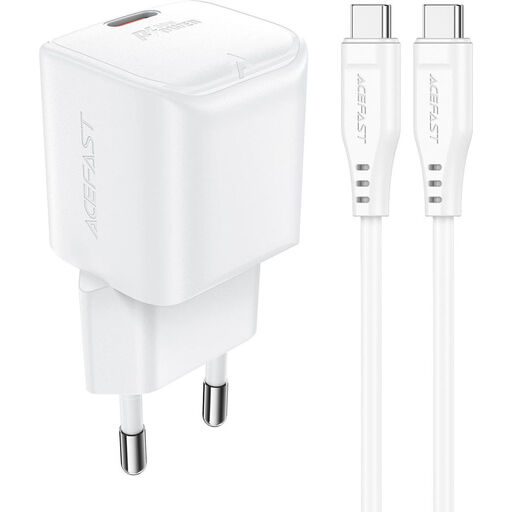
- Why we recommend this product: The ACEFAST A77 is a highly specialised solution for maximum portability. With 30W of power and an integrated USB-C cable, it's streamlined to the essentials. Its GaN technology enables an extremely compact form factor, ideal for users who only need to fast-charge a single primary USB-C device like a smartphone or a small tablet.
- Pros:
- Extremely compact and lightweight design.
- Integrated USB-C cable eliminates the need for a separate cable.
- 30W Power Delivery for fast charging of compatible devices.
- Built-in protection mechanisms against overcharging, overcurrent, and overheating.
- Best for: Minimalists and travellers looking for a dedicated, ultra-portable charging solution for their smartphone or tablet.
Anker 735 PRIME Wall Charger 67W
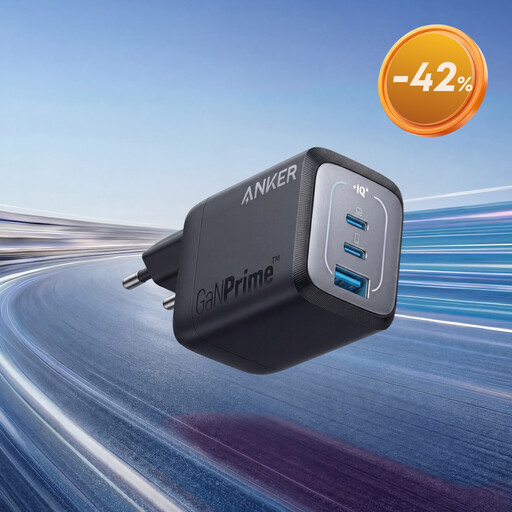
- Why we recommend this product: The Anker 735 Charger offers a balanced combination of power and versatility. With 67W of total output and three ports (two USB-C, one USB-A), it can power a laptop, a smartphone, and another device simultaneously. According to the manufacturer, the charger is 51% smaller than an original 67W MacBook charger, highlighting its suitability as a travel charger. The ActiveShield 2.0 safety system monitors temperature and regulates power output.
- Pros:
- High 67W output, sufficient for most laptops.
- Flexible port configuration (2x USB-C, 1x USB-A).
- Compact design for high portability.
- Advanced safety system (ActiveShield 2.0).
- Best for: Professionals and tech-savvy users who need a single, compact charging solution for their laptop, smartphone, and other devices, whether at the office or on the go.
D-Link DCP-101 100W GaN USB Charger
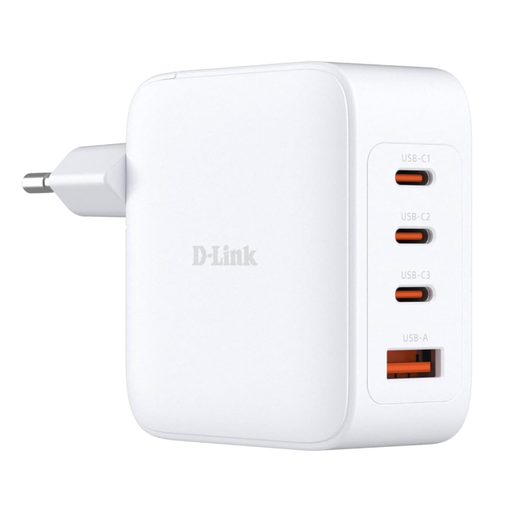
- Why we recommend this product: This model from D-Link is designed for maximum power and connectivity. With 100W of total output and four ports (three USB-C, one USB-A), it is capable of powering even demanding setups, including a high-performance laptop, a tablet, and two other devices simultaneously. It supports both PD 3.0 and QC 4.0, ensuring broad compatibility.
- Pros:
- Very high total output of 100W.
- Four charging ports for maximum flexibility.
- Support for PD 3.0 and QC 4.0 for universal fast charging.
- Comprehensive integrated protection circuits.
- Best for: Power users, families, or anyone looking for a central charging station for all their devices, including power-hungry laptops, without compromising on speed.
More Options and Alternatives
The models featured cover specific use cases. If your requirements differ—for instance, if you need a different number of ports or a different power level—exploring a wider selection may be beneficial. You can find a comprehensive overview of other models and configurations in our USB Wall Chargers category.
Frequently Asked Questions (FAQ)
1. What is the advantage of a GaN charger? The main advantage lies in the higher efficiency of the semiconductor material Gallium Nitride compared to silicon. This leads to less heat generation, allowing components to be placed closer together. The result is a fast charger that is significantly smaller and lighter than traditional models while offering the same or higher power output.
2. Can I charge any USB-C device with a GaN charger? In principle, yes. The USB-C standard is universal. However, to use the fast-charging feature, both the charger and the device must support a compatible charging protocol like Power Delivery (PD) or Quick Charge (QC). Without this compatibility, the device will charge at a slower, standard speed.
3. How many watts do I need for my laptop charger? Check the specifications of your laptop's original power adapter. The wattage is printed on it. A 13-inch ultrabook often requires 45-65W, while a 15 or 16-inch performance laptop may require 87-100W or more. Choose a GaN charger whose maximum output per port meets or exceeds your laptop's requirements.
Authored by: Joybuy Product Recommendation Officer

