
Lieferung heute & morgen

Qualitätsgarantie

Willkommens-Angebote freischalten: KOSTENLOSE Lieferung | Bis zu 80 % RABATT | Kostenlose 30-Tage-JoyPlus-Testphase
App herunterladen
A garden heater can extend the time you spend on your patio, balcony or covered outdoor area. Options range from an electric patio heater to a traditional fire pit. However, impressive power ratings and blanket coverage claims do not automatically mean you have found the right solution. The key factors are where you will use it, the energy source, safety features and the actual conditions on site.
Claims such as “up to 35 m²” refer to specific conditions. Wind, open sides, ceiling height, insulation and the distance from the seating area all have a significant effect on warmth. An infrared heater mainly warms the people and surfaces it is directed at, whereas a fan heater circulates the room air. For an open patio, the stated square-metre coverage is therefore only a guide.
An IP rating describes protection against dust and water according to a defined classification. It does not mean that a device should be left permanently exposed to the rain. Cables, plug connections and the surface it stands on must also be suitable for outdoor use. Even a weatherproof patio heater should be stored somewhere dry or covered after use, where recommended by the manufacturer.
A garden fire pit, chiminea or fire bowl produces open flames, sparks and smoke. Before buying, check local requirements, any building or property rules and possible minimum-distance regulations. The fire pit must stand on a stable, non-combustible surface and must not be used beneath easily flammable coverings. A cover does not automatically protect against flying sparks or the risk of fire.
The power of electrical appliances is given in watts. An electric patio heater rated at 2,000 watts uses 2 kWh per hour when operating at full power. The simple calculation is:
Power in kW × operating time in hours × electricity price per kWh = running costs
A device with several settings can adjust consumption to suit the situation. An energy-efficient garden heating concept therefore involves more than simply choosing a low rated power. A thermostat, timer, Eco mode or targeted infrared heat distribution can all help. It is not possible to state a blanket saving without knowing the electricity tariff and usage pattern.
For covered outdoor areas, ratings such as IP65 or IP66 are relevant. They should be clearly stated in the product description. Even so, the following rules still apply: do not submerge the appliance, do not cover it while in use and do not operate it if the cable is damaged. In practical terms, a patio heater with remote control, a 24-hour timer or a patio heater with app control can make operation easier. With app control, you should also consider Wi-Fi range, permissions and whether the heater can be operated manually.
Measure the available space before placing your order. Important points include:
For fire pits, you should also consider spark guards, ash removal and the right choice of fuel. Wood should be dry and untreated. The relevant local regulations and manufacturer’s instructions take priority.
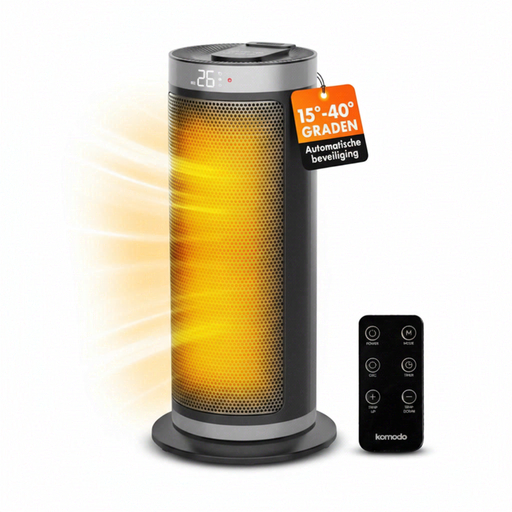
Why this product suits the profile: Three power settings make it easy to adjust the heat for smaller rooms or covered areas. The thermostat, Eco mode and remote control will appeal to anyone looking for a versatile electric heater.
The power rating is not the only consideration: 750, 1,500 and 2,000 watts, together with a thermostat, make it easier to use the heater according to demand rather than running it continuously at full power.
Three heat settings, 90-degree oscillation, Eco mode, overheat and tip-over protection, plus IP66 according to the product details.
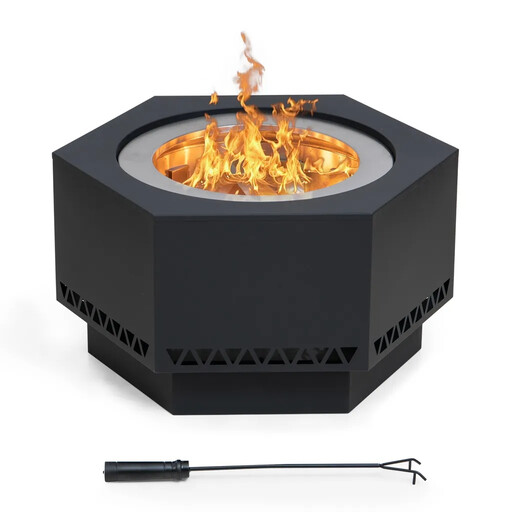
Why this product suits the profile: The double-walled stainless-steel construction, removable ash pan and included poker will appeal to buyers who want to assess the materials and ease of cleaning in practical terms.
The product details specify the material, dimensions and ash liner. This makes it easier to check that the fire pit will fit the available space before buying.
66 × 57 × 38 cm, double-walled stainless steel, removable ash liner and poker according to the product description.
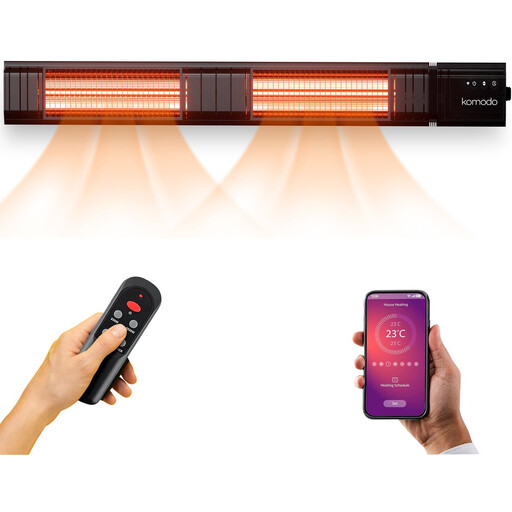
Why this product suits the profile: For frequently used patios or larger covered outdoor areas, this infrared heater offers multiple settings, oscillation, and control via remote control and app.
Nine heat settings and a timer allow more precise adjustment than a simple on/off switch. However, the IP65 rating should not be interpreted as approval for permanent storage without protection from the elements.
3,000 watts, nine settings, 180-degree oscillation, LED display, 24-hour timer and IP65 according to the supplier’s information.
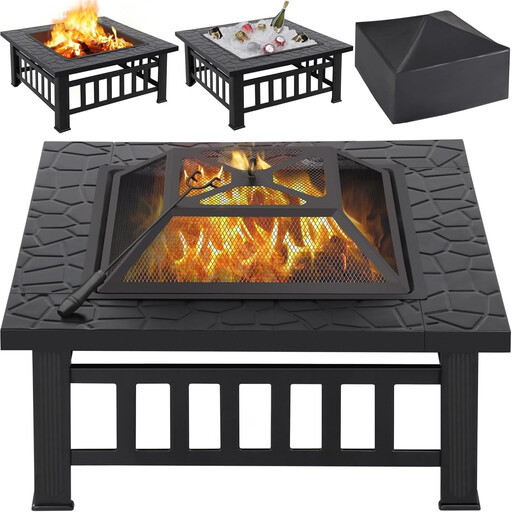
Why this product suits the profile: This square fire pit is designed for hosts who want to combine warmth, a practical ledge and useful accessories for occasional gatherings in the garden.
A spark guard and poker are listed as included. The rain cover makes storage easier, but it does not replace checking the surface and local regulations.
80.5 × 80.5 × 49.5 cm with mesh lid, poker and rain cover according to the product description.
We have put together a complete, regularly updated list of products that fully meet these strict selection criteria and the safety regulations applicable in the EU.
An infrared heater can be a sensible choice for an open patio because it directs heat towards a specific area. However, wind can affect these appliances too. A model with oscillation and several heat settings can be adjusted to suit the seating arrangement and outdoor temperature. With a fire pit, you must consider flying sparks, smoke and the distance from flammable materials.
The cost depends on the power rating, operating time and electricity tariff. A 2,000-watt appliance uses 2 kWh per hour when operating at full power. Assuming a tariff of 0.35 euros per kWh, this would work out at 0.70 euros per hour of operation. A thermostat, timer and lower heat settings can reduce actual consumption.
Its service life depends on the number of operating hours, storage conditions, moisture and maintenance. Electrical appliances should be stored somewhere dry once cool and checked regularly for damage to the cable or casing. Fire pits need to be stored in a dry place, with ash removed and the coating checked. Rust, distortion or damaged spark guards are all reasons to stop using the product.