Hosts with fresh herbs
If you mainly need herbs for a particular get-together, first consider whether they’ll work better fresh in your dish. The German Federal Centre for Nutrition recommends adding delicate herbs just before serving.


If you want herbs to finish off a dish shortly before serving, you probably don’t need a food dehydrator: the German Federal Centre for Nutrition recommends adding delicate herbs just before serving. For regular or larger harvests – especially of leafy herbs with a higher moisture content – an appliance with adjustable low-temperature settings and enough space may be useful. Choose based on how much you need to dry, the available drying area and the space you have, as more tiers alone don’t guarantee better results.
If you mainly need herbs for a particular get-together, first consider whether they’ll work better fresh in your dish. The German Federal Centre for Nutrition recommends adding delicate herbs just before serving.
If you have several harvests or leafy herbs with a higher moisture content, controlled drying and enough room to spread the herbs out loosely are important. Penn State Extension notes that leafy herbs with a high moisture content can go mouldy if they dry too slowly.
If you only dry small amounts occasionally, weigh up the space it takes against the possibility of needing extra batches. For compact appliances such as the KÜCHENminis Dörrautomat Snack to go, WMF lists five racks and a timer of up to 24 hours.
A good fit if: You need basil, parsley or chives as a fresh seasoning for a particular meal.
The trade-off: You don’t need a food dehydrator for fresh herbs; the German Federal Centre for Nutrition recommends adding delicate herbs just before serving.
A good fit if: You have small amounts of hardier herbs such as thyme or sage, and can set aside a dry, clean, well-ventilated spot.
The trade-off: Leafy herbs with a high moisture content can go mouldy if they dry too slowly, as Penn State Extension points out.
A good fit if: You want to dry smaller amounts regularly while saving worktop space.
The trade-off: A smaller usable drying area may mean extra batches; check the temperature range and whether the racks can hold small leaves.
A good fit if: You want to dry larger harvests regularly, spread out in loose layers.
The trade-off: More drying space usually takes up more room on your worktop and in storage; manufacturers’ stated capacity doesn’t automatically mean better drying results.
For herbs, the Oregon State University Extension Service recommends a temperature setting of 95–115 °F (around 35–46 °C). Also check that the racks are suitable for small leaves and provide enough room to spread them in a loose layer.
| Consideration | What to check before buying | Who is it important to? |
|---|---|---|
| Fresh or dried? | Check whether dried herbs will work in your dish. The German Federal Centre for Nutrition recommends adding delicate herbs just before serving. | If I only need the herbs to season the dish I’m bringing, flavour comes first. Around 40% of consumers prioritise this. |
| Drying moist leaves | Look for a low temperature setting, good air circulation and suitable racks. Oregon State University Extension recommends a temperature setting of 95–115 °F (around 35–46 °C); check how dry the herbs are rather than relying on the timer alone. | For leafy herbs with a higher moisture content, I want to keep an eye on the drying process instead of relying solely on a timer. Around 30% of consumers prioritise this. |
| Harvest size and drying area | Compare the usable drying area and the appliance’s external dimensions, not just the number of tiers. Rommelsbacher lists five tiers and a total area of 0,42 m² for the DA 350; Steba lists six trays, each measuring 37 × 30 cm, for the ED 6. These are manufacturer specifications for different models. | If I regularly dry larger garden harvests, I want to be able to spread them out loosely and plan my batches. Around 20% of consumers put harvest size first. |
| Space and running costs | Measure your worktop and storage space, and check which racks are included. Calculate electricity costs using the appliance’s power consumption, running time and your electricity tariff. | If kitchen space is limited, I want to know where I can use and store the appliance before choosing one. Around 10% of consumers prioritise space and running costs. |
Delicate herbs are often added just before serving. So a food dehydrator may not be the right solution if you only need herbs for one meal.
First, decide how you’ll use the herbs in your dish. A food dehydrator is a better choice if you want to dry a supply regularly.
Drying times vary. Leafy herbs with a high moisture content can go mouldy if they dry too slowly.
Spread the herbs out loosely and check them as they dry. Oregon State University Extension says leaves are dry when they crumble and stems snap when bent.
The number of trays alone doesn’t tell you how much room there is to spread herbs out loosely. Appliances also vary in their external dimensions and tray sizes.
Compare the tray and appliance dimensions with the size of your usual harvest and the space where you plan to use it.
Model names, temperature ranges and the racks included can differ between versions.
Check the product page for the full model name, racks, temperature range and what’s included.
The DA 350 is an example of a model with adjustable-height tiers and fine stainless steel mesh trays.
The KÜCHENminis Dörrautomat Snack to go is a compact option for occasional batches of herbs.
The ED 5, supplied with a herb mat, and the ED 6, with six larger stainless steel trays, show the different drying areas and temperature settings available across the range.
The 5-Tray Food Dehydrator and the separately named stainless steel model are different product versions.
The Joybuy options below are food dehydrators whose product descriptions list herbs as suitable for drying. Compare the temperature range, racks and drying area with the size of your harvest and the space you have available.
 No image available
For batches of herbs; the product description lists herbs as suitable for drying.
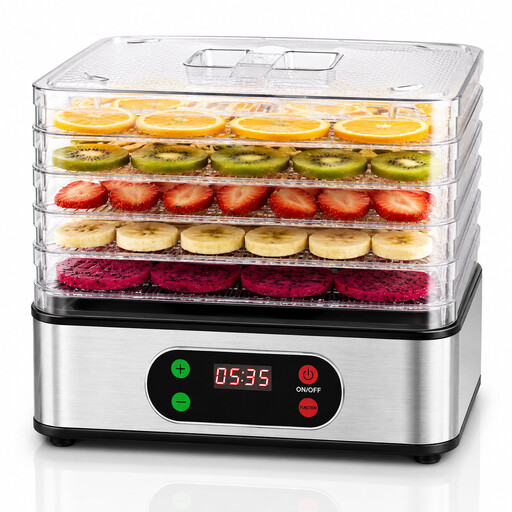
Five removable, stackable tiers; continuously adjustable temperature from 35–70 °C; 350 W.
 No image available
For herbs and controlled drying; the product description lists herbs as suitable for drying.
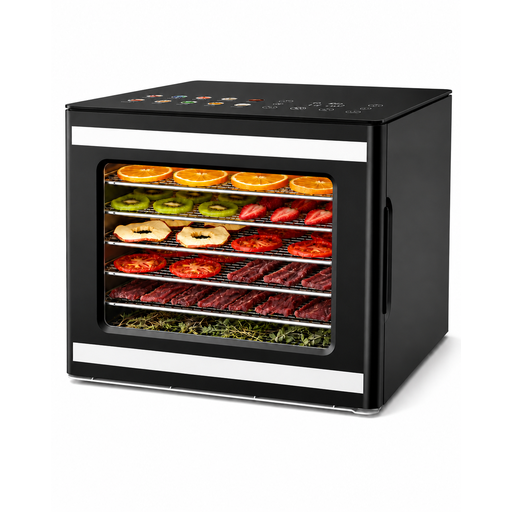
Temperature control from 35–70 °C; timer from 0,5 to 72 hours in 30-minute increments; 350 W.
 No image available
For batches of herbs; the product description lists herbs and six trays.
Manual temperature setting from 35–75 °C; external dimensions: 32 × 33,2 × 25,6 cm.
 No image available
For herbs and larger batches; the product description lists ten spacious trays.
Variable temperature setting; timer of up to 48 hours; ten preset programmes; 850 W.
 No image available
For batches of herbs; the product description lists herbs as suitable for drying and eight trays.
Temperature range of 35–85 °C; timer of up to 48 hours; 650 W.
Leaves should crumble and stems should snap when bent. Oregon State University Extension recommends checking them as they dry, as drying times vary and a timer going off isn’t enough on its own.
Use clean hands and utensils, remove any damaged or dirty parts, rinse the herbs and shake off excess water. Spread them out in a single, uncrowded layer and also follow the instructions for your appliance.
Store fully dried herbs in a suitable sealed container in a cool, dry, dark place. If you’re adding them to a perishable dish, make sure the whole dish is kept chilled during storage and transport. The German Federal Office of Consumer Protection and Food Safety recommends keeping perishable foods chilled until just before they’re eaten.
When you buy from a trader in the EU, you have at least two years of legal rights if the goods are faulty, starting from the day you receive them. Your Europe, the European Union’s consumer portal, distinguishes these rights from a voluntary manufacturer’s guarantee. Contact the seller about your legal rights and check any guarantee terms separately.
When food-contact materials, such as racks intended for drying, are placed on the EU market, they must meet the requirements of Regulation (EC) No 1935/2004. Regulation (EC) No 852/2004 excludes the domestic preparation, handling or storage of food for private domestic consumption; this does not mean there is a blanket exemption for commercial or organised food provision. Good food hygiene is important even when you’re bringing food to a private get-together.