Herbs for the freezer
If you mainly want to keep your garden harvest fresh and portioned, you can freeze finely chopped herbs with a little water. The Federal Centre for Nutrition describes this method, so you don’t need a dehydrator.


You don’t need a dehydrator to freeze fresh, portioned garden herbs: the Federal Centre for Nutrition describes freezing finely chopped herbs with a little water as a method in its own right. If you’d also like to store dried herbs, look for a low, adjustable temperature, good air circulation and suitable trays. The drying area you need depends on how much you harvest and how much space you have.
If you mainly want to keep your garden harvest fresh and portioned, you can freeze finely chopped herbs with a little water. The Federal Centre for Nutrition describes this method, so you don’t need a dehydrator.
If you’d also like to store dried herbs, look for low, adjustable temperatures and good airflow. Oregon State University Extension Service recommends 95–115 °F, approximately 35–46 °C, for its drying method; delicate, moist leaves need to dry quickly enough.
If you have several trays’ worth of herbs, compare the usable drying area with the space available in your kitchen and for storage. A higher number of tiers alone doesn’t tell you how many herbs you can dry in one batch.
First decide whether you want a supply of dried herbs at all. If you do, choose temperature settings and trays to suit your herbs, then check that the drying area matches your harvest and storage space.
Best for: using your harvest later as fresh herbs in your cooking.
Consider: You’ll need freezer space, and this won’t give you a supply of dried herbs.
Best for: having dried herbs as well as frozen portions, when you have limited space.
Consider: A compact drying area may mean several batches for a larger harvest.
Best for: regularly harvesting lots of herbs at once and having space for a larger appliance.
Consider: Herbs should still be spread in a single layer, even across a larger area; manufacturers’ specifications don’t confirm a particular harvest capacity per batch.
Best for: drying small quantities in a dry, well-ventilated spot.
Consider: Delicate, moist herbs can go mouldy if they don’t dry quickly enough, so this method isn’t suitable for every harvest.
| Consideration | What to check before buying | Who is this most relevant to? |
|---|---|---|
| Freeze or dry | Before buying, decide which part of your harvest you actually want to dry. The Federal Centre for Nutrition describes freezing fresh herbs in portions as a method in its own right. | If I mainly want to portion and freeze my herbs fresh, I don’t need a dehydrator. Around 36% of consumers mainly want to build up a supply in the freezer. |
| Flavour and drying | Check for an adjustable low temperature, good airflow and the option to spread herbs in a single layer. Oregon State University Extension Service recommends 95–115 °F, approximately 35–46 °C, for its drying method. | If I also want to store dried herbs and preserve as much flavour as possible, I look for controlled drying conditions. Around 29% of consumers prioritise flavour and controlled drying. |
| Usable drying area | Compare the area and trays, not just the number of tiers. For small leaves, check whether a suitably fine mesh tray is included. | If I have several trays’ worth of herbs, usable area matters more than the number of tiers alone. Around 21% of consumers mainly consider the size of their harvest. |
| Space and ease of use | Consider the appliance’s dimensions, removable trays and how much cleaning it needs. You can work out electricity costs from the power consumption, actual running time and your own tariff. | If I have limited storage space or want to minimise cleaning and running effort, I weigh up the size against how I’ll use it. Around 14% of consumers prioritise space and ease of use. |
You can freeze fresh herbs in portions without drying them first. An appliance may be unnecessary for this purpose.
Before buying, decide which part of your harvest you actually want to store as dried herbs.
An appliance takes up part of your budget and storage space, and adds extra effort when you use it.
Herbs should be spread in a single layer on the trays, and small leaves may need a finer mesh. A higher number of tiers alone doesn’t confirm how much usable herb capacity there is per batch.
Compare the drying area, mesh openings and what’s included with the specific model.
A compact drying area may mean extra batches for a larger harvest.
Drying herbs at too high a temperature can affect their flavour. At the same time, delicate, moist leaves need to dry quickly enough with good airflow.
Check that you can set a low temperature, and monitor how dry the herbs are rather than relying only on a time setting.
According to WMF, the KÜCHENminis Snack to go is a compact option for smaller batches of herbs.
The DA 650 is an option to compare if you’re looking for a larger stated drying area.
The six-tray model described as a stainless-steel dehydrator is another option if you want to compare tray materials.
Severin explicitly describes the OD 2940 as an appliance for drying herbs.
These Joybuy appliances are intended for drying herbs as an additional storage option. The range includes models with different numbers of trays and stated features.
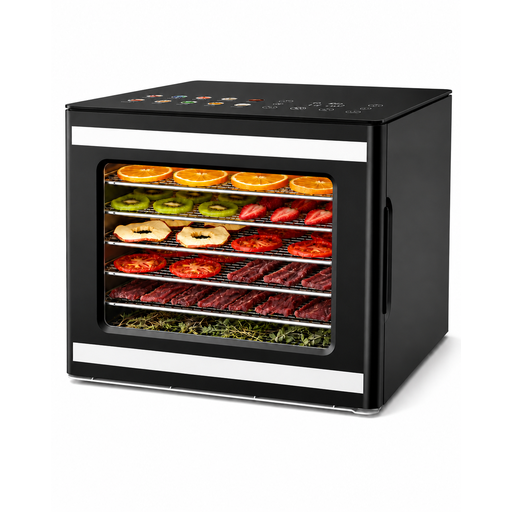 No image available
For small to medium quantities of herbs; the product description lists six removable stainless-steel trays.
 No image available
If you’d like to compare several trays, the model specifications list ten stainless-steel trays.
The product title mentions variable temperature control and a timer of up to 48 hours.
 No image available
For drying extra herbs, the product title lists eight stainless-steel racks and an adjustable temperature range.
The stated specifications are 35–85 °C, 650 W and a timer of up to 48 hours.
No. The Federal Centre for Nutrition describes freezing finely chopped fresh herbs with a little water as a method in its own right. Drying is an additional option if you’d like to build up a supply of dried herbs.
Oregon State University Extension Service recommends checking the herbs as they dry: the leaves should crumble and the stems should snap when bent. Pat the herbs dry after washing, spread them in a single layer and follow the appliance instructions too.
Dried herbs should be stored somewhere cool, dry and dark. Use freezer-safe containers labelled for storing fresh frozen portions, and mark them with the contents and date.
Electrical appliances covered by the relevant EU requirements must carry the prescribed CE marking as part of their conformity requirements. According to Your Europe, the European Union’s information portal, the marking is a declaration by the manufacturer, not evidence of an independent appliance test. Check the model and its marking in the specific listing.