Season them fresh today
If you mainly harvest garden herbs for dinner, you can use them fresh and decide afterwards what to do with any leftovers. The German Federal Centre for Nutrition recommends washing and chopping herbs shortly before serving.


For tonight’s dinner, using herbs fresh is usually the better choice: the German Federal Centre for Nutrition recommends washing and chopping them shortly before serving. A food dehydrator is more useful for preserving any extra harvest. Choose one based on its adjustable temperature, airflow and drying area, which should suit the quantity you usually harvest. Check the herbs as they dry, and read the instructions and product labelling for the specific appliance before you buy.
If you mainly harvest garden herbs for dinner, you can use them fresh and decide afterwards what to do with any leftovers. The German Federal Centre for Nutrition recommends washing and chopping herbs shortly before serving.
If you regularly gather modest quantities, compare the adjustable temperature and usable tray area with the amount you have. The National Center for Home Food Preservation points out that food dehydrators have a limited capacity.
If you regularly harvest larger quantities, you’ll need enough space to spread the leaves out in a single layer wherever possible. The National Center for Home Food Preservation lists limited capacity as one drawback of food dehydrators.
Best for: When you want delicate herbs to season dinner tonight.
The trade-off: You won’t need another appliance, but you won’t be building up a supply of dried herbs.
Best for: If you want to dry smaller leftover quantities regularly for later use.
The trade-off: Check that the usable tray area suits your harvest; a compact design alone tells you nothing about capacity.
Best for: If you regularly harvest a large quantity of herbs at once.
The trade-off: More space can make it easier to spread out the herbs, but you’ll need somewhere suitable to use and store the appliance.
Best for: If you want to dry robust herbs such as rosemary or thyme for later, and have a suitable, well-ventilated place to do so.
The trade-off: Delicate, damp herbs can go mouldy if they take too long to dry. Air-drying isn’t a quick fix if you’re preparing dinner.
The percentages below refer to consumers in Germany who consider each of these their main purchasing priority for this topic.
| Purchasing priority | What to look for when buying | Who it matters most to |
|---|---|---|
| Use fresh or dry? | Think about which herbs you’ll use fresh in your meal today and what you’ll have left afterwards. The German Federal Centre for Nutrition recommends washing and chopping herbs shortly before serving. | If I want to use the herbs fresh today, I don’t want to dry a supply just for one meal. Around 36% of consumers prioritise using herbs fresh that day. |
| Temperature and drying | Compare the temperature range and the appliance instructions. The National Center for Home Food Preservation recommends 95–115 °F (around 35–46 °C) for herbs and up to 125 °F (around 52 °C) in higher humidity. The setting doesn’t necessarily match the temperature of the leaves. | If I’m drying herbs for later, I want to adjust the temperature and airflow to suit them and check how dry they are. Around 29% of consumers prioritise controlled drying. |
| Usable drying area | Compare the stated area and tray design, not just the number of tiers. Rommelsbacher lists a total area of 0,42 m² for the DA 350; the five fine-mesh trays on the WMF KÜCHENminis don’t indicate a comparable total area. | For a larger harvest, I want enough space to spread the leaves out in a single layer wherever possible. Around 21% of consumers prioritise being able to dry several harvests in one go. |
| Ease of use and ongoing effort | Check for a timer, removable trays and spare parts. The stated power rating alone doesn’t tell you how much electricity the appliance uses per drying cycle. | If I use the appliance regularly, ease of use and keeping the effort manageable matter to me. Around 14% of consumers prioritise straightforward operation and ongoing costs. |
You can use fresh herbs straight away; drying is more suitable for preserving the rest of your harvest for later.
First decide which herbs you’ll use fresh with dinner, then consider how often you have herbs left over and in what quantities before choosing an appliance.
Two appliances with five trays don’t necessarily offer the same area. Rommelsbacher lists a total area of 0,42 m² for the DA 350, so you can’t compare it with a tray count alone.
Compare the area measurements and tray design, and check whether your herbs will fit in a single layer.
The Stöckli dörrex 0076.70M is listed with specific timer and tray features. The F.A.Z. Kaufkompass, on the other hand, lists the 0076.72M variant. This doesn’t mean the two models have identical features.
Before buying or choosing accessories, compare the full model number and the exact contents of the package.
The examples below refer to specific model ranges; features and selection criteria may vary between variants.
According to the manufacturer, the DA 350 has five height-adjustable tiers and a stated total drying area.
The KÜCHENminis Snack to go is a compact design with five fine-mesh trays.
The dörrex 0076.70M is a model with a timer and metal trays.
The 5-tray food dehydrator is an adjustable-temperature design for smaller batches of herbs.
Severin lists herbs as one of the intended uses for the OD 2940.
The appliances below are intended for preserving future herb harvests, rather than adding fresh flavour to tonight’s meal. For mains-powered household appliances covered by the relevant EU regulations, check that the required CE marking is present and read the product information for the specific listing. The CE mark is based on the manufacturer’s conformity assessment and is not an independent quality or safety certification.
 No image available
For future herb harvests when you’d like several trays and adjustable temperature control.
Product details: 10 stainless steel trays, variable temperature control, 48-hour timer, 10 programmes and 850 W.
 No image available
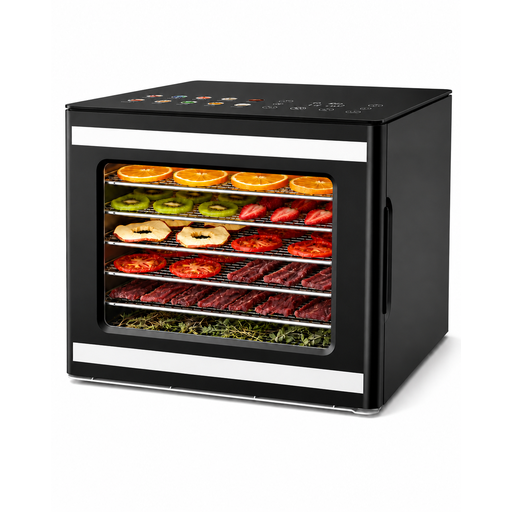
An option for smaller or regular herb harvests that you want to dry for later.
Product details: six stainless steel trays, touch display, interior light and overheat protection.
 No image available
For future harvests when eight drying trays and an adjustable temperature suit your needs.
Product details: eight stainless steel drying trays, 650 W, 35–85 °C, 48-hour timer, touch display and interior light. The National Center for Home Food Preservation usually recommends 95–115 °F (around 35–46 °C) for herbs; follow the appliance instructions and check the herbs as they dry.
Yes, if you want to use them fresh today. The German Federal Centre for Nutrition recommends washing and chopping herbs shortly before serving; add delicate herbs to hot dishes right at the end.
The National Center for Home Food Preservation recommends a thermostat setting of 95–115 °F (around 35–46 °C), rising to 125 °F (around 52 °C) in higher humidity. Also follow the instructions for your specific appliance and check the herbs as they dry.
The National Center for Home Food Preservation suggests that leaves should crumble and stems should snap when bent. Spread the herbs out individually on the trays and check them as they dry.
It depends on how many herbs you want to dry at once. Compare the stated usable area and tray design with the size of your usual harvest; a higher tray count alone doesn’t guarantee a larger total area.
No. According to information from the European Union, the manufacturer uses it to declare that the product meets the applicable EU requirements; it is not a general, independent test certificate. For a specific mains-powered appliance, check the relevant marking and the product information on the listing.