
Lieferung heute & morgen

Qualitätsgarantie

Willkommens-Angebote freischalten: KOSTENLOSE Lieferung | Bis zu 80 % RABATT | Kostenlose 30-Tage-JoyPlus-Testphase
App herunterladen
Garden lighting can make paths easier to see, highlight flower beds or create a pleasant atmosphere on your patio or balcony. However, design and colour-changing effects are not the only factors to consider. Many poor purchases result from unclear weather-resistance information, an unsuitable power supply or insufficient brightness for the intended location.
The IP44 rating generally protects a light against solid foreign objects larger than 1 mm and splashing water. It is suitable for sheltered patios, entrances and balconies, but should not be left in puddles or cleaned with a high-pressure jet.
IP65 protects against dust and water jets from various directions. However, the light must not be submerged. For recessed ground lights, IP67 may be relevant if the manufacturer expressly approves this type of use. The combination of IP rating, installation location and operating instructions is always decisive.
Garden solar lights need a location with as much direct sunlight as possible. Shade from trees, house walls or neighbouring buildings reduces charging performance. Statements such as ‘8 to 12 hours of illumination’ generally refer to suitable charging conditions and a fully charged battery.
Before buying, check the following:
RGB garden lights can add colourful accents to flower beds, façades or seating areas. For path lighting or entrances, however, suitable brightness and a clearly recognisable light colour are often more important than numerous colour effects.
With LED garden lights, you should also pay attention to the luminous flux in lumens. A light with 200 to 300 lumens can illuminate a table or a small entrance area. An adjustable LED spotlight, on the other hand, is better suited to targeted accent lighting for trees, walls or paths.
Solar lights and rechargeable outdoor lamps can be used flexibly without permanent wiring. They are practical for flower beds, lawns, balconies and movable seating areas. In cloudy weather or shade, however, their operating time may be shorter.
Mains-powered lights provide a constant supply, but require a suitable outdoor socket and professional installation. For the 220 V smart Wi-Fi garden light, the manufacturer expressly states that connection must be carried out by a qualified electrician in accordance with local regulations.
Warm white light at around 2700 to 3000 Kelvin often creates a subtle atmosphere and is suitable for patios, seating areas and decorative garden lighting. More neutral or cooler white tones can be useful for paths and work areas.
Smart garden lighting offers additional functions such as:
Before buying, check compatibility with your existing system. Matter, Wi-Fi, Bluetooth Mesh, Apple Home, Google Home and other platforms are not automatically compatible with one another.
Spike lights are pushed directly into soft ground or a lawn. The ground should be stable enough to prevent the light from tipping over. For paths, an even spacing is recommended, while spotlights should be positioned so that they do not shine into windows or seating areas.
For outdoor wall lights with motion sensors, the installation height, detection range and sensor orientation are crucial. An IP44 light should ideally be installed in a sheltered position beneath a canopy. For exposed areas subject to heavy weather, the protection rating specified by the manufacturer should be checked particularly carefully.
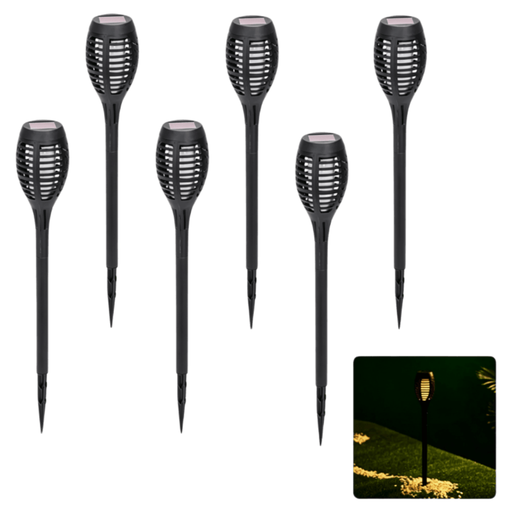
Why this product suits this profile: This 6-piece set needs no permanent wiring and is designed for flower beds, lawns, patios and paths. The warm white light colour at 2700 K creates a decorative flame effect.
Charging and operating times are clearly specified at around 4–6 hours for charging and 8–12 hours of operation under suitable conditions. The limitations of IP44 are clear and easy to understand.
Six lights, integrated Ni-MH rechargeable batteries, automatic switching on at dusk and a 2700 K light colour.
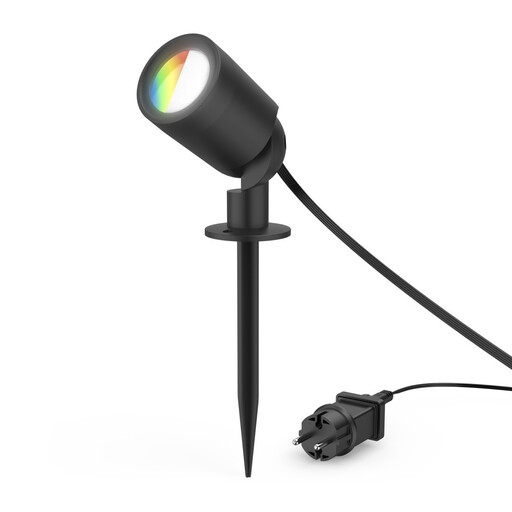
Why this product suits this profile: This LED garden spotlight is designed for users who want to combine app control, Matter compatibility and an adjustable angle.
The description specifies IP65 while also making clear that the light must not be submerged. The 7 W rating, 220 V supply and required electrical installation are also clearly stated.
Matter, Wi-Fi app and voice control, stepless dimming, 16 million colours, plus installation with a ground spike or base.
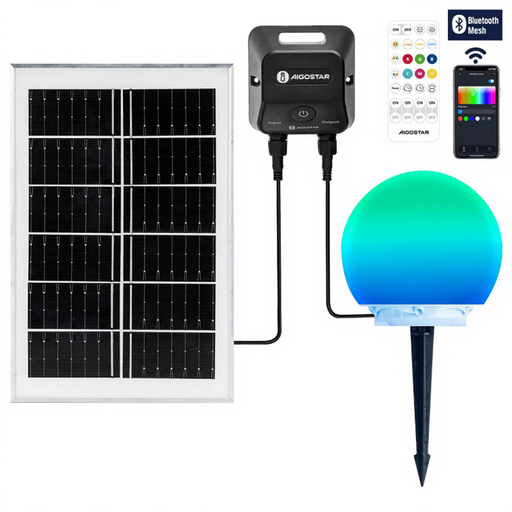
Why this product suits this profile: The combination of a separate solar panel, Bluetooth Mesh and RGB-CCT control is aimed at larger outdoor areas with multiple coordinated lights.
The separate solar panel can be positioned towards the sun independently of the light. Even so, the stated IP67 rating should be checked against the instructions when planning the installation.
20 W, RGB and adjustable white light from 2700 to 6500 K, 4000 mAh battery, 5 W solar panel and Bluetooth Mesh.
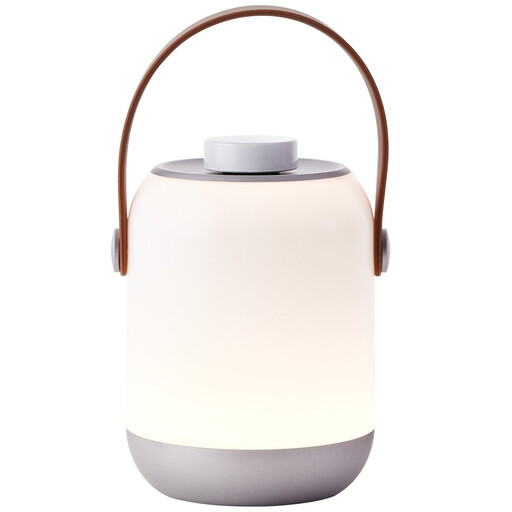
Why this product suits this profile: This compact rechargeable table lamp can be used on a balcony, patio or garden table and easily moved whenever needed.
The light is clearly described as battery-powered and dimmable. IP44 makes its limitations clear for exposed locations subject to heavy weather.
200 lumens, warm white light at 3000 K, dimming function and a compact 120 mm-high design.
We have put together a complete, regularly updated list of products that fully meet these strict selection criteria and the safety regulations applicable in the EU.
Garden solar lights with ground spikes are practical for paths when sufficient sunlight is available. For constant use and even illumination, mains-powered LED garden lights may be more suitable. The lights should be positioned to mark the path without dazzling people.
Actual operating time depends on sunlight, charge level, battery capacity, temperature and battery age. Manufacturer specifications such as 8–12 hours should therefore be regarded as guide values under suitable conditions. Keeping the solar panel clean and choosing a sunny location will support charging performance.
Consumption depends on power rating, operating time and power supply. A mains-powered light rated at 7 W uses 0.07 kWh when operated for ten hours. Solar and rechargeable models do not consume mains electricity directly during operation, but they do need to be charged. For a fair comparison, you should also take the purchase price, battery replacement and any installation costs into account.