Joybuy Insights

Garden Lighting Guide: Avoid Costly Mistakes and Choose Right Lights

Well-planned garden lighting can transform a balcony, patio, or garden into an atmospheric extension of your living space. However, the search for the perfect solution can quickly become overwhelming. Many products overpromise and underdeliver, leading to disappointment instead of cozy evenings outdoors. Before you invest, it's crucial to understand the common pitfalls that often only become apparent after your purchase.

The most common problems are easy to identify:

  1. Inadequate Weather Resistance: A light is advertised as "weatherproof" but fails after the first heavy rain or winter season. The cause is often an insufficient protection rating, unsuitable for the local climate.
  2. Disappointing Solar Performance: Many solar garden lights look bright and long-lasting in product photos. In reality, they often produce only a faint glow that fades after just a few hours, especially on cloudy days. The battery capacity and the quality of the solar panel are the deciding factors here.
  3. Inflexible Installation: The most beautiful light is useless if its installation requires a power outlet in an inaccessible location or if the cable is too short. Flexible solutions, such as battery-powered outdoor lights or those with long cables, offer significantly more design freedom.

To avoid these mistakes, a close look at the technical specifications is essential.

What Really Matters When Choosing: The Key Parameters

Instead of being swayed by marketing promises, you should check three objective criteria. These will determine the durability, functionality, and ambiance of your new LED outdoor lighting.

1. The IP Rating: The Standard for Weather Resistance

The IP (Ingress Protection) rating indicates how well a light is protected against the entry of foreign objects (first digit) and water (second digit). For outdoor use, two ratings are particularly important:

  • IP44: Protection against splashing water from all directions. This is the minimum standard for weatherproof garden lamps mounted on a sheltered house wall or under an eave. They are protected against normal rain but not against powerful water jets.
  • IP65: Complete protection against dust and water jets (e.g., from a garden hose) from any angle. Lights with this rating can be safely placed anywhere in the garden without shelter, even near the ground.

2. Power Source and Autonomy: Solar, Battery, or Mains?

The choice of power supply determines flexibility and installation effort.

  • Solar Lights: Ideal for decorative accents and locations without a power outlet. Pay attention to the battery capacity (specified in mAh) and the type of solar panel. Polycrystalline panels are a good standard. Models with a dusk-to-dawn sensor switch on and off automatically.
  • Battery-Powered Outdoor Lights: Offer maximum flexibility for balcony lighting or as a portable garden lantern. They are ready to use out of the box and are not dependent on sunlight. The runtime depends on the quality of the batteries and usage.
  • Mains-Powered Lights: The most reliable choice for functional lighting, such as illuminating pathways or for patio lighting. However, for safety reasons, the installation of 230-volt systems should always be carried out by a qualified professional.

3. Light Colour and Brightness: Kelvin and Lumens, Not Watts

With modern LED technology, the wattage rating is less meaningful. More important are:

  • Lumen (lm): Indicates the actual brightness of the light. For purely decorative glowing garden decor, values under 100 lumens are often sufficient. For pathway lighting, 200-400 lumens is a good range.
  • Kelvin (K): Describes the light colour (colour temperature). Warm White (under 3,300 K) creates a cozy, inviting atmosphere. Neutral White (3,300-5,300 K) appears more functional and is suitable for task areas. Cool White (over 5,300 K) provides a very clear, daylight-like brightness.

Top Picks for Every Need

Based on these objective criteria, we have identified products that offer an ideal solution for specific use cases.
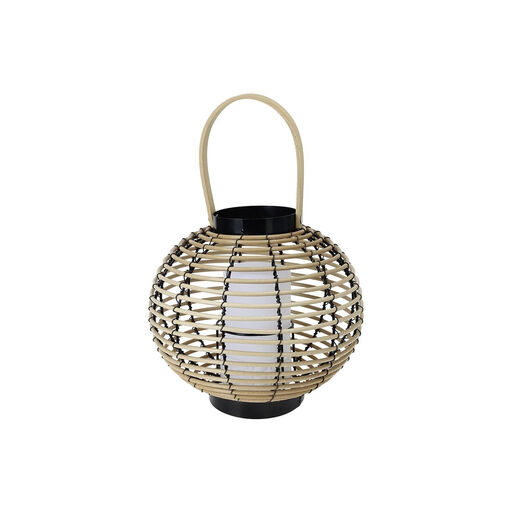
MATCH FOR: THE ATMOSPHERE CREATOR
LANTERN PE RATTAN WITH HANDLE

Rattan Lantern with LED Candle

Why This Fits Their Persona: Ideal for users who want to create a cozy atmosphere on their balcony or patio without any installation hassle. The lantern is portable and a stylish decorative element.

How It Avoids the Trap

It bypasses the complex installation trap. As a battery-powered outdoor light, it is ready for immediate use anywhere, independent of power outlets or sunshine.

Key Advantage & Pros

The IP44 rating protects against splashing water. The combination of a rattan look and a safe LED candle creates an attractive and hazard-free alternative to an open flame.
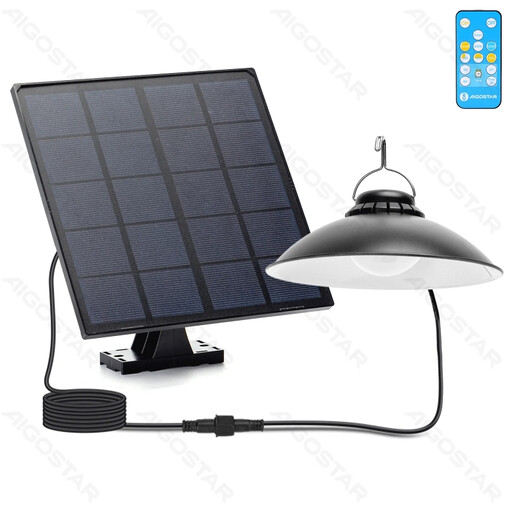
MATCH FOR: THE EFFICIENCY-FOCUSED
Aigostar LED Chandelier Solar, 50W, 3000K/4000K/6500K, 1 Piece

Aigostar LED Solar Pendant Light

Why This Fits Their Persona: Perfect for anyone looking for functional, self-sufficient lighting for a garden shed, carport, or covered patio. This light offers high brightness and reliability.

How It Avoids the Trap

It overcomes the pitfall of weak solar lights with a powerful 5000mAh LiFePO4 battery and 500 lumens of brightness. The IP65 certification guarantees true weather resistance.

Key Advantage & Pros

The separate solar panel with a 3m cable allows for optimal alignment with the sun while the light hangs in the shade. Three selectable light colours (3000K/4000K/6500K) offer maximum flexibility.
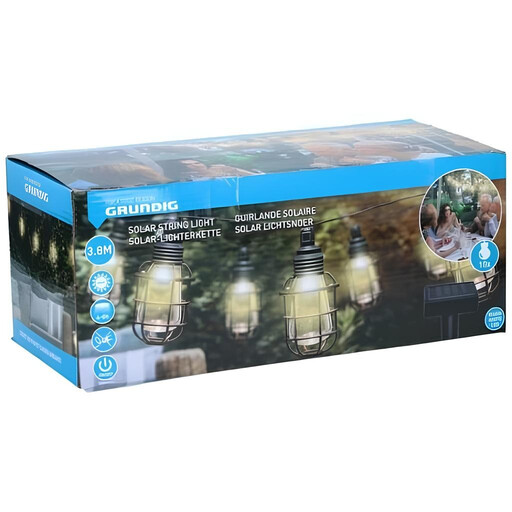
MATCH FOR: THE DECOR ENTHUSIAST
Solar Light String - 10 pcs - Lanter

Solar String Lights with 10 Lanterns

Why This Fits Their Persona: Ideal for effortlessly decorating fences, pergolas, or railings. These outdoor string lights instantly create a festive or romantic mood with no electricity costs.

How It Avoids the Trap

Solves the problem of power dependency and high running costs. As a pure solar solution with an automatic dusk-to-dawn sensor, it's a "set-it-and-forget-it" solution.

Key Advantage & Pros

The weatherproof construction is designed for permanent outdoor use. The lantern design provides a diffuse, pleasant light and is a classic piece of glowing garden decor.

Looking for more options?

We have compiled a complete, up-to-date list of products that fully meet these strict selection criteria and safety regulations.

## Frequently Asked Questions (FAQ)

1. How long does a solar garden light last?

The lifespan depends on several components. The LEDs themselves are very durable, often lasting over 20,000 hours. The critical factor is the battery. High-quality lithium batteries (like LiFePO4) typically last 2-4 years before their capacity noticeably decreases. You can extend the lifespan by keeping the solar panel clean and storing the unit in a frost-free location during winter if not in use.

2. What exactly does the IP rating mean for garden lighting?

The IP rating is an international standard. The first digit (0-6) describes protection against solid objects (e.g., dust), while the second digit (0-9) describes protection against water. For garden lighting, the second digit is crucial:

  • IPx4 (e.g., IP44) means "protection against splashing water." Sufficient for lights placed under a roof.
  • IPx5 (e.g., IP65) means "protection against water jets." These lights can withstand heavy rain or a garden hose.
  • IPx7 means "protection against temporary immersion." Relevant for in-ground spotlights or pond lighting.

3. Can I install LED garden lights myself?

That depends on the power source. Solar lights and battery-powered outdoor lights require no electrical installation whatsoever. You can simply place them, hang them, or stake them into the ground. Low-voltage systems (usually 12V or 24V) can also often be safely installed by a layperson. However, for any lights that require a direct connection to the 230-volt mains supply, it is mandatory for safety reasons to hire a qualified electrician.