What should you look for when buying?
When uploading designs from your garden office, test your internet connection and the backhaul to your workspace separately before comparing devices.
| Buying priority |
What to check before buying |
Who it's important for |
| Backhaul to the garden office |
Check for Ethernet backhaul and available ports. If using a wireless connection, assess the signal quality at the planned node location. |
If I upload designs from a separate garden office, the node itself needs a good connection to the house; around 36% of consumers therefore prioritise the backhaul. |
| Internet upload speed |
Measure upload and download speeds as close to the router as possible, then at your workspace. The Bundesnetzagentur explains how to measure the actual speed achieved by your connection. |
If I want to identify the bottleneck before buying a device, I compare the connection at the router with the one in the garden office; around 29% of consumers prioritise the available internet upload speed. |
| Placement and power |
Decide whether the node will be installed in a sheltered indoor location or outdoors. Check that the specific model is weatherproof and has a suitable power supply. |
If I want to install the node by my garden office, the location and power supply need to work together; around 21% of consumers therefore pay particular attention to placement and power. |
| Compatibility and accessories |
Check compatibility with your existing router, supported mesh family and operating mode. Find out which cables, adapters or PoE components you'll need for your setup. |
If I want to extend my existing home network, I need a suitable solution without any overlooked extra components; around 14% of consumers make ease of upgrading a key consideration when buying. |
Joybuy products
The products below include wired access points and Deco mesh devices with Ethernet ports. Check that the specific model is suitable for your planned installation location, and find out what kind of connection and power supply your setup requires.
 No image available
Ubiquiti U7 Mesh (5000 Mbit/s, PoE)
This mesh access point could be a good fit with a wired uplink if you have a suitable cable route and PoE power supply.
Product information lists a 2.5-GbE uplink with PoE and an IPX6 enclosure. For outdoor cabling, use shielded Cat 6 or higher, and take earthing and surge protection into account. A compatible PoE/PoE+ injector or switch is required.
View at Joybuy
 No image available
TP-Link Deco M4 AC1200 (1-pack)
This single node can extend an existing Deco network with Ethernet backhaul, if you plan to use it indoors.
AC1200, dual-band and two Gigabit Ethernet ports. This model is designed for indoor use and must not be exposed to rain or moisture.
View at Joybuy
 No image available
TP-Link Deco M4 AC1200 (3-pack)
This 3-pack is worth considering if you need several Deco units to extend your network.
AC1200, dual-band, three units and two Gigabit ports per unit.
View at Joybuy
 No image available
TP-Link Deco X1500 AX1500 Wi-Fi 6 (2-pack)
This 2-pack is an option if you need two mesh units to extend your network.
Wi-Fi 6 AX1500 and two Gigabit ports per unit.
View at Joybuy
 No image available
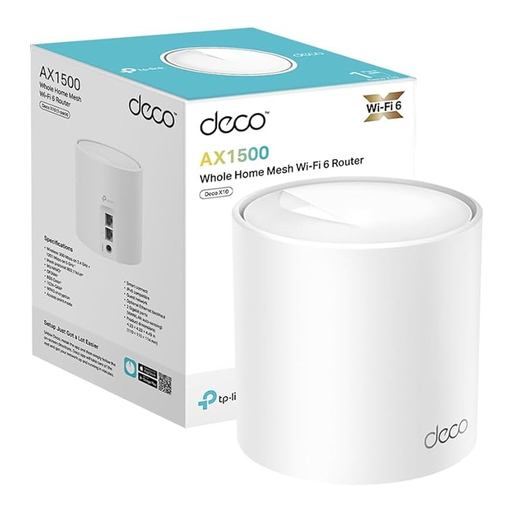
TP-Link Deco X10 AX1500 Wi-Fi 6 (1-pack)
This single unit can extend an existing Deco mesh if you need an additional node with Ethernet ports.
Wi-Fi 6 AX1500 and two Gigabit Ethernet ports.
View at Joybuy
Frequently asked questions
Will mesh help if my upload speed is already slow at the router?
No. Mesh won't fix a bottleneck in your internet connection. Before choosing Wi-Fi hardware, measure the connection near your router and compare it with the upload speed in your garden office.
Does the mesh node need to be outside by the garden office?
No. A sheltered indoor location may be enough, as long as the node gets a good connection to your home network. For an exposed outdoor installation, the specific model must be suitable for outdoor use. Installation guidance varies by model, so check the manufacturer's information.
What should I check after installation?
Check the node's connection to your home network and run another upload test at your actual workspace. For powerline, devolo recommends testing the sockets you plan to use and checking for possible electrical interference if the connection is weak.
What extra components should I plan for?
Depending on your setup, you may need cables, a PoE power supply or adapters. Before buying, check your existing router, supported mesh family, ports and what's included in the box.
Can I set any 5 or 6 GHz channel for an outdoor node in Germany?
No, you shouldn't assume that every channel and operating mode is permitted. For 5 GHz, the Bundesnetzagentur refers to Verfügung 136/2022, as amended by Verfügung 49/2023. For the 5945–6425 MHz frequency range, Verfügung 76/2025 applies instead of the repealed Verfügung 12/2025. Check the German operating requirements for your specific device and planned installation location.


