
Lieferung heute & morgen

Qualitätsgarantie

Willkommens-Angebote freischalten: KOSTENLOSE Lieferung | Bis zu 80 % RABATT | Kostenlose 30-Tage-JoyPlus-Testphase
App herunterladen
A garden parasol should provide shade, stand securely and be easy to use every day. But many buyers run into problems not with the canopy itself, but with details such as a base that’s too light, the wrong shape or unclear information about UV protection.
A parasol with a diameter of 300 or 350 cm provides plenty of shade, but it also catches more wind. A cross base supplied with the parasol doesn’t automatically mean it’s ready to use safely. Suitable paving slabs are often not included.
So check:
A water-repellent parasol can keep out light rain for a short time. But it isn’t a shelter for prolonged rain or thunderstorms. Wet conditions, wind pressure and storing it away while it’s still damp can all put strain on the fabric and frame. After use, let the canopy dry completely before folding or covering it.
Claims such as UV protection 50+ or UPF 80+ should be stated clearly in the product details. According to the manufacturer, the Schneider Genua’s UV protection is tested to AS/NZS 4399. This refers to a standardised test of the material, but it’s still important to use other forms of sun protection, such as clothing and sun cream, or to stay in the shade.
A round parasol with a diameter of 270 to 300 cm is often a good choice for a garden table placed in the centre of the canopy. A 300 cm parasol can cover several seats, but it needs enough space and a suitably weighted base.
A rectangular parasol often works better against a house wall, on a long, narrow balcony or over a rectangular table. Check the canopy’s actual measurements rather than relying on the product name alone. For example, the Schneider Salerno measures approximately 300 × 150 cm.
A cantilever parasol stands to one side of the area it shades, leaving the space beneath the canopy free of a central pole. However, the side arm needs to be weighted particularly carefully. On a small balcony, make sure you account for the space taken up by the base as well.
A crank parasol is generally easier to open and close than a basic push-up model. Turn the crank smoothly, and don’t force it if you feel resistance.
A height-adjustable parasol or one with a tilting canopy lets you adjust the shade more easily. This is particularly useful in the morning and evening, when the sun is lower in the sky. Some models also let you rotate the whole parasol. According to the product details, the Suncomfort Slide by Glatz rotates through 360 degrees and has a continuously adjustable tilt mechanism.
Powder-coated steel provides a relatively sturdy frame, while aluminium can be lighter. Also consider the pole diameter, rib construction, joints and whether you’ll be able to store the parasol somewhere dry.
A parasol with a base is only ready to use straight away if the base is suitable for the canopy size. The Schneider Genua 300/6 is designed for 40 × 40 × 5 cm slabs, which are not included. The Rhodos Rondo is designed for 50 × 50 × 5 cm slabs. Remember to factor in the cost of these when comparing prices.
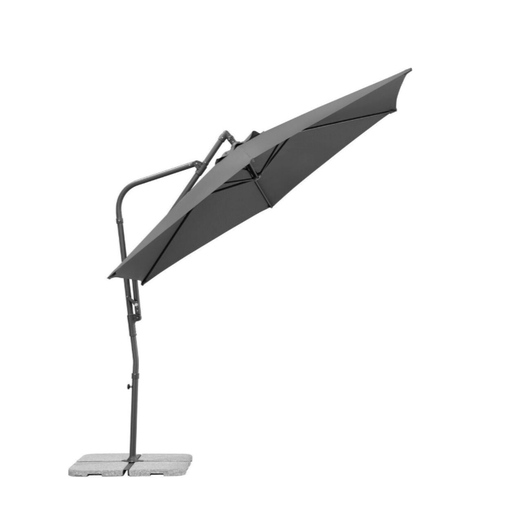
Why it suits this type of buyer: With a diameter of 300 cm, this round garden parasol provides generous shade for a garden table or seating area. It also has a crank and a tilting function.
The product details specify a base designed for 40 × 40 × 5 cm slabs and advise closing the parasol when it’s windy.
300 cm diameter, steel frame, crank opening, ventilation vent and, according to the manufacturer, UV protection 50+ to AS/NZS 4399.
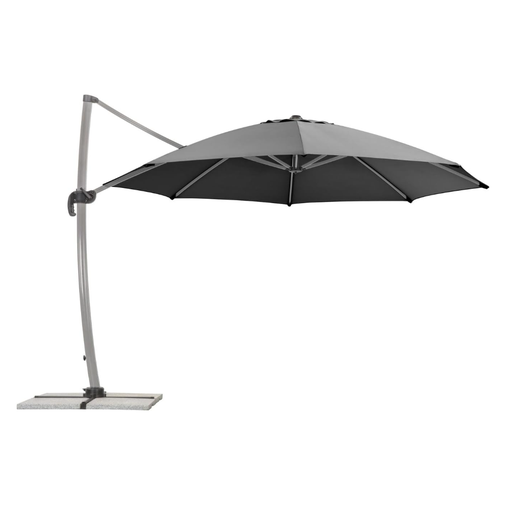
Why it suits this type of buyer: The larger round canopy is designed for spacious patios. It’s a good choice if you’re looking for a tilting, rotating parasol with an aluminium frame.
The slab base is designed for 50 × 50 × 5 cm slabs, so remember to budget for the weights separately.
350 cm canopy diameter, aluminium frame, 360-degree rotation using a foot pedal, protective cover included and water-repellent polyester fabric.
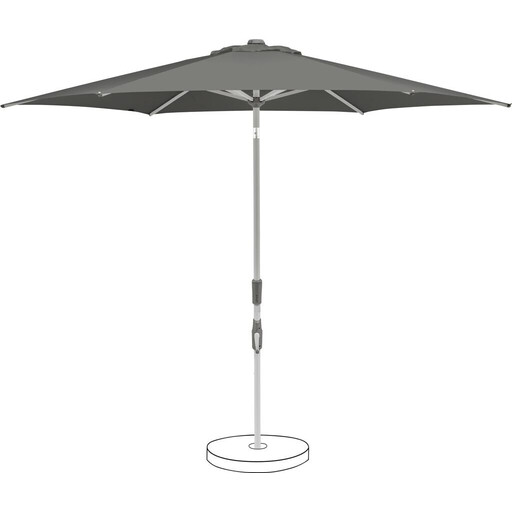
Why it suits this type of buyer: This model is suited to patios and balconies if you’re looking for a compact, rotating parasol with continuously adjustable settings.
The base isn’t included, so you can choose one that suits your balcony floor and the space available.
Aluminium and steel components, 360-degree rotation, hand crank, continuously adjustable tilt and, according to the product details, UV protection 80+.
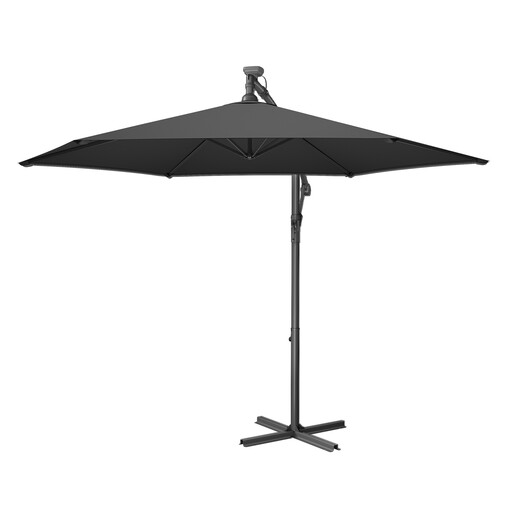
Why it suits this type of buyer: This cantilever parasol is ideal for seating areas where a central pole would get in the way and you want to adjust the shade to suit.
The product details recommend adding up to 80 kg of extra weight, which isn’t included. They also advise against using the tilt function in windy or rainy conditions.
3 m diameter, crank mechanism, tilting canopy, 180 g/m² polyester and cross base included.
We’ve put together a complete, regularly updated selection of products that meet these strict selection criteria and the safety regulations in force in the EU.
It depends on the size and style of the parasol, where it’s positioned and how exposed it is to the wind. A 300 cm parasol usually needs considerably more weight than a small balcony parasol. Always follow the manufacturer’s guidance. For a cantilever parasol, make sure you use the full recommended additional weight and close it when it’s windy.
Its lifespan depends on exposure to UV rays, damp, wind, how it’s used and how it’s stored. Close it when it’s windy, let the fabric dry and store it somewhere dry over winter. A removable canopy makes cleaning easier. Spare parts or replaceable components can help you keep some models in use for longer.
Yes, as long as there’s enough space and the distance from the railings and the base are suitable. A large parasol can take up too much room on a balcony or become difficult to manage in windy conditions. Before buying, check the canopy measurements, overall height, pole diameter and base weight.