
Lieferung heute & morgen

Qualitätsgarantie

Willkommens-Angebote freischalten: KOSTENLOSE Lieferung | Bis zu 80 % RABATT | Kostenlose 30-Tage-JoyPlus-Testphase
App herunterladen
Solar lights let you enjoy garden lighting without a mains connection. They charge via a solar panel during the day and usually switch on automatically when it gets dark. They’re especially handy for paths, lawns, flowerbeds, patios and driveways when you don’t want to lay cables.
To make sure your purchase suits your outdoor space in the long term, it’s worth taking a close look at the technical specifications. These three common buying misconceptions often lead to disappointment:
Check the details for charging time, lighting time, battery technology and the solar panel. For example, several Aigostar models are listed with a charging time of around 4 to 6 hours and 8 to 12 hours of lighting in suitable conditions. These are manufacturer’s specifications, and actual performance depends on the location and sunlight available.
A spot in direct sunlight is therefore essential. Trees, walls, canopies and tall shrubs can significantly reduce charging performance. Before installation, check that the panel will be in direct sunlight for several hours a day.
With a solar light set, the distance between each light is also important. For long paths, a set with several lights can help create a more even layout. For individual flowerbeds or planters, a single solar stake light is often enough.
The IP rating describes protection against solid objects and water. A light rated IP44 is protected against solid objects measuring 1 millimetre or more, as well as splashes of water from different directions. However, it shouldn’t be submerged in water or left standing in a puddle.
For IP44-rated products, positioning is particularly important: the solar panel should face upwards, and the casing shouldn’t be placed where water can collect. Models rated IP54 offer extra protection against dust deposits, but this rating also doesn’t mean they can be submerged.
Materials include plastic casings, stainless-steel effect finishes and stainless-steel components. A stainless-steel effect finish may be made of plastic, as specified for some decorative models. This can be a good choice if you want something lightweight that’s easy to move. For areas that see regular use, check the casing, ground spike and connection points particularly carefully.
Light colour affects the look and feel of your garden lighting:
For safe visibility along paths, consider more than just the light colour: the position of each light, the spacing and the stated brightness all matter. A decorative solar light with a ground spike won’t necessarily be suitable as the only lighting for a driveway.
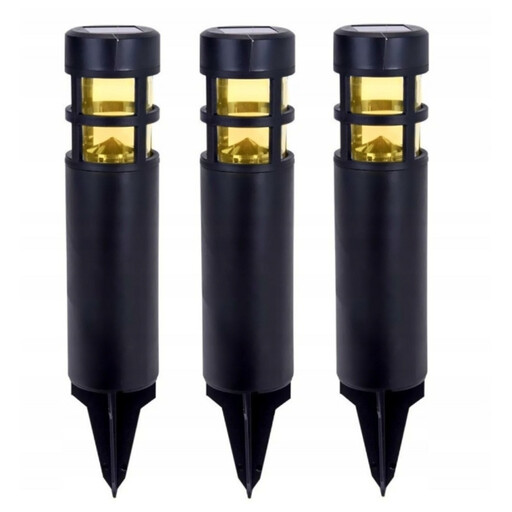
Why it suits these needs: This set of three lights is a good way to get started with lighting flowerbeds, sections of a path or the boundaries of your property. There’s no need for a fixed mains connection.
The number of lights is clearly stated, so you can plan how to cover the area before buying, rather than expecting a single light to illuminate a large space evenly.
Three lights, automatic switch-on at dusk and easy placement in sunny spots.

Why it suits these needs: With a stated colour temperature of 6500 Kelvin, a polycrystalline silicon solar panel and a ground spike, this model is worth considering for clearly defined path and flowerbed areas.
The specifications include charging time, lighting time and an IP44 rating, making it easier to assess whether the light is suitable for a sheltered outdoor area.
6500-Kelvin light, a stated lighting time of 8–12 hours in suitable conditions, and automatic switching on and off.
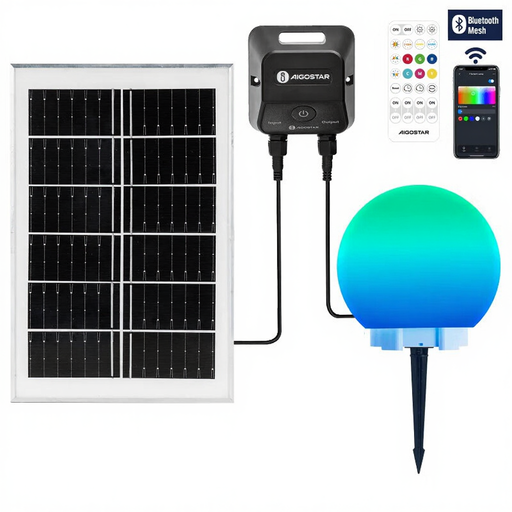
Why it suits these needs: RGB+CCT, Bluetooth Mesh and app control will appeal if you want to coordinate several lights and switch between warm white, cool white and coloured settings.
The control options are clearly listed, so you can see before buying that the smart features require a compatible app connection.
RGB+CCT from 2700–6500 Kelvin, Bluetooth Mesh grouping and IP54/IP44 ratings for outdoor use.
We’ve put together a complete, regularly updated list of products that meet these strict selection criteria and fully comply with the safety regulations in force in the EU.
Solar lights with ground spikes should be placed in soft, firm soil. If the ground is very hard, it may help to make a pilot hole first. Don’t force the spike into stone or compacted ground, as this could damage the casing or connection.
For the most consistent performance:
Lighting time depends on sunlight, the time of year, shade, battery condition and temperature. The Aigostar models mentioned above are stated to provide 8 to 12 hours in suitable conditions. This isn’t a guaranteed figure for every night.
It depends on the IP rating. IP44 protects against splashes of water, but the light isn’t designed to be submerged. Position your lights so water can’t collect around the casing, and always check the specifications for the product you’ve chosen.
They don’t need to be connected to the mains during normal use. The solar panel charges the built-in battery during the day. However, there are still the initial purchase cost and, where applicable, the cost of replacement batteries or the proper disposal of electronic components.