
Lieferung heute & morgen

Qualitätsgarantie

Willkommens-Angebote freischalten: KOSTENLOSE Lieferung | Bis zu 80 % RABATT | Kostenlose 30-Tage-JoyPlus-Testphase
App herunterladen
Garden solar lights are a practical way to illuminate outdoor spaces without laying permanent cables. During the day, a solar panel collects energy; at dusk, the light switches on automatically, depending on the model. They’re suitable for garden paths, flower beds, lawns, balconies and patios.
Despite their simple design, it’s easy to spend more than you need to when buying solar lights. For example, a decorative light might not be bright enough for a dark entrance. On the other hand, a very bright, cool-white lamp can look out of place beside a seating area. Before you buy, it’s worth considering where you’ll use it, its IP rating, light colour and battery capacity.
Claims such as ‘up to 8–12 hours’ apply only under suitable conditions. A shaded location, limited sunlight or a dirty panel will reduce the energy available. For garden solar lights, position the solar panel where it’s as free from shade from trees, walls and roof overhangs as possible.
Charging performance can also drop in autumn and winter. So a solar light won’t necessarily shine with the same brightness every night. For reliable security lighting at an entrance, a mains-powered option may be more suitable. For decorative accents and paths, solar lights are often a simple alternative.
The IP rating needs to suit the surroundings. According to the product information, IP44 protects against solid objects larger than 1 millimetre and splashing water from different directions. This doesn’t mean the light can be submerged or left out in heavy rain for long periods.
Position weatherproof solar lights so that water can’t collect inside the casing or around the electronics. Be sure to follow the manufacturer’s instructions, particularly in frosty weather, heavy rain and when cleaning the light.
Warm-white solar lights at around 2700 Kelvin give off a warm, yellowish glow and are often a good fit for seating areas, flower beds and decorative parts of the garden. 6500 Kelvin looks noticeably cooler and whiter. RGB solar lights, on the other hand, cycle through different colours and are mainly used to create atmosphere.
Positioning also matters when choosing solar lights for paths. Lights with ground spikes are easy to move, but they need to be placed in firm enough soil. The spike could be damaged if you try to push it into very hard or frozen ground.
A clearly stated IP rating is important for outdoor use. The products featured below have an IP44 rating. According to the product information, they’re designed for outdoor areas but must not be submerged in water. The stated temperature range for the Aigostar models is -10 °C to 50 °C.
Aigostar lists a charging time of around 4–6 hours and a running time of 8–12 hours under suitable charging conditions for several models. Depending on the model, they’re fitted with NiMH batteries of different capacities, such as 40 mAh or 200 mAh. Higher capacity is a useful specification to compare, but it doesn’t guarantee the same running time in all conditions.
Before first use, charge the light in a sunny spot. Clean the panel regularly with a soft, damp cloth. Abrasive cleaners could damage its surface.
Think about whether you need subtle accent lighting or a practical guide to help you find your way. Models with ground spikes can be pushed straight into soft ground. The height affects how visible the light source is above flower beds or lawns. For balconies and patios, compact models or a set of 3 solar lights are often easier to position.
If you’re looking for garden lighting without mains power, also check whether the light switches on automatically at dusk. This means less effort day to day, but you’ll still need to check it manually during long spells of bad weather.
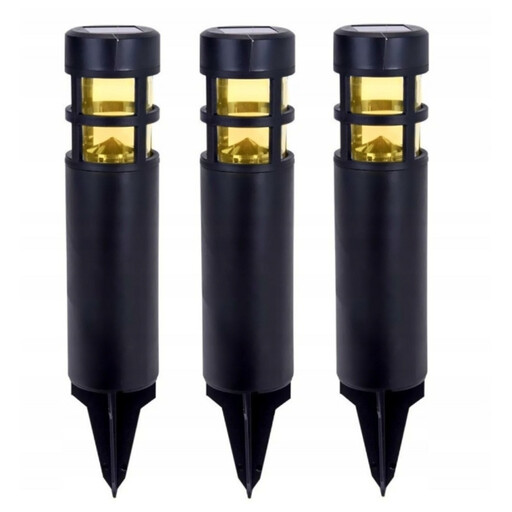
Why it suits this type of buyer: The set includes three solar lights, making it a handy choice if you want to light several areas, such as a path, flower bed or boundary, without buying each light separately.
The pack size is clearly stated, so you can work out how many small points of light you need before buying.
Three lights per set, solar charging and automatic switch-on at dusk, according to the product description.

Why it suits this type of buyer: The stated technical specifications make it easier to plan lighting for paths and outdoor areas where a cool, clearly visible light is preferred.
The specifications include charging time, running time, IP44 rating and temperature range. This makes it easier to assess whether the light is suitable for your intended outdoor space.
Polycrystalline solar panel, NiMH battery, 6500K light, IP44 rating and a stated running time of 8–12 hours under suitable conditions.
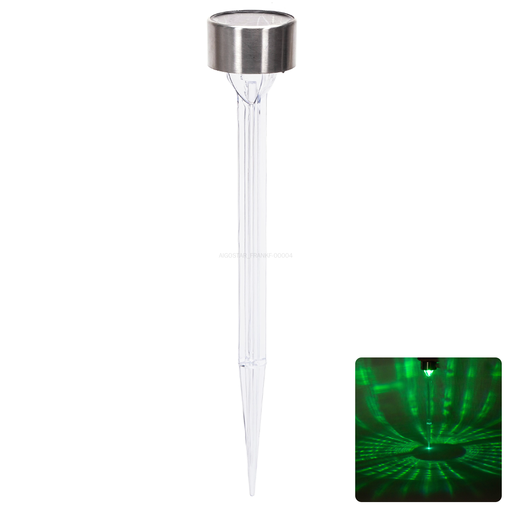
Why it suits this type of buyer: The RGB version is designed for anyone who wants to add a decorative touch to paths, lawns or flower beds with changing colours.
The colour-changing feature is clearly described as RGB, rather than being presented as functional lighting. IP44 and the temperature range are still important when choosing where to place it.
RGB light, 200-mAh NiMH battery, 4–6-hour charging time, stated running time of 8–12 hours and ground spike installation.
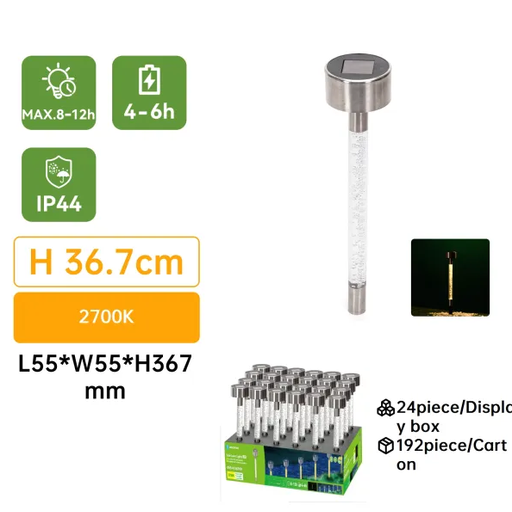
Why it suits this type of buyer: At 36.7 cm tall, this compact light has a warm-white glow and works well in smaller outdoor spaces, planters and seating areas.
The light colour is specifically stated as 2700 Kelvin, so buyers don’t have to rely solely on vague descriptions such as ‘pleasant light’.
2700K light, IP44 rating, automatic dusk switch, ground spike and a stated running time of 8–12 hours under suitable conditions.
We’ve put together a complete, regularly updated list of products that meet these strict selection criteria and fully comply with the safety regulations in force in the EU.
This depends on battery capacity, sunlight, the panel, temperature and how clean the light is. Several Aigostar models are listed as running for 8–12 hours under suitable charging conditions. In winter or during prolonged cloudy weather, they may stay lit for less time.
Solar lights with ground spikes are best placed where they’ll get direct sunlight. Trees, buildings and tall plants can shade the panel. Along paths, position the lights so they don’t create a trip hazard and leave enough space between them and the edge of the path.
They don’t need to be connected to the mains while they’re operating. The solar panel collects energy during the day and stores it in the battery. This means that, when used as intended, they don’t draw power from the mains. However, the actual running time depends on the charging conditions.