
Lieferung heute & morgen

Qualitätsgarantie

Willkommens-Angebote freischalten: KOSTENLOSE Lieferung | Bis zu 80 % RABATT | Kostenlose 30-Tage-JoyPlus-Testphase
App herunterladen
Solar lights promise a simple and eco-friendly way to bathe your garden, patio, or balcony in an atmospheric glow. With no wiring required and no extra electricity costs, they seem like the ideal solution. Yet, the reality is often quite different: lights that fail after the first downpour, a runtime that barely lasts a short evening, or materials that turn brittle after just one season.
To avoid disappointment, it's crucial to know the common pitfalls. Many products advertise features that don't hold up in practice. These primarily include:
This guide will help you navigate these issues and define the right criteria for your selection.
To make an informed decision, don't be swayed by marketing promises. Instead, focus on verifiable technical specifications. Three factors are particularly crucial.
The IP rating (Ingress Protection) is an international standard that indicates how well an electrical device is protected against the ingress of foreign objects (first digit) and water (second digit). For waterproof garden lights, two levels are especially relevant:
solar garden lighting in exposed garden areas, IP65 is the more reliable choice.The advertised runtime can only be achieved if the battery and solar panel are properly matched. Pay attention to the following metrics:
The type of light determines the atmosphere. LED solar lights offer a wide variety here:
solar garden decor for parties or special occasions. RGBCCT models also offer the ability to seamlessly adjust the white tones from warm to cool white.Based on objective criteria, we have compiled a selection of products for different user profiles.

Why This Fits Their Persona: Ideal for users on a limited budget who want simple yet effective lighting for paths, flowerbeds, or a balcony. The 5-pack offers a hassle-free entry point into the world of solar lighting.
The product sidesteps the pitfall of unrealistic runtimes with a clear specification of 6-8 hours, achievable with its 600mAh battery on a full charge. Its weather resistance is designed for standard garden use.
Practical 5-pack for a uniform look. Switchable light modes (warm white or RGB) offer flexibility for different moods.
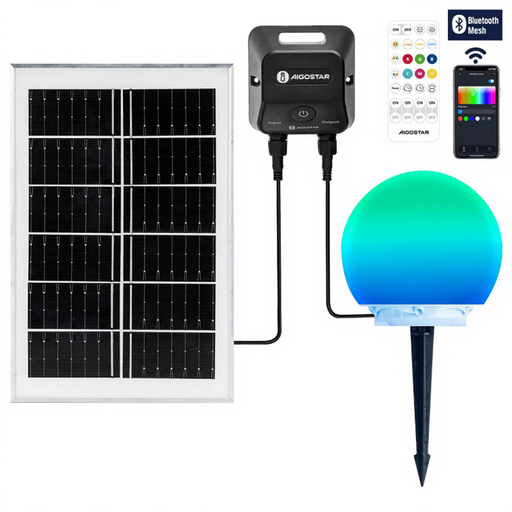
Why This Fits Their Persona: Perfect for users who want full control and custom lighting scenes. The Bluetooth Mesh technology allows for networking and central control of over 200 lights via an app.
This model directly addresses issues of runtime and weather resistance: a powerful 4000mAh battery and an efficient monocrystalline solar panel provide up to 24 hours of light. The IP65 certification guarantees high durability.
Full RGBCCT colour control (millions of colours plus white tones from 2700K-6500K). The separate solar panel can be optimally positioned towards the sun, independent of the light's location.

Why This Fits Their Persona: At 10 metres long with 160 LEDs, this `outdoor solar string light` is ideal for creating an atmospheric setting across large areas like pergolas, fences, or party tents. The 8 lighting modes provide variety for any occasion.
With an IP65 rating, this string light is explicitly designed for demanding outdoor use, thus overcoming the common problem of poor water resistance. The 1200mAh lithium battery ensures a reliable runtime of up to 12 hours.
Robust construction of plastic and copper for long-term durability. The 8 different lighting functions allow for versatile and dynamic garden decoration.
We've compiled a complete, up-to-date list of products that fully meet these strict selection criteria and safety regulations.
The lifespan of a solar light is determined by two main components: the LEDs and the battery. Modern LEDs have a very long lifespan, often 15,000 hours or more. The limiting factor is usually the rechargeable battery, which loses capacity after about 1 to 3 years, depending on quality and usage. However, on many higher-quality models, the battery can be easily replaced.
Yes, solar lights do work in winter, but with reduced performance. The shorter days and the lower angle of the sun mean that the batteries do not fully charge. The runtime per night is therefore significantly shorter than in summer. Models with high-efficiency monocrystalline solar panels tend to perform better in low-light conditions.
The ideal location for the solar panel is a spot that receives at least 6 to 8 hours of direct, unobstructed sunlight daily. A south-facing orientation is optimal in the Northern Hemisphere. Avoid locations in the shade of trees, buildings, or shrubs. It is also advisable to regularly clean the solar panel of dust, leaves, or snow to ensure maximum charging efficiency. This applies to lights in the garden as well as solar lights for balconies and patios.