For a single storyteller, start with a directional microphone positioned close to them and make a test recording with the fan running. As Shure and Audio-Technica explain, a cardioid pickup pattern is less sensitive to sound from the sides and rear, but it won’t block out the fan completely. For interviews with different people, a handheld microphone that you can point towards each speaker may be a good option. If two people will be speaking at once or moving around, consider a kit with two transmitters, provided the connection, wind protection and ambient sound all work in a test recording.
Who this recording setup is for
Storytellers in a fixed position
If you’ll be recording a story mainly while seated, you can position the microphone close to you and keep it pointed consistently. Shure and Audio-Technica describe cardioid microphones as less sensitive to sound from the sides and rear.
Interviewers in the garden
When you’re interviewing different people, consider how easily you can point the microphone towards whoever is speaking, and whether it’s compatible with your recording equipment. Sennheiser says the MD 46’s long handle helps you get closer to the person you’re interviewing.
Teams with two speakers
If two people are telling a story at the same time or moving around, make sure the number of transmitters, microphone positions and recording setup work for both voices. DJI says the two-transmitter version of the DJI Mic offers separate or combined channels.
What to consider when choosing
First, check how close you can position the microphone to the speaker and whether it’s compatible with your recording equipment. A test in your actual garden setup with the fan running will show whether the positioning works for your recording.
| What matters |
What to look for when buying |
Who it matters most to |
| Clear speech despite the fan |
Check the microphone’s pickup direction, how close you can position it and how it sounds in a test recording with the fan running. |
When the fan is on, I want to be able to hear my voice clearly in a test recording, rather than relying on the pickup pattern alone. Around 36% of consumers put speech clarity above all else when there’s fan noise. |
| Microphone positioning in the garden |
Check how easy it is to handle, whether it connects to your recorder or mobile device, and whether you’ll need wind protection. |
If I move between garden spots or interview different people, I want to be able to point the microphone towards whoever is speaking quickly. Around 29% of consumers prioritise being able to reposition the microphone. |
| Two people speaking at once |
Check the number of transmitters, the receiver connection and whether you can record separate or combined tracks. |
When two people are recording at the same time, I want to capture each voice with its own microphone position. Around 21% of consumers prioritise clear recordings of two voices at once. |
| Connection and monitoring your recording |
Check the USB or XLR input, compatible cables, mount and headphone socket for the exact model variant. |
When I’m working on a computer or with existing recording equipment, I want the right connection and a way to monitor my recording. Around 14% of consumers prioritise an easy connection and the ability to monitor a recording as it’s being made. |
Avoid common selection mistakes
-
Assuming a cardioid pattern will block out the fan completely
A cardioid pickup pattern is directional: it picks up sound from the front more strongly, and sound from the sides and rear less strongly. You may still hear the fan, especially if it’s close to the person speaking.
Make a test recording in your intended position with the fan on, and point the microphone towards your mouth.
-
Expecting an XLR microphone to work like a USB microphone
Connections and included accessories vary by model. An XLR-only microphone needs a compatible microphone input on your recording equipment; a desktop microphone also needs a suitable stand.
Check the full model name against the input on your recorder or computer, and confirm exactly what’s included.
-
Choosing a wireless kit just because it says ‘two channels’
The exact kit variant determines how many transmitters are included. Omnidirectional transmitters can also pick up ambient noise.
Check the number of transmitters, the receiver connection and the track settings, then make a test recording in the garden.
-
Treating similarly named models as the same product
DJI Mic and DJI Mic Mini are different products. PodMic and PodMic USB are different too; the connection details for one model don’t automatically apply to the other.
Before buying, compare the full model and kit name with the manufacturer’s details and the specific product page.
Relevant brands and product ranges
Sennheiser
Sennheiser describes the MD 46 as a dynamic XLR handheld microphone for interviews, while the Profile Streaming Set is a USB condenser microphone for a fixed position.
- Sennheiser specifies a cardioid pattern and long handle for the MD 46, along with design features to reduce wind and handling noise.
- The MD 46 needs a compatible XLR recording setup. A test will show whether the Profile Streaming Set works with the fan noise at your recording location.
Audio-Technica
Audio-Technica describes the ATR2100x-USB as a dynamic cardioid handheld microphone with USB and XLR outputs.
- Audio-Technica lists a headphone socket, cables and a desktop stand as included.
- Check which connection is compatible with your recording equipment and whether the setup suits your recording needs.
RØDE
RØDE describes the PodMic USB as a USB/XLR microphone for close-up speech in a fixed position. Wireless GO II is a separate wireless system with two transmitters.
- RØDE lists headphone monitoring and a tight cardioid pattern for the PodMic USB. For this model, the manufacturer recommends a distance of around 5–10 cm.
- RØDE says a desktop stand isn’t included with the PodMic USB on its own. RØDE lists Wireless GO II as discontinued; this doesn’t indicate whether other models are available.
Shure
The dynamic SM58 is a wired cardioid option for close-up speech, while the MV6 is a standalone USB desktop option.
- Shure lists a built-in wind and pop filter and reduced handling noise for the SM58.
- Shure’s description of the MV6’s noise processing doesn’t independently prove that it will remove fan noise at your recording location.
DJI
DJI Mic is a portable wireless system; the two-transmitter version is designed for recordings with two speakers.
- DJI says the two-transmitter version offers separate or combined channels.
- The omnidirectional transmitters aren’t designed to block out the fan. DJI Mic Mini is a different model and shouldn’t be confused with DJI Mic.
Joybuy products for recording speech in the garden
The following Joybuy products include microphones and kits for a fixed recording position, a portable kit with two transmitters, and a directional microphone for a camera or smartphone. The best way to check whether you can still hear the fan in your particular setup is to make a test recording.
 No image available
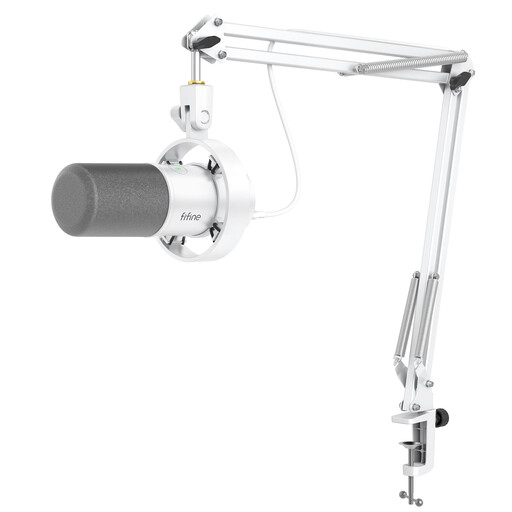
FIFINE K688CTW microphone with boom arm kit, XLR/USB, white
For a fixed storytelling spot where you can position the microphone close to your voice.
The product name lists USB-C and XLR, a headphone socket, mute button, volume control and boom arm kit.
View on Joybuy
 No image available
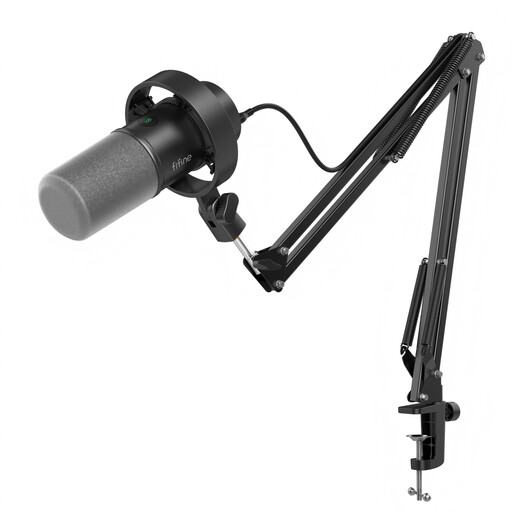
FIFINE K688CT microphone kit, USB/XLR, with boom arm
This kit is designed for a fixed recording position, where you can adjust the microphone on its arm.
The product name lists USB/XLR, a mute button and a headphone socket. The XLR cable isn’t included; according to the product details, the clamp is designed for desks less than 2 inches thick.
View on Joybuy
 No image available
DJI Mic Mini 2S (2 TX + 1 RX + Charging Case)
The two-transmitter version is worth considering if you want to record two voices, each close to its own transmitter.
The product name lists two transmitters, one receiver and a charging case. Before recording, check that the receiver is compatible with your recording equipment.
View on Joybuy
 No image available
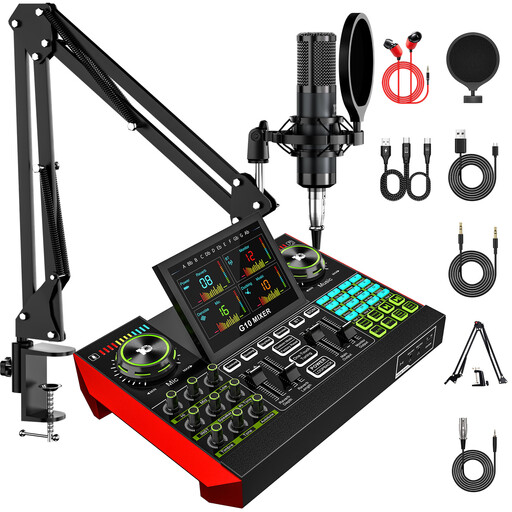
Yinkaer G10-P15-XB microphone kit with mixer and boom arm
This kit is designed for a set recording position, provided the microphone arm and mixer are compatible with your existing equipment.
The product name lists a 3.5 mm condenser microphone, an audio mixer or sound card, and a boom arm; computers and mobile devices are also listed.
View on Joybuy
 No image available
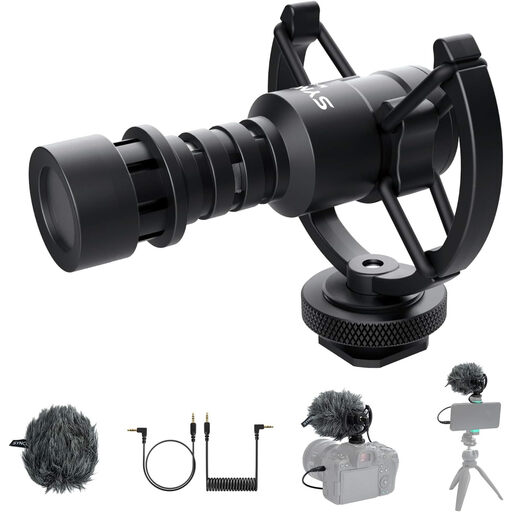
SYNCO M1S directional video microphone with shock mount and windscreen
Consider this external microphone if you want to record with a compatible camera or smartphone.
The product name lists a cardioid pickup pattern, shock mount and windscreen. A test in your garden setup will show how much the fan comes through in the finished recording.
View on Joybuy
Frequently asked questions
How should I position the microphone with the fan running?
Speak close to the microphone, in the direction it’s designed to pick up sound from, and listen to a test recording made in the actual recording location. RØDE recommends around 5–10 cm for the PodMic USB; this is a recommendation for that model, not a general rule. You may still hear a fan if it’s next to the person speaking.
Will a windscreen help with the fan?
A windscreen can reduce noise caused by air movement directly at the microphone capsule, but it won’t automatically remove the audible operating noise of a fan. In a test recording, check whether you can hear a draught, the fan itself or both at your recording location.
What should I check about connections and accessories?
Check that your recording equipment’s input matches the connection type and the included accessories for the specific model. The Sennheiser MD 46 needs a compatible XLR recording setup; Audio-Technica lists USB and XLR connections, cables and a desktop stand for the ATR2100x-USB. RØDE notes that a desktop stand isn’t included with the PodMic USB on its own.
Can I record conversations in a shared garden?
Under § 201 StGB, recording words spoken in private without authorisation is unlawful. The Federal Ministry of Justice describes the protection given to words spoken in private; whether a particular conversation is considered public or private depends on the circumstances. If identifiable people are recorded or their recordings are processed, you’ll also need an appropriate legal basis under Art. 6(1) of the GDPR. The Federal Commissioner for Data Protection and Freedom of Information explains that consent is one of six possible legal bases. Make sure you discuss the recording and its intended purpose with everyone involved beforehand.


