
Lieferung heute & morgen

Qualitätsgarantie

Willkommens-Angebote freischalten: KOSTENLOSE Lieferung | Bis zu 80 % RABATT | Kostenlose 30-Tage-JoyPlus-Testphase
App herunterladen
The search for the ideal retreat in your own garden, on the terrace, or on the balcony leads many to ask: what type of seating offers the desired comfort and style? From the classic garden swing to the versatile hammock, the selection is vast. This article serves as a guide, objectively presenting various models and their features to help you decide on the right outdoor furniture for relaxation.
To make an informed decision, several objective criteria should be considered. These parameters help you find the model that best meets your requirements for space, use, and durability.
The longevity of garden furniture depends heavily on the material. Frames made of powder-coated steel offer high stability and are corrosion-resistant with proper care. Wooden frames require regular maintenance to withstand the elements. For cushions and seating surfaces, materials like polyester are often a practical choice due to their UV resistance and quick-drying properties. In contrast, a cotton hammock or a cotton-polyester blend offers a particularly pleasant feel against the skin but should be protected from moisture. Look for the weather-resistant label, but keep in mind that a protective cover or storing it indoors during winter will extend the lifespan of all materials.
The dimensions and maximum load capacity are crucial factors. A 3-seater garden swing is suitable for families or social gatherings, while a more compact garden swing bench or a spreader bar hammock for 2 people is ideal for couples or smaller spaces. Always check the manufacturer's specified maximum static load capacity in kilograms to ensure safe use. The seating or lying surface should provide enough space for the intended number of people.
The choice between a stationary swing and a hammock is often determined by the available space and setup.
Here is a selection of different models that cater to various needs and applications. The descriptions are based on manufacturer specifications.

Why it stands out: This model embodies the classic design of a garden swing. With room for up to three people and an integrated sun canopy, it provides a comfortable and sheltered seating area for the outdoors.
Advantages:
Who is it for? For users looking for a stationary, classic swing bench for the garden or terrace who value integrated sun protection. Ideal for families or couples wanting to create a permanent relaxation spot.
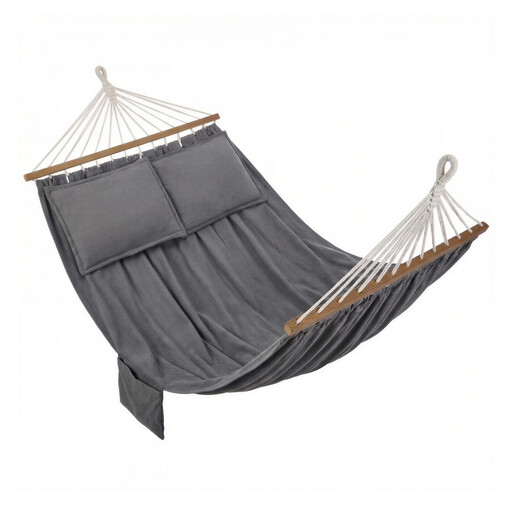
Why it stands out: This spreader bar hammock is distinguished by its generous lying surface and high load capacity. The included wooden spreader bars keep the surface open, making it easier to get in and out.
Advantages:
Who is it for? For individuals who already have mounting options (e.g., trees, posts, or a separate stand) and are looking for a flexible, spacious, and highly durable spreader bar hammock for 2 people.
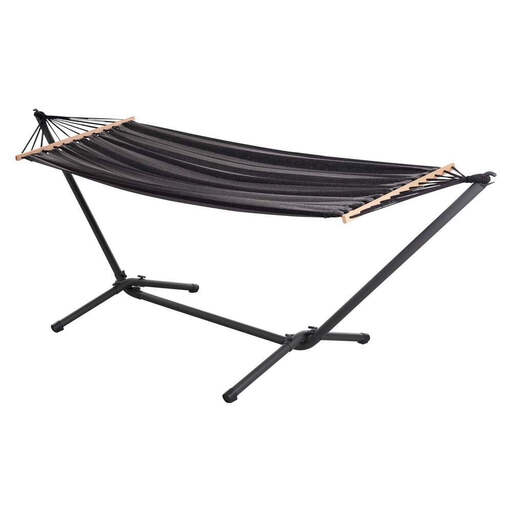
Why it stands out: This set is an all-in-one solution, consisting of a hammock and a matching freestanding frame. It eliminates the need for trees or other anchor points.
Advantages:
Who is it for? Ideal for users who do not have a way to hang a traditional hammock. It is a practical solution for anyone looking for a straightforward and ready-to-use relaxation option for one person.
This selection represents just a small sample of the available models. If you wish to explore other variations or designs that match your personal style and spatial constraints, you can find additional inspiration in our broader collection.
Explore our full range of Outdoor Hammocks and Swing Chairs with Stands
1. What is the difference between a garden swing and a swing bench? The term "garden swing" (or "porch swing") typically refers to a freestanding swing with its own frame and often a sun canopy. A "swing bench" is a more general term that can also include models designed to be hung from a porch ceiling, for example. In common parlance, however, the terms are often used interchangeably.
2. How do I make my garden swing weather-resistant? Most modern garden swings use powder-coated steel and weather-resistant fabrics. To maximize their lifespan, it is recommended to store the cushions in a dry place when not in use and to cover the frame with a protective cover during winter. For wooden models, regular treatment with appropriate wood preservatives is advisable.
3. Can you hang a hammock without trees? Yes, special stands are available for this purpose. A hammock with a stand is an all-in-one solution that does not require external anchor points. These stands are usually made of steel or wood and allow you to place the hammock freely on any flat surface.