
Lieferung heute & morgen

Qualitätsgarantie

Willkommens-Angebote freischalten: KOSTENLOSE Lieferung | Bis zu 80 % RABATT | Kostenlose 30-Tage-JoyPlus-Testphase
App herunterladen
A garment rack is a flexible and often affordable solution for creating order—whether in the bedroom, hallway, or as a temporary wardrobe for guests. However, the selection is vast, and not every model lives up to its promises. Wobbly frames, bending rods, or jamming wheels are common annoyances.
This guide will help you navigate the typical pitfalls of buying a garment rack. As your Joybuy Product Recommendation Officer, I will show you which objective criteria truly matter so you can find a durable and practical solution for your needs.
Many buyers focus on price or appearance, overlooking critical design flaws that severely limit usability. Pay special attention to these three points:
To avoid a bad purchase, you should check three technical features before making a decision. These largely determine the stability and longevity of your garment rack.
The stability of a garment rack is directly linked to the material and wall thickness of its tubes. Models made of metal, particularly steel or powder-coated carbon steel, generally offer greater strength than all-plastic designs. A key indicator of a sturdy garment rack is the tube diameter. While basic models often use tubes of 16 mm or less, frames with diameters of 19 mm or more provide visibly higher stability and are less prone to bending.
The manufacturer's stated maximum static load capacity is an important benchmark. It indicates how much weight the frame can support when evenly distributed without deforming.
Consider how you intend to use the garment rack. A garment rack with a shelf provides extra storage for shoes, bags, or storage boxes while also increasing the frame's stability. If mobility is important, pay attention to the quality of the wheels. Large, 360-degree swivel casters, ideally with locking brakes, ensure easy manoeuvrability even on carpets and provide a secure stance.
Instead of an overwhelming list, we present specific models tailored to particular use cases.
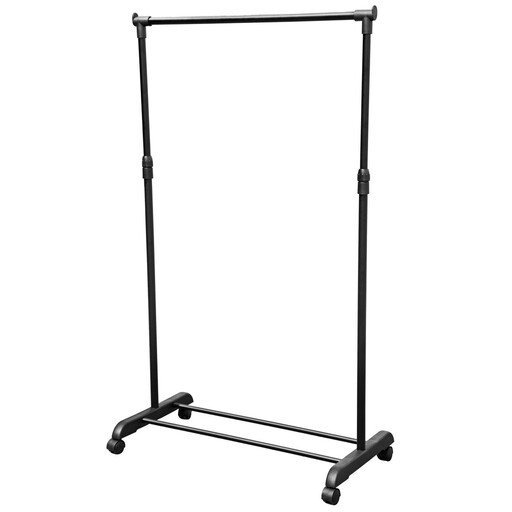
Why it's a good fit: Perfect for students, a first apartment, or as a flexible secondary wardrobe. The adjustable height and wheels offer functionality for light clothing like shirts and blouses without breaking the bank.
The maximum load capacity of 10 kg is clearly stated, preventing overloading and the associated bending of the rod. Its simple construction avoids complex, break-prone connection points.
Height-adjustable from 100 to 170 cm to accommodate even longer garments. The bottom shelf provides space for shoes and increases stability.
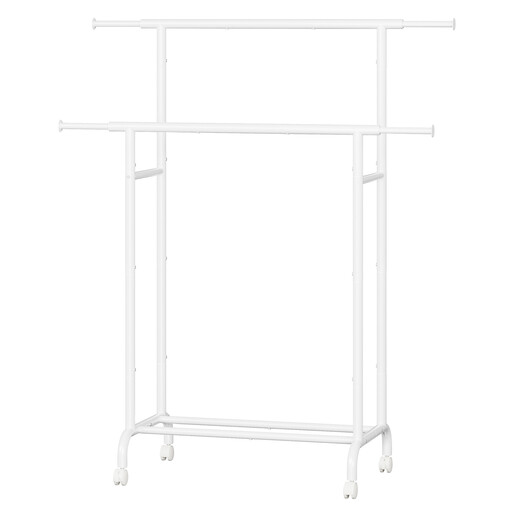
Why it's a good fit: For anyone seeking a robust, high-capacity solution as an open wardrobe. Ideal for storing a complete wardrobe, including heavy winter jackets and coats.
The solid metal construction and a clearly defined total load capacity of 80 kg (according to the manufacturer) prevent bending. The heavy-duty swivel casters ensure true mobility without jamming.
Two extendable hanging rods double the hanging capacity. The bottom shelf offers additional storage space and increases the frame's stability.
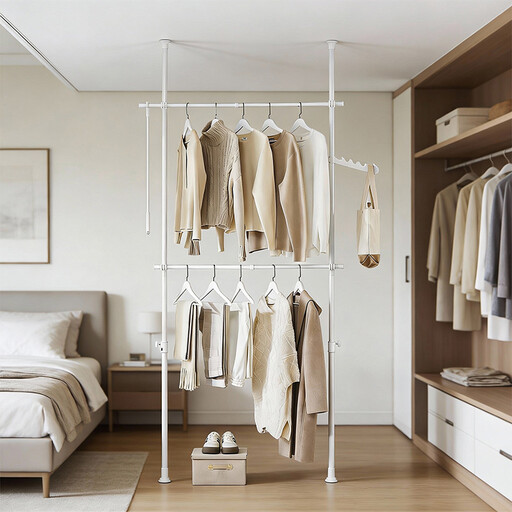
Why it's a good fit: This tension system utilizes the space between the floor and ceiling, requiring zero floor space. It's the ideal solution for small bedrooms, narrow hallways, or unused alcoves where a conventional rack won't fit.
The problem of a wobbly base is completely bypassed. Stability is created by the firm tension between the floor and ceiling, enabling secure and space-saving hanging.
Extremely flexible: The height (200–295 cm) and width (75–126 cm) are infinitely adjustable to fit the room's dimensions. Assembly requires no drilling and leaves no marks.
We have compiled a complete, up-to-date list of products that fully meet these strict selection criteria and all applicable safety regulations.
The load capacity varies greatly depending on the model and construction. Simple, lightweight models are often designed for only 10 to 15 kg. In contrast, robust metal garment racks can hold 30 kg, 80 kg, or even more. Always check the manufacturer's specified maximum static load capacity and distribute the weight evenly along the hanging rod.
Choose a model with a wide, stable base or a bottom shelf that acts as a counterbalance. Never exceed the specified maximum load. Distribute heavy items like coats evenly and avoid hanging them all on one side. For very tall or heavily loaded models, some manufacturers offer an anti-tip kit for securing the rack to the wall.
It depends on the quality and size of the wheels. Larger, sturdy casters, often found on heavier models, generally handle low-pile carpets well. Small plastic wheels, common on budget models, can get stuck on carpets. For high-pile carpets, a stationary garment rack without wheels is often the more reliable choice.