
Lieferung heute & morgen

Qualitätsgarantie

Willkommens-Angebote freischalten: KOSTENLOSE Lieferung | Bis zu 80 % RABATT | Kostenlose 30-Tage-JoyPlus-Testphase
App herunterladen
Wrinkled shirts on a business trip or a creased dress just before an important event—traditional ironing with a board is often cumbersome and time-consuming. A garment steamer, also known as a clothes steamer, promises a quick solution for removing wrinkles without an iron. But the market is flooded with devices whose marketing promises often fall short in practice.
As your Joybuy Product Recommendation Officer, I'm here to help you separate the wheat from the chaff. We'll highlight the most common pitfalls and show you which technical features truly matter, so you can find a device that simplifies your daily routine, rather than complicates it.
Many buyers are disappointed with their new device after a short time. This is often due to exaggerated advertising claims that conceal significant drawbacks. Pay special attention to these three points:
To avoid a bad purchase, you should focus on objective performance data. These three parameters are crucial for the function of a steamer for clothes.
The most important metric for effectiveness is the steam output, measured in grams per minute (g/min). It indicates how much steam the device emits per minute. A higher steam output means the steam penetrates deeper into the fibres and smooths out wrinkles faster.
The power rating in watts is secondary and primarily affects the heat-up time. A good value here is under 45 seconds.
The size of the water tank determines how long you can steam vertically in one go. The key is to find a compromise between portability and usage duration.
Make sure the tank is detachable and easy to refill.
A high-quality 2-in-1 garment steamer should work both vertically on a hanging garment and horizontally on a flat surface without dripping. This is achieved through special pump technology and a sealed construction. Models with a heated ceramic plate can also be used like a classic iron to eliminate stubborn wrinkles.
Based on these objective criteria, we have identified several models that offer a suitable solution for specific user profiles.
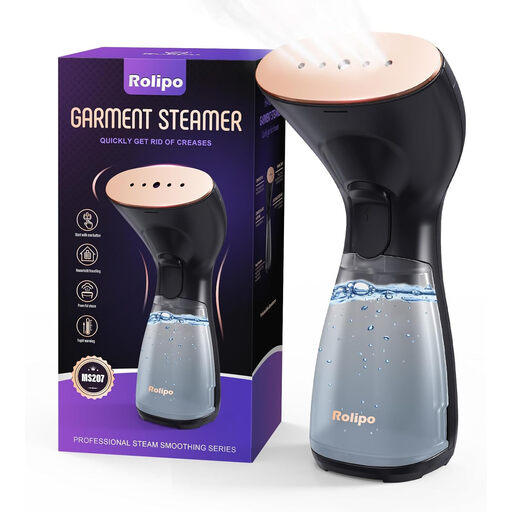
Why This Fits Their Persona: With its foldable design and a weight of just 730 grams, this device is specifically designed for transport in a suitcase. It's the ideal solution for quickly ensuring wrinkle-free clothes on business trips or holidays.
This device avoids the mini-tank trap by intentionally focusing on portability. The 130 ml tank is a thoughtful compromise, sufficient for 1-2 garments without making the device unnecessarily heavy.
Foldable Handle: Significantly reduces packing size. Simple Operation: One-button system for quick use.
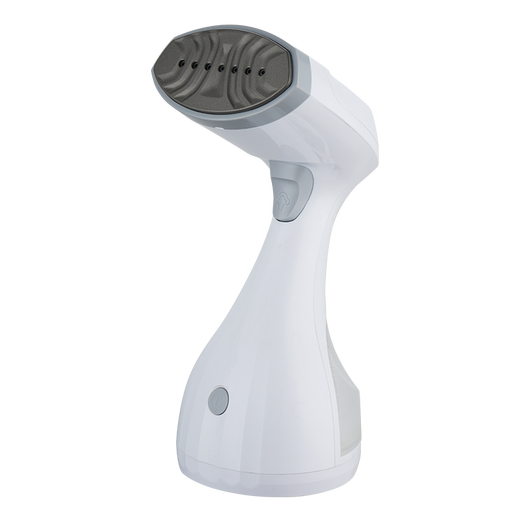
Why This Fits Their Persona: Anyone who needs to quickly prep several shirts or blouses for the week needs power and endurance. This model is optimised for home use, where efficiency is more important than minimal weight.
It combines high heating power (1500 W for a 30s heat-up time) with a strong steam output (23±3 g/min) and a large 300 ml tank. This ensures a long, uninterrupted usage time of up to 15 minutes.
Large Water Tank (300 ml): For longer sessions without refilling. Continuous Steam Function: A lock button allows for continuous steam output without having to hold the button down.
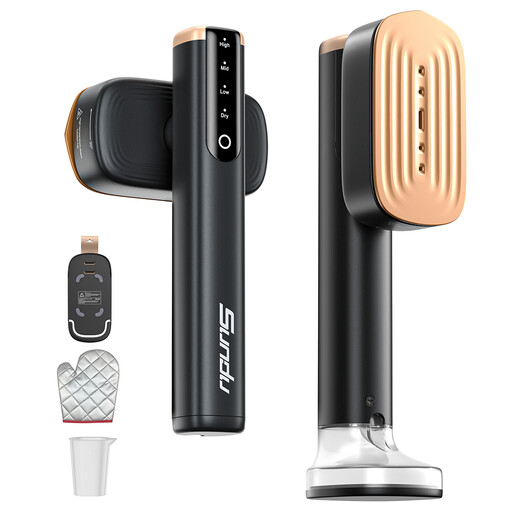
Why This Fits Their Persona: This user is looking for a versatile device that serves as both a quick steamer for hanging clothes and a precision iron for collars and cuffs. It's ideal for small apartments and occasional travel.
It solves the dripping problem with a smart 2-in-1 design. The 90° rotating head and ceramic soleplate enable safe horizontal use, making it a true 2-in-1 garment steamer.
Pivoting Head: Flexible switching between vertical steaming and horizontal ironing. Smart Temperature Control: Protects delicate fabrics like silk or wool.
We have compiled a complete, up-to-date list of products that fully meet these strict selection criteria and adhere to all relevant safety standards.
Most manufacturers recommend using distilled or demineralised water to minimise limescale buildup. If limescale does form, you can fill the tank with a mixture of water and white vinegar (in a 1:1 ratio), let the device heat up, and release the steam into a sink until the tank is empty. Afterwards, repeat the process with clean water to remove any vinegar residue. Always follow the manufacturer's specific instructions.
For most everyday needs, such as refreshing clothes and removing light to medium wrinkles, a garment steamer is an excellent alternative. It is particularly gentle on delicate fabrics. However, for very stubborn creases in thick materials like heavy cotton or linen, a classic steam iron with high pressure may still be superior. A 2-in-1 model with an ironing plate largely closes this gap.
Steam is generally gentler than the direct heat of an iron. Therefore, garment steamers are very well-suited for delicate materials such as silk, wool, cashmere, and viscose. For very heat-sensitive synthetic fabrics or printed textiles, it is advisable to test on an inconspicuous area first and maintain some distance. For durable fabrics like cotton or linen, a brush attachment can help guide the steam deeper into the fibres.