
Lieferung heute & morgen

Qualitätsgarantie

Willkommens-Angebote freischalten: KOSTENLOSE Lieferung | Bis zu 80 % RABATT | Kostenlose 30-Tage-JoyPlus-Testphase
App herunterladen
A German mechanical keyboard needs to offer more than just a German key layout. Gamers value short actuation distances and reliable multi-key input, while frequent typists focus on switch feel and noise levels. In the office, compact dimensions, volume control and wireless use may be more important.
However, some common marketing claims can lead to poor purchasing decisions. An RGB keyboard is not automatically more functional, a compact case may leave out important keys, and a wireless connection is not equally suitable for every application. The following criteria will help you assess technical specifications realistically.
Many models advertise millions of colours and numerous lighting effects. For everyday use, however, it is more important to consider how the lighting is controlled, whether individual keys can be configured separately and whether the lighting can be switched off completely. Coloured backlighting does not replace clear key legends and says nothing about switch quality.
A 75% keyboard usually retains the function keys, arrow keys and important navigation keys. A 65% keyboard is even more compact, but often omits the separate function-key row. If you regularly use F-keys, Home, End or Print Screen, check the key layout before buying.
Linear switches such as Red or Speed variants offer a smooth keypress without a tactile bump. Tactile switches such as Brown variants provide noticeable feedback when actuated. Actual noise levels also depend on the case, keycaps, dampening and desk surface. A low-profile keyboard can feel more direct thanks to its shorter key travel, but it is not automatically more comfortable for every frequent typist.
Look for the designation German, DE or ISO-DE. QWERTZ alone describes the key arrangement but does not always confirm all the features of the German layout. Important details include the position of the Enter key, the labelling of umlauts and the arrangement of “Y” and “Z”. On Windows, you should also check that the keyboard layout is set to German in the system settings.
Actuation force is often specified in grams, while the actuation point is given in millimetres. These values provide an initial guide:
Manufacturer claims such as “over 100 million keystrokes” should be understood as the technical service life of the switches. They do not guarantee that the keycaps, cable, battery or electronics will function faultlessly for just as long.
A wired keyboard does not need a battery and works without pairing. USB-C with a detachable cable makes replacement and transport easier. A wireless mechanical keyboard, on the other hand, offers greater flexibility but should provide at least details about battery capacity, charging time, wireless standard and available connection modes.
For gaming, 2.4 GHz wireless is generally designed for low latency. Bluetooth is better suited to switching between a PC, tablet and laptop. A tri-mode model combines 2.4 GHz, Bluetooth and USB-C. Also check whether the quoted battery life applies with RGB lighting switched on or with the lighting disabled.
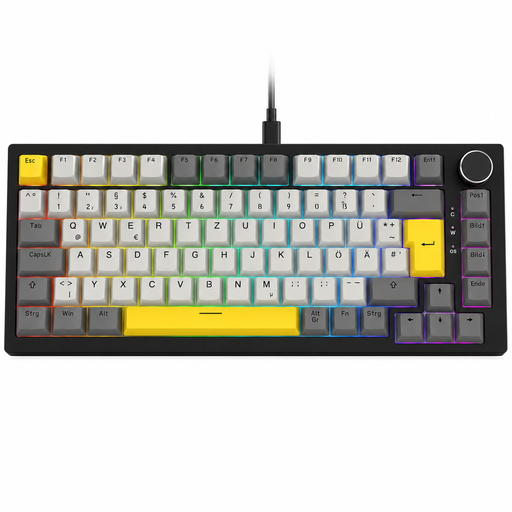
Why this product suits this profile: The 75% form factor with 82 keys provides function keys, arrow keys and navigation keys while taking up less space than a full-size model. The USB-C connection needs neither a battery nor wireless configuration.
The German QWERTZ layout is explicitly specified. Hot-swap compatibility for compatible 3-pin switches allows later modifications without soldering.
RGB lighting, volume control, a gasket-mounted construction and a detachable USB-C cable.
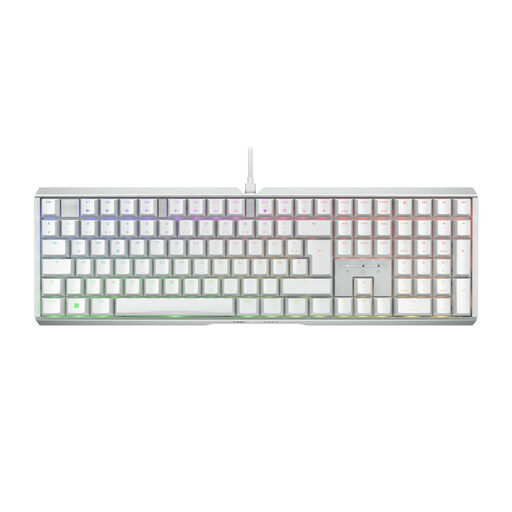
Why this product suits this profile: This full-size model combines a German layout with an aluminium frame, tactile CHERRY MX2A Brown switches and programmable media keys.
The construction is described using more than just lighting: the frame material, switch type, dampening and N-key rollover are all specified in detail.
Full aluminium frame, per-key RGB and side lighting, plus a detachable USB cable.

Why this product suits this profile: The 65% layout is designed for small desks and mobile setups. Tri-mode connectivity allows you to use 2.4 GHz, Bluetooth or USB-C.
The wireless options are listed separately. Wired use while charging is also possible.
Low-profile MX Speed switches, 69 keys, per-key RGB and connectivity with up to three Bluetooth devices.

Why this product suits this profile: Tactile Quiet Low Profile switches, a QWERTZ layout and Easy-Switch make this model appealing for offices, programming and switching between multiple devices.
The product specifications identify the switch characteristics, wireless standards and operating systems rather than relying only on general convenience claims.
Bluetooth and Logi Bolt receiver, switching between up to three devices and adaptive white backlighting.
We have put together a complete, regularly updated list of products that fully meet these strict selection criteria and the safety regulations applicable in the EU.
Choose a model with an explicitly specified ISO-DE or German QWERTZ layout. You should also select the form factor according to your habits: full-size for a number pad and office software, 75% for a compact workspace or 65% for maximum freedom of movement with your mouse.
Service life depends on the switches, keycaps, cable, battery and how the keyboard is used. Claims specifying a particular number of keystrokes generally refer to the switches and come from the manufacturer’s data. For a longer service life, detachable cables, replaceable switches and regular cleaning are practical features.
Power consumption mainly depends on the wireless standard and lighting. RGB reduces battery life more quickly than having the lighting switched off. If you work or play frequently, choose a keyboard with USB-C charging and optional wired operation. This means you can continue using it even when the battery is low.