
Lieferung heute & morgen

Qualitätsgarantie

Willkommens-Angebote freischalten: KOSTENLOSE Lieferung | Bis zu 80 % RABATT | Kostenlose 30-Tage-JoyPlus-Testphase
App herunterladen
A good blender can significantly simplify meal preparation, from nutritious morning smoothies to creamy evening soups. However, the market is crowded and full of marketing promises that often create more confusion than clarity. Before you make a decision, it's crucial to understand the common pitfalls that can lead to a bad purchase.
A common misconception is that high wattage automatically equals better performance. Many manufacturers advertise impressive numbers, but a poorly designed blade or an inefficiently shaped container can render the power of a strong motor useless. Another point is the allure of the "all-in-one" device. A multifunction blender that promises to do everything—from kneading dough to crushing ice—often turns out to be a compromise solution where none of the functions are truly convincing.
To find an appliance that will meet your needs for the long term, you should focus on objective and practical features. These three criteria are crucial for the performance and durability of your future kitchen blender.
A high-performance blender is not defined by its wattage alone. While higher power (from 600 watts upwards) is advantageous for breaking down hard ingredients like nuts, frozen fruits, or ice cubes, the quality of the motor and the maximum rotational speed (RPM) are also critical. A well-engineered motor ensures consistent power transfer to the blades. Furthermore, variable speed settings and a pulse function provide the necessary control to precisely prepare everything from fine purées to chunky salsas. Pay attention to the interplay of these factors rather than an isolated watt figure.
The choice between a countertop blender and an immersion blender (also called a stick blender) depends entirely on your intended use.
The material of the blender jar has a direct impact on handling, cleaning, and durability.
The volume should match your household size. For individuals or couples, a capacity of 1 litre is often sufficient, while families will benefit from jars with 1.5 to 2 litres.
To make your decision easier, we have compiled a few models based on different user profiles and their requirements.

Why It's a Match: Ideal for individuals or small kitchens. Its compact design saves space, while the core functions are sufficient for daily smoothies, juices, or simple baby food. A straightforward, entry-level device.
This device doesn't try to be a professional do-it-all machine. It focuses on basic, small-scale blending and grinding tasks, thus avoiding the trap of over-promising.
Compact footprint and easy cleaning thanks to detachable parts. Fits in any kitchen and is ready to use in seconds.
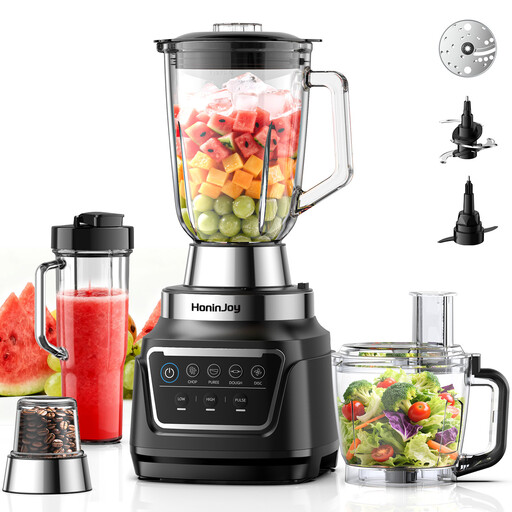
Why It's a Match: This set is designed for families who do more than just make smoothies. With a large blender jar, a food processor bowl, and various attachments, it covers a wide range of tasks—from chopping vegetables to preparing dough.
Instead of weak universal attachments, this model offers dedicated containers for different tasks (blending, processing). The motor power of up to 1300 watts is sufficiently powerful to actually handle the various functions.
Comprehensive accessory kit, including a 1.5-litre glass jar, 2-litre food processor bowl, and a grinding cup. All removable parts are dishwasher-safe.
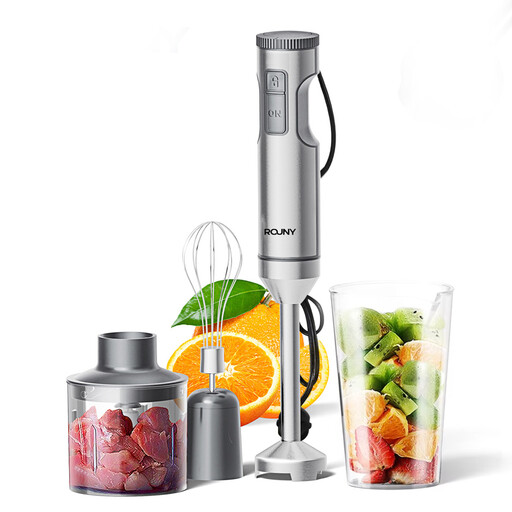
Why It's a Match: This immersion blender is for anyone who values flexibility. Purée soups directly in the pot, whip cream with the whisk attachment, or chop herbs in the chopper bowl. The variable speed control gives you full command over the final texture.
Instead of relying on high wattage alone, this model combines solid motor power (up to 1200 watts) with a high-quality stainless steel shaft and precise speed control. This ensures efficiency without unnecessary splashing.
The 4-in-1 set with blending stick, 700ml beaker, 500ml chopper, and whisk offers great versatility in a small package.
We've compiled a complete, up-to-date list of products that fully meet these strict selection criteria and quality standards.
No, not every blender is suitable for hot liquids. Blenders with glass jars are generally the safer choice here, as glass is heat-resistant. For plastic jars, you should check the manufacturer's specifications. It's important never to fill the jar to the brim and to leave the lid cap slightly ajar (if a vent is provided) to allow steam to escape and prevent a dangerous pressure build-up.
A quick and effective cleaning method is the self-cleaning function that many devices offer. Alternatively, you can fill the jar halfway with warm water and a drop of dish soap immediately after use. Put the lid on and run the blender on its highest setting for about 30 seconds. Then rinse—and you're done. For stubborn residue, most removable parts are dishwasher-safe.
For preparing smoothies, especially with frozen fruit or ice, a power output of 600 watts or more is recommended. A high-performance blender with 800 to 1200 watts offers more power in reserve and ensures a smoother, chunk-free result. However, a robust blade system and a sturdy construction that can withstand the strain are also crucial.