Bazaar bakers making lots of trays
If you want to bake lots of ginger biscuits in a short time, check whether the specific model explicitly supports baking on several levels at once.


If you’re baking lots of ginger biscuits in just a few batches, a built-in oven with clearly specified multi-level fan-assisted cooking could be a good fit, provided you have a suitable housing unit. If you can’t install an oven, a countertop model may suit smaller batches, as long as its tray capacity and the number of rounds work for you. Dr. Oetker Germany’s ginger biscuit recipe gives conventional top/bottom heat and fan-assisted cooking as options. So check the recipe, tray dimensions and included accessories rather than comparing only oven capacity or shelf levels.
If you want to bake lots of ginger biscuits in a short time, check whether the specific model explicitly supports baking on several levels at once.
With a freestanding appliance, the tray capacity and number of baking rounds need to suit the space you have available.
If you’re following a particular recipe, check that the oven offers the specified heating method before weighing up other features.
A good fit if: you plan to bake several trays in one round and have a suitable housing unit.
Bear in mind: the stated number of levels doesn’t tell you how many compatible trays are included.
A good fit if: a built-in oven isn’t an option; compact models can work for smaller baking rounds.
Bear in mind: depending on the tray capacity, you may need more baking rounds, while a larger countertop model takes up more space.
A good fit if: your oven offers the recipe’s heating method and you can fit individual trays into your schedule.
Bear in mind: baking trays one after another means more rounds in total.
| What matters | What to check when buying | Who is this especially important for? |
|---|---|---|
| Baking lots of biscuits quickly | Explicit manufacturer confirmation of simultaneous fan-assisted baking; the number and dimensions of compatible trays included. | If I need to bake lots of trays in a short time, a clearly specified multi-level function matters to me. Around 31% of consumers put baking capacity first. |
| Making space for the oven and trays | Installation or external dimensions and placement guidance; usable tray dimensions rather than capacity in litres alone. | Without a suitable housing unit, I need to weigh up the available space and tray size. Around 25% of consumers prioritise space and fit. |
| Choosing a heating method to suit the recipe | Match the available heating methods to the recipe; keep an eye on browning and baking time during the first batch. | If I’m using a set ginger biscuit recipe, I want to stick to its specified heating method rather than transferring the temperature without checking. Around 19% of consumers put following the recipe first. |
| Energy use over several baking rounds | For appliances with the relevant energy label, check the kWh figure per standard baking cycle for the heating method you’ll use, and factor in the planned number of rounds. | If I’m baking several batches, I want to estimate energy use on a like-for-like basis. Around 13% of consumers prioritise running costs. |
| Cleaning and accessories | Check the included trays, compatible extra trays and the cleaning instructions for the specific model. | If I bake often, I want to plan ahead for cleaning and any accessories I’ll need. Around 12% of consumers put cleaning and accessories first. |
For the Rommelsbacher BG 1805/E, the manufacturer lists a 42 l capacity and four shelf levels, but includes one roasting/baking tray. This doesn’t mean that four biscuit trays will fit at once or are included.
Check tray capacity, what’s included and whether simultaneous use is explicitly confirmed—all separately.
Dr. Oetker Germany’s ginger biscuit recipe specifies different temperatures for conventional top/bottom heat and fan-assisted cooking. These settings apply to that particular recipe and aren’t universal settings for other doughs.
Follow your own recipe and keep an eye on browning and baking time during the first batch.
According to the Verbraucherzentrale, energy use for ovens with the relevant energy label is stated per standard baking cycle. The European Commission lists small and portable ovens as outside the scope of the energy labelling rules in question.
Compare figures only on a like-for-like basis and factor in the number of baking rounds you’ll need. Don’t assume this automatically tells you which type of oven will be cheaper.
Guidance on selling home-baked goods varies according to the type of sale, packaging and how it is organised. There’s no universal yes-or-no answer that applies to every bazaar.
Before selling, check the details with the organiser and the relevant food safety authority, and have ingredient and allergen information ready.
For its HBA272BB3 built-in oven, Bosch specifies 3D fan-assisted cooking on up to three levels.
For its HB572ABS3 built-in oven, Siemens specifies 3D fan-assisted cooking on up to three levels.
According to the manufacturer, the freestanding BG 1805/E has a 42 l capacity and offers conventional top/bottom heat and fan-assisted cooking.
According to the manufacturer, the compact TO 2068 has a 20 l capacity and offers fan-assisted, top and bottom heat.
For its B54CR31N0 built-in oven, NEFF specifies Circo Therm for baking on up to three levels at once.
This selection includes freestanding countertop ovens for smaller baking rounds and a built-in oven with specified multi-level fan-assisted cooking. For each model, check the tray capacity, heating method and what’s included against your recipe and schedule.
 No image available
A freestanding option if you’re planning a small baking round and don’t want a built-in solution.
32 l, 1.600 W and a timer; temperature range 100–250 °C. A baking tray and wire rack are listed.
 No image available
A compact freestanding option if you want to bake small quantities one after another.
10 l; temperature setting 100–230 °C and conventional top/bottom heat. A baking tray and wire rack are listed.
 No image available
A freestanding option if you’re planning to use the other functions mentioned in the product name as well as baking.
28 l and a timer; temperature control 100–230 °C. Top heat, bottom heat and combined heat are listed, along with a baking tray and wire rack.
 No image available
A built-in option if you want to use several levels in one baking round and have a suitable housing unit.
3D fan-assisted cooking on up to three levels and conventional top/bottom heat are specified. Temperature range 30–275 °C; one baking tray is listed. The multi-level function doesn’t confirm that three biscuit trays are included.
 No image available
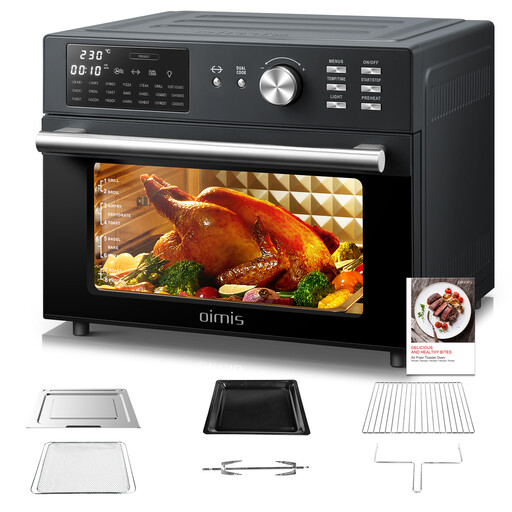
A freestanding option if you’d like to use the other appliance functions listed as well as baking.
30 l, 1.800 W and 21 pre-set functions. 360° fan-assisted cooking, a rotisserie and a dehydrating function are listed; the stated pizza size is 13 inches.
Dr. Oetker Germany’s ginger biscuit recipe recommends preheating to around 180 °C for conventional top/bottom heat or around 160 °C for fan-assisted cooking. For one tray on the middle shelf, it gives a baking time of 10–12 minutes. If you’re using a different dough, follow its own instructions and keep an eye on the first batch.
No, the number of shelf levels alone doesn’t tell you that. For the Rommelsbacher BG 1805/E, the manufacturer lists four levels but includes one roasting/baking tray. Check whether extra compatible trays are available and whether simultaneous use is explicitly confirmed.
For appliances with the relevant energy label, compare energy use per standard baking cycle and factor in how many rounds you’ll need for your quantity of biscuits. The European Commission lists small and portable ovens as outside the scope of the oven energy labelling rules in question; this doesn’t establish a general energy advantage for either type.
Check exactly what’s included, whether compatible extra trays are available and the cleaning instructions for the specific model. Multiple shelf levels don’t replace any extra trays you may need.
This depends on factors such as the type of sale, packaging and how it’s organised, so there’s no general yes-or-no answer for every situation. The Düren district provides guidance for home-baked goods sold in bags at markets and events, while the Verbraucherzentralen food forum covers occasional charity sales separately. Check the details in advance with the relevant food safety authority and the event organiser.