For a single small tray, a freestanding mini oven may be enough, provided the tray fits and you have a safe place to put it. If you regularly bake several trays, a built-in oven may be a better option if your kitchen can accommodate one and the manufacturer explicitly confirms that the required heating function can be used on multiple levels. Bosch, for example, states that the HBA572BB4 can use hot air on up to three levels. The key factors are still the heating function specified in your recipe, the usable tray area and the installation instructions. Capacity alone does not tell you how many biscuits you can bake or how much energy you will use.
Which oven type suits you?
If you’re preparing several trays
If you regularly bake larger batches for picnics, check how many levels the specific model supports at the same time with the heating function you plan to use. A stated number of shelf positions alone does not confirm that you can bake several loaded trays at once.
If you have limited kitchen space
A freestanding oven may suit you if you don’t have a suitable space for a built-in model, provided the tray, worktop space and installation requirements are right for your kitchen.
If you bake from different recipes
If you want to choose between conventional heat and a fan setting, compare the heating functions actually available with the instructions in your recipes. Some models have a fan that cannot be switched off.
What to look for when buying
First, work out how many trays you want to prepare and which heating function your recipe calls for. Then compare the appliance dimensions and energy consumption on a like-for-like basis.
| What matters |
What to check before buying |
Who it matters most to |
| Several trays |
Usable tray dimensions and explicit confirmation that multiple trays can be baked at the same time using the intended heating function. |
I want to plan as few baking rounds as possible for my picnic batch, so I’m checking how many trays can fit at once. Around 33% of consumers are likely to prioritise baking several trays. |
| A suitable space |
The appliance’s external and internal dimensions, along with the installation or fitting instructions for the specific model. |
Space is tight in my kitchen, so I need dimensions and installation guidance that work for me. Around 25% of consumers are likely to prioritise finding a suitable place for their appliance. |
| The heating function in the recipe |
The recipe instructions and the heating functions you can actually select; some models have a fan that runs continuously. |
I want to be able to choose conventional heat or a fan setting to suit my recipe, rather than switching heating functions without checking. Around 25% of consumers are likely to base their choice on the heating function specified in the recipe. |
| Energy consumption |
For labelled appliances, compare the kWh per standard cycle and heating function on a like-for-like basis. This figure does not measure the energy used for your own recipe. |
I want to understand energy consumption when planning my baking, without treating a standard figure as the amount my recipe will use. Around 17% of consumers are likely to pay particular attention to energy consumption. |
Common buying mistakes
-
Assuming capacity or shelf positions tell you how many suitable biscuit trays will fit
The capacity in litres and the number of shelf positions do not, by themselves, tell you the usable tray area or whether several loaded trays can be baked at the same time using your chosen heating function.
Compare the tray dimensions and the specific model’s explicit guidance on baking on multiple levels with the batch size you have in mind.
-
Assuming you can switch off the fan on every mini oven
Steba describes the KB 27 U.2 as having a fan that runs continuously, while Rommelsbacher says the fan on the BGE 1580/E can be switched on as needed.
Before choosing an oven, check the heating functions available on the specific model against the requirements of your recipes.
-
Taking the energy rating or rated power as the energy used for your own batch of biscuits
Verbraucherzentrale explains that the energy figures for a labelled oven relate to consumption per standard cycle and heating function, not to the energy used for your specific recipe. Small and portable ovens may fall outside the scope of the EU energy label for ovens.
For labelled appliances, compare the kWh figures on a like-for-like basis and consider how many baking rounds your batch will require.
Brands and model examples
Steba
Freestanding mini ovens for smaller batches; the KB 27 U.2 is one example, with a capacity of 20 l.
- According to the manufacturer, the KB 27 U.2 has conventional heat, a continuously running fan and a timer.
- If your recipe calls for a setting without a fan, bear in mind that the fan runs continuously. A capacity of 20 l does not tell you how many biscuits it can bake.
Rommelsbacher
Freestanding mini ovens with selectable heating functions; the BGE 1580/E is one example, with a capacity of 30 l.
- According to the manufacturer, you can switch on the fan on the BGE 1580/E; conventional heat is also available.
- Four shelf positions do not confirm that you can bake four loaded biscuit trays at the same time.
Severin
Larger freestanding baking and toaster ovens are an option if you’re not planning to install a built-in model; one example is the TO 2073, with a capacity of 60 l.
- The manufacturer lists conventional heat, a fan setting and an included baking tray.
- Check the tray area and how many trays can be used at once; four shelf positions alone don’t answer this question.
Bosch
Built-in ovens for suitable kitchens and baking on multiple levels; the HBA572BB4 is one example.
- Bosch lists a capacity of 71 l and 3D hot air on up to three levels for this model.
- This is a manufacturer’s specification, not independent proof of a particular result when baking ginger biscuits. Check the installation space and accessories separately.
Siemens
Built-in ovens with hot air for baking on multiple levels; the HB517GBS3 is one example.
- Siemens lists 3D hot air on up to three levels and hydrolytic cleaning for this model.
- These manufacturer specifications do not prove that this model will perform better than another one for a particular biscuit recipe.
Oven models at Joybuy
This selection includes built-in ovens, freestanding ovens and a freestanding cooker with an oven. Check that the type, available heating functions and appliance dimensions suit your kitchen and recipe.
 No image available
Bosch HBA571BB4 Series 2 built-in oven
Consider this if you’re looking for a built-in oven with hot air on multiple levels and conventional heat.
71 l capacity; 3D hot air on up to three levels; conventional heat; universal tray. Installation must follow the stated niche dimensions; the product description recommends installation by a qualified professional.
Joybuy
 No image available
Bosch HBG578ES3 Series 6 built-in oven
Consider this if you’re looking for a built-in oven with hot air on multiple levels and want to explore additional heating functions.
71 l capacity; ten heating functions; 3D hot air on up to three levels; conventional heat; one baking tray. The product description also lists AirFry and pyrolytic cleaning. Check the niche dimensions and ensure it is installed correctly.
Joybuy
 No image available
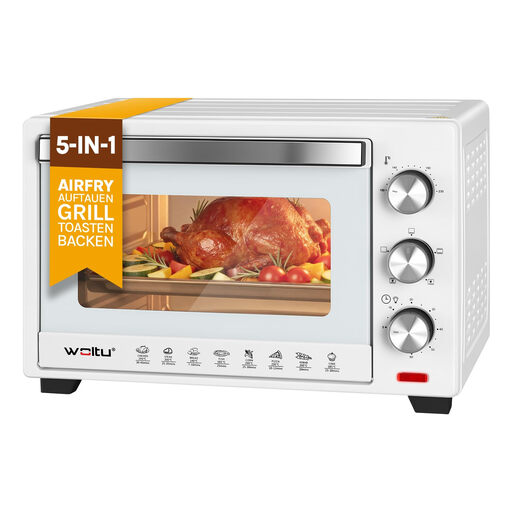
Woltu mini convection oven, 28 l
For smaller batches, if you’re looking for a freestanding oven rather than a built-in model and want to switch between different heating functions.
28 l; temperature control from 100 °C to 230 °C; top heat, bottom heat and combined heat; baking tray and wire rack; three adjustable shelf positions.
Joybuy
 No image available
HAUSWIRT C40 Smart Convection Oven
Consider this if you’re looking at a freestanding oven with a fan and several shelf positions.
35 l; 360-degree convection heating; four-level baking rack; built-in thermometer; LED display.
Joybuy
 No image available
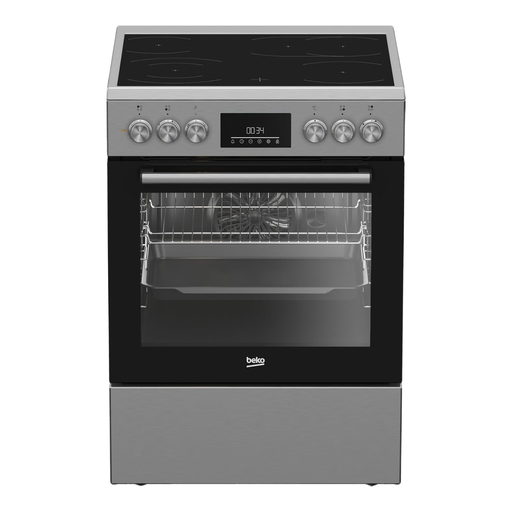
Beko FBM67320XS freestanding cooker
Consider this if you need a ceramic hob as well as a freestanding oven, and have enough space for both.
72 l oven; eight cooking functions, including hot air with a ring heating element; ceramic hob; dimensions 85 × 60 × 60 cm.
Joybuy
Frequently asked questions
Which heating function should I use for ginger biscuits?
Start with the instructions in your specific recipe. Dr. Oetker notes that a fan setting may be suitable for baking several trays, but switching from conventional heat does not work in the same way for every recipe. Check your oven’s settings too.
Can I put a mini oven in a tight-fitting shelf space?
Not just because its external dimensions fit. Before setting up the oven, check the operating instructions for the specific appliance to find out about its surroundings and required safety clearances.
Does every mini oven need an EU energy label for ovens?
No. The European Commission lists small and portable ovens as being outside the scope of this energy labelling scheme. For an oven that is covered, the label includes details such as capacity and energy consumption per standard cycle; this figure is not a measurement of the energy used for your biscuit recipe.
What does the CE marking on an electric oven mean?
For electrical equipment covered by the relevant EU product rules, the manufacturer uses the CE marking to declare that it meets the applicable requirements. It is not an independent test mark, so check the product information for the specific item you’re considering.
Who should I contact if my new oven has a fault?
As Verbraucherzentrale explains, the seller is generally your point of contact if a product is faulty. Any additional manufacturer’s guarantee is separate, voluntary and subject to its own terms and conditions.


