Batch bakers using several trays
If you’re preparing biscuits for several lunchboxes, look for a multi-level function explicitly approved for the specific model, as well as suitable baking trays.


For small batches and if you don’t have a suitable built-in space, a countertop oven is an obvious choice, provided its usable tray area suits your needs and the space available. If you often want to bake several trays at once, a built-in oven with an explicitly stated multi-level baking function may be suitable; a countertop oven is only suitable for this if simultaneous use is approved for that specific model. Choose the heating method to suit the recipe, and only compare energy figures on the same basis.
If you’re preparing biscuits for several lunchboxes, look for a multi-level function explicitly approved for the specific model, as well as suitable baking trays.
If you bake smaller quantities and don’t have a suitable built-in space, compare the usable tray area and installation requirements with the space available.
If you usually bake one batch at a time according to a recipe, the right heating method and temperature setting matter more than a multi-level function you won’t use.
| Buying priority | What to look for | Who is this especially important to? |
|---|---|---|
| Several trays in one batch | Check the approval for the specific model, suitable tray sizes and the requirements for fan-assisted cooking and air circulation. | If I’m preparing several lunchboxes, I want to limit the number of baking rounds and know which trays will fit at the same time. Around 36% of consumers put baking several trays at once first. |
| Counter space without a built-in space | Compare the external dimensions and installation instructions with the space available; internal and tray dimensions are more useful than the litre capacity alone when assessing baking area. | If there’s no built-in space and smaller quantities are enough for me, I need an appliance that fits on the available worktop. Around 29% of consumers prioritise having a suitable space for small batches. |
| Heating method to suit the recipe | Check whether conventional top-and-bottom heat and fan-assisted cooking are available, and whether you can set the required temperature. | If I’m baking a single batch from a recipe, I want to be able to choose its heating method and temperature setting. Around 21% of consumers prioritise the right heating method for single batches. |
| Energy use and cleaning | For appliances with an energy label, compare consumption per standard cycle for the same heating method; also check the cleaning function on the specific model. | If I bake regularly, I want to compare energy use on a like-for-like basis and take day-to-day cleaning into account. Around 14% of consumers put electricity use and cleaning effort first. |
The oven capacity and shelf positions alone don’t tell you how many biscuit trays a model can bake at the same time.
Check the instructions for the exact model number, approval for multi-level baking and the conditions that apply. Also check which suitable trays are included.
Depending on the usable tray area, you may need extra baking rounds or another suitable tray.
External dimensions and usable internal space are not the same. A built-in oven also requires a suitable installation space; work on electrical installations in Germany is subject to specific requirements.
Compare the model instructions, usable tray dimensions, installation dimensions and connection type with your kitchen. If work on the electrical installation is required, the Federal Network Agency sets out the applicable requirements under § 13 (2) NAV.
An unsuitable countertop or installation space could prevent you from using the oven as planned; any necessary connection work may involve additional costs or effort.
Watts measure power, while energy consumption is measured in kWh. Energy figures on the label are based on standard baking cycles, not directly on a particular quantity of biscuits.
Compare labelled appliances using the same consumption figure per cycle and heating method. The Verbraucherzentrale (consumer advice centre) and the Federal Environment Agency explain that these figures describe standardised cycles.
Countertop ovens for households without a suitable built-in space.
Built-in ovens for kitchens with a suitable installation space.
Built-in ovens for households with a suitable installation space.
Compact countertop ovens for small batches.
Countertop baking and toast ovens with a choice of heating methods.
These appliances are described as countertop ovens for smaller baking quantities and compact kitchens. Compare the temperature settings and stated accessories with your recipe and the space available.
 No image available
For smaller baking quantities in a compact kitchen; check the usable tray area and the space needed for the oven.
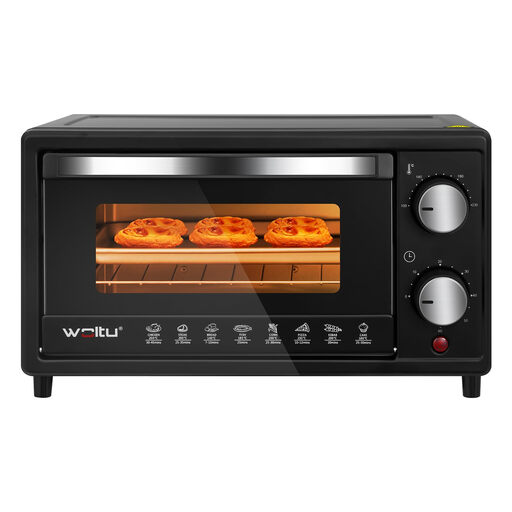 No image available
For a small batch when worktop space is limited; check that the tray size suits your recipe.
 No image available
For smaller baking quantities, with several heating modes listed; this doesn’t mean that simultaneous baking on several trays is approved.
Dr. Oetker’s ginger biscuit recipe recommends about 180 °C after preheating with conventional top and bottom heat, or about 160 °C with fan-assisted cooking. It gives a baking time of 10–12 minutes on the middle shelf; these settings apply to that particular recipe and aren’t general oven recommendations.
For ovens with an energy label, it shows, among other things, the oven capacity and consumption per standard cycle for the heating methods listed. Without details of your actual baking, you can’t use this information to work out a reliable cost for baking your ginger biscuits.
If connecting the oven requires work on the electrical installation, the Federal Network Agency states under § 13 (2) NAV that this work must be carried out by the network operator or an installation company registered in an installers’ register. Whether the chosen oven requires this work depends on its connection type and the existing installation.
The seller is responsible for the statutory guarantee. According to information from the European Union, goods purchased come with a minimum two-year period from the date of receipt; any additional manufacturer’s guarantee doesn’t replace these rights.
Electrical appliances must not be put in household waste. The Federal Environment Agency lists local collection points and retailer take-back options; when you buy a new appliance of the same type and size, it also describes free take-back of the old appliance for online purchases with delivery.