Gingerbread can occasionally be packed as a small sweet treat in your child’s lunchbox, but it shouldn’t replace their lunch. The Federal Centre for Nutrition recommends wholegrain foods, as well as fruit or vegetables, for snacks. Check the size of the piece, the nutritional information and the ingredients of the gingerbread you’re considering, especially if allergens are a concern.
Who should take extra care when choosing?
Families who need to check for allergens
If your child needs to avoid certain ingredients, check the labelling on the specific pack. The German Food Federation points out that cereals containing gluten and other allergens that must be declared should be identifiable in the ingredients list. The ingredients in gingerbread vary from product to product.
Families packing an occasional treat
A small piece of gingerbread should complement your child’s lunchbox, not replace bread, fruit or vegetables. The Federal Centre for Nutrition recommends wholegrain foods, as well as fruit or vegetables, as part of a packed lunch.
Shoppers comparing sugar content and portion sizes
When choosing between types of gingerbread, you can compare the nutritional information per 100 g with the weight of an individual piece. A claim such as “Less sugar” doesn’t replace either of these checks or a look at the ingredients.
What should you look for when buying?
When choosing gingerbread as a treat for your child’s packed lunch, three questions matter: can your child eat the ingredients, what role will the gingerbread play in their lunchbox, and how big is each piece?
| What to check |
What to look for when buying |
Who it matters to |
| Allergens and gluten |
Read the ingredients list and check the allergens highlighted on the specific pack; don’t assume that “no flour in the dough” means it’s gluten-free. |
If my child needs to avoid certain ingredients, I need clear labelling before I put the gingerbread in their lunchbox. Around 40% of shoppers make this their top priority. |
| Its role in the lunchbox |
Plan to include gingerbread as an occasional treat and put the rest of the packed lunch together separately. |
It’s important to me that a sweet treat doesn’t replace the main snack. Around 40% of shoppers put this question first. |
| Sugar and portion size |
Compare the sugar per 100 g, the weight of each piece and, where available, the nutritional information per portion. |
I want to know how big the piece I’m packing is, rather than judging it by the claims on the front of the pack. Around 20% of shoppers focus on this above all. |
Common mistakes when choosing
-
Packing gingerbread instead of lunch
A sweet baked treat doesn’t take the place of a balanced packed lunch. The Federal Centre for Nutrition recommends wholegrain foods, as well as fruit or vegetables.
If you do pack gingerbread, make it a small, occasional extra.
-
Assuming “Less sugar” means gluten-free
This claim refers to the sugar content and says nothing about whether the product contains cereals with gluten or other allergens. For “Elise Weniger Zucker”, Lebkuchen-Schmidt lists ingredients including wheat, nuts, egg and milk protein.
Check the sugar information and ingredients list separately. If gluten needs to be avoided, the labelling on the specific product is what matters.
-
Assuming every product from a brand is the same
Piece sizes and ingredients can vary between types of gingerbread. So an overview of a brand’s range won’t answer every question about the pack that ends up in your child’s lunchbox.
Before packing it, check the ingredients, allergen information, piece size and nutritional information for the product you’ve bought.
Gingerbread brands to consider
Lebkuchen-Schmidt
The manufacturer offers Elisen gingerbread, including the “Elise Weniger Zucker” variety.
- This variety gives you a specific product to use when checking the ingredients and nutritional information of an option labelled as having less sugar.
- Lebkuchen-Schmidt says it cannot offer gluten-free gingerbread. “Elise Weniger Zucker” contains ingredients including wheat, nuts, egg and milk protein.
Wicklein
The brand offers a seasonal range that includes wafer gingerbread and other varieties.
- Different pack and piece formats may be useful when comparing portion sizes.
- For ingredients, allergens and nutritional information, check the labelling on the specific variety you’ve chosen, rather than relying on a general description of the range.
Lambertz
Lambertz lists products including gingerbread bars and mini gingerbread.
- These formats give you a starting point for comparing the sizes of individual pieces.
- You can only tell whether a specific product is suitable for a lunchbox by checking its ingredients, nutritional information and portion sizes.
Gingerbread at Joybuy
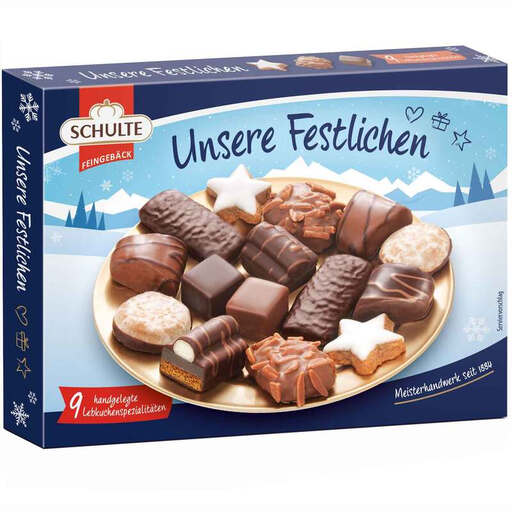
This product could work as an occasional sweet treat alongside a packed lunch put together separately. Before packing it, check the information on the specific pack, especially the ingredients and piece size.
 No image available
Schulte Our Festive, 250 g Bt
Enjoy as a sweet treat alongside a packed lunch, not as a replacement for the snack.
The product name gives the pack size as 250 g. Check the weight of each piece, along with the ingredients and nutritional information on the pack, to work out the portion you plan to include.
View at Joybuy
Frequently asked questions
Can gingerbread replace a school packed lunch?
No. Gingerbread is better as a small, occasional treat than as a snack in its own right. The Federal Centre for Nutrition recommends wholegrain foods, as well as fruit or vegetables, for a packed lunch.
How can I spot cereals containing gluten in gingerbread?
Check the ingredients list on the specific pack for cereals containing gluten, such as wheat or rye. The German Food Federation explains that allergens which must be declared are highlighted in the ingredients list.
Does “no flour in the dough” also mean gluten-free?
No. This wording alone doesn’t confirm that a product is gluten-free. Lebkuchen-Schmidt, for example, points out that the wafer used in some gingerbread can contain wheat starch with gluten. The labelling on the specific product is what matters.
What does “May contain traces of nuts” mean?
This warning describes the possibility of accidental contamination; it doesn’t mean that nuts have been used as an ingredient. But it doesn’t rule out their presence either. If your child has a relevant allergy, choose a product that meets their specific needs.


