Anyone buying for a small school group
You’d like to share a small treat around lunchtime. Whether a serving bowl or gift box is suitable depends on the recipients, how easy the contents are to share and the school’s rules.


For a secondary school lunch, gingerbread works as a small treat, not as a meal replacement. A gift box may be suitable for a member of staff or a small group of recipients; if you’re sharing it with a group, check that the contents can actually be divided up and read the labelling on the specific pack. Check for known allergies and the school’s rules in advance.
You’d like to share a small treat around lunchtime. Whether a serving bowl or gift box is suitable depends on the recipients, how easy the contents are to share and the school’s rules.
Check the labelling on the specific pack against any known allergies among the recipients. As well as cereals containing gluten, the gingerbread may contain tree nuts, egg, milk or soya, depending on the product.
You may want to look for the protected designation of origin. The European Office Nuremberg explains that Nuremberg gingerbread must be made in Nuremberg; the designation alone tells you nothing about the ingredients, allergens or whether it’s suitable for a group.
First decide who the gingerbread is for and how you’ll share it. Then check the pack labelling and the school’s rules before choosing between a gift box, a small assortment or a pack with a protected designation of origin.
| What matters | What to check before buying | Who it matters most to |
|---|---|---|
| Allergens and school rules | The ingredients and allergen information on the specific pack, plus the school’s rules on sharing food. | If I want to share gingerbread with pupils, I need to take known allergies and school guidelines into account. This is the top priority for around 42% of consumers. |
| Portioning and pack size | Net weight, the number of packs or pieces, and whether the items are individually wrapped. | If I’m buying for a small group, I want to know beforehand whether the contents can be shared out as planned. This is a priority for around 33% of consumers. |
| Origin and presentation as a gift | The “Nuremberg gingerbread” designation or presentation in a gift box; check allergens separately. | If the treat is for one person, I may care more about its origin or gift-ready packaging than about how easily it can be portioned. Around 25% of consumers make this their main consideration. |
Ingredients vary from product to product. The Federal Ministry of Agriculture, Food and Regional Identity highlights the requirement to declare the relevant allergens. In the gingerbread formats covered here, allergens other than cereals containing gluten may also be present.
Check the ingredients list and allergen information on the pack you actually buy against the recipients’ known requirements.
A box or serving bowl doesn’t tell you whether the items are individually wrapped or whether there are enough pieces for the group.
Decide who the recipients are before you buy, then check the contents, pack sizes and rules on handing out unwrapped food.
If there aren’t enough pieces in the pack, you may need to buy another one.
A sweet gift pack serves a different purpose from a school meal. School + Essen’s practical guidance on snacks includes fruit and vegetables, among other things.
Plan to give the gingerbread as a treat alongside or after lunch, and check with the school before sharing it.
Availability can vary by retailer and time of year. EDEKA notes that one of the products covered may not be available in every store.
Check the specific store or delivery date in good time, and read the labelling on the pack you receive.
This specialist retailer sells gingerbread packs and formats specifically designed as gifts.
The retail formats covered include smaller gingerbread assortments for shopping in store.
The seasonal mini Elisen gingerbread products covered come in compact packs, rather than gift boxes specifically marketed as such.
This 250 g pack could work as a small gingerbread treat. Check the packaging to see whether the contents can be shared individually with your intended group.
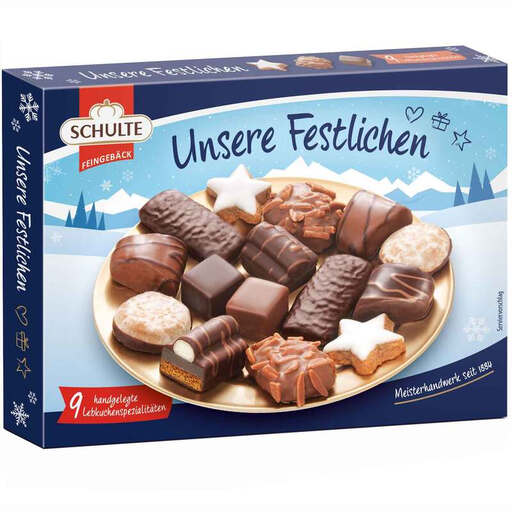 No image available
This pack could make a small treat to share around school lunchtime, provided the contents and how they’re distributed suit the group.
Pack size: 250 g. Check the pack you receive for allergens, as well as the number of pieces and how they’re packaged.
Check the food name and ingredients list on the specific pack for any cereals listed. The Federal Ministry of Agriculture, Food and Regional Identity explains the requirement to declare allergens; the EDEKA and Lebkuchen-Schmidt examples covered here list wheat or cereals containing gluten.
Check with the school beforehand and take any known allergies into account. If food is served by a school kitchen or caterer, the Consumer Advice Centre says they must provide information about the 14 main allergens.
No. The designation of origin doesn’t tell you whether it’s suitable for someone with a particular intolerance or allergy. According to the European Office Nuremberg, the protected designation means it must be made in Nuremberg; you’ll still need to check the ingredients and allergens on the individual pack.
Check that the pack you want will be available in time and that its actual labelling is suitable for the recipients. EDEKA notes that one of the items covered may not be available in every store; seasonal ALDI SÜD products may also vary in availability depending on the date and branch.