Who is this guide for?

Families managing gluten or allergen requirements

If your child needs to avoid wheat or other ingredients, check the label on the specific gingerbread product. The varieties described here may contain wheat, nuts, egg and milk, among other ingredients. Precautionary ‘may contain’ statements can also be important when choosing.

Families who occasionally pack a sweet treat

You may want to include gingerbread as an occasional treat, without letting it replace the rest of the packed lunch. The consumer advice centre recommends not making pastries a regular lunchbox item.

Shoppers comparing reduced-sugar options

You’re looking at the sugar content per 100 g and per piece. A claim such as ‘30% less sugar’ refers to a comparison product or reference recipe; ingredients and portion size are separate factors to consider when buying.

What should you look for when buying?

First, check whether any ingredients need to be avoided. Then compare sugar content and piece sizes to find a suitable portion for an occasional treat.

What matters What to check Who it matters to
Gluten and allergens Check the current ingredients list, highlighted allergens and precautionary statements. If a gluten-free diet is required, look for an explicit gluten-free label. If my child needs to avoid certain ingredients, I don’t want to rely on the name ‘Elisen gingerbread’ alone. For around 38% of shoppers, checking allergens is a top priority.
Sugar and portion size Compare sugar per 100 g and, where stated, per piece, as well as the weight of each piece. For an occasional sweet treat, I want to pack a single portion and be able to assess its sugar content. This is a top priority for around 38% of shoppers.
An occasional treat Consider the size of each piece and the packaging, so you can pack a small portion separately in the lunchbox. If gingerbread is included as a seasonal change, it should remain separate from the rest of the packed lunch. This is the main consideration for around 24% of shoppers when choosing.

Common selection mistakes

  • Assuming ‘low in flour’ means gluten-free

    The name of the dough alone doesn’t tell you whether a gingerbread product is suitable for someone who needs to follow a gluten-free diet. Lebkuchen-Schmidt says it does not offer gluten-free gingerbread.

    Check the ingredients for the specific variety. If a gluten-free option is required, choose only a product that is explicitly labelled as gluten-free.

  • Treating ‘less sugar’ as a substitute for choosing a portion

    The reduced-sugar varieties described by Lebkuchen-Schmidt and Wicklein are still pastries and may contain ingredients such as wheat, nuts, milk or egg, depending on the product.

    Compare the sugar content for the portion you actually plan to pack, and check the allergens separately from the sugar claim.

  • Only reading the front of the pack

    Glazed, chocolate-coated and reduced-sugar varieties can have different ingredients and nutritional values. Manufacturers also point out that product information can change.

    Before packing, check the current ingredients list, nutritional information and best-before date on the specific pack.

  • Choosing loose gingerbread without allergen information

    Gingerbread bought loose from a counter won’t have an individual pack’s ingredients list. According to the consumer advice centre, allergen information must also be provided for loose foods and meals served in communal catering settings.

    Ask for allergen information before buying. If certain ingredients need to be avoided, make sure the information clearly relates to the product on offer.

Brands to consider

Lebkuchen-Schmidt

The manufacturer offers Elisen gingerbread, including the ‘Elise Less Sugar’ variety.

  • According to Lebkuchen-Schmidt, ‘Elise Less Sugar’ contains 30% less sugar than the reference recipe. The manufacturer states that each piece, weighing around 56 g, contains 13,8 g of sugar.
  • For allergy-aware choices, ingredients including wheat, nuts, egg and milk should be considered. Lebkuchen-Schmidt says it does not offer gluten-free gingerbread; always check the label on the current pack.

Wicklein

The ‘Meisterstücke’ range includes an assortment of gingerbread with a ‘30% less sugar’ claim.

  • Wicklein states that this gingerbread assortment contains 23,3 g of sugar per 100 g.
  • According to the manufacturer, this variety contains wheat flour, wheat protein, butter and milk chocolate. It may contain traces of tree nuts, egg, sesame and soya; check the pack before buying.

Gingerbread for an occasional treat

This gingerbread range could be considered as an occasional sweet treat, packed separately alongside the rest of the lunch. Whether it meets specific allergen requirements depends on the information on the pack.
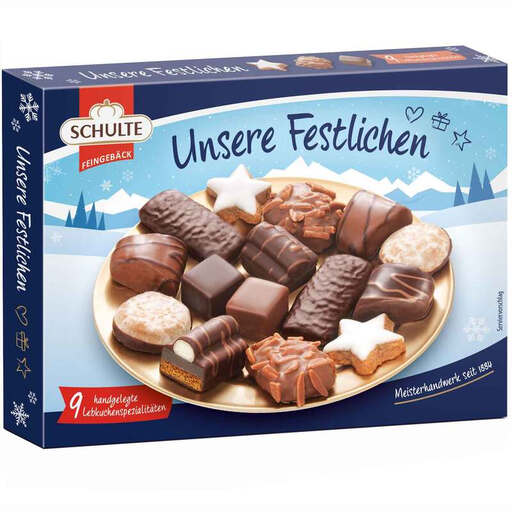
Schulte Our Festive, 250 g Bt

Schulte Our Festive, 250 g Bt

Consider it as an occasional lunchbox treat if the ingredients meet your requirements.

Pack information: 250 g Bt. Set aside a single portion for the lunchbox and check the current ingredients and allergen information.

View at Joybuy

Frequently asked questions

Is gingerbread suitable for a daily packed lunch?

No. Gingerbread is not a substitute for a regular packed lunch. The consumer advice centre does not recommend pastries as a regular lunchbox item. If you do include some, keep it to a small, occasional treat alongside the rest of the meal.

Is Elisen gingerbread with little flour gluten-free?

Not simply because it contains little flour. Lebkuchen-Schmidt says it does not offer gluten-free gingerbread. If a gluten-free diet is required, check for an explicit gluten-free label and review the ingredients of the specific product.

What does ‘30% less sugar’ mean on gingerbread?

It means the product contains less sugar than a comparison product or reference recipe; it doesn’t mean it’s suitable as a daily lunchbox snack. Also compare the sugar content for the portion you plan to pack and check the ingredients.

How do I check allergens in packaged and loose gingerbread?

For packaged gingerbread, start with the current ingredients label. For loose products, ask for allergen information about the item on offer. EU Regulation (EU) No 1169/2011 on the provision of food information to consumers covers the declaration of allergenic ingredients listed in Annex II. According to the consumer advice centre, the requirement to provide allergen information has also applied to loose foods and meals served in communal catering settings since December 2014.