
Lieferung heute & morgen

Qualitätsgarantie

Willkommens-Angebote freischalten: KOSTENLOSE Lieferung | Bis zu 80 % RABATT | Kostenlose 30-Tage-JoyPlus-Testphase
App herunterladen
A glass ceramic hob combines a smooth surface with electrically heated cooking zones. This makes cleaning straightforward and allows precise control. At the same time, unclear installation dimensions, confusing power ratings and missing safety features often lead to unsuitable purchases.
Before choosing a ceramic hob, you should therefore look beyond its appearance. The available space, electrical installation, size of your pans and the features you genuinely need in everyday use are all important factors.
The appliance width alone says little about installation. For example, a 60 cm hob may have external dimensions of around 59 × 52 cm and require a cut-out measuring 56 × 49 cm. Other models are considerably more compact.
Before buying, measure:
The total power is distributed across several cooking zones. If all zones are used at the same time, the appliance may limit the power depending on its design. In addition, a higher connected load places greater demands on the electrical connection.
For a small kitchen or single-person household, a 2-zone glass ceramic hob may be sufficient. Families and people who use several pans at the same time are more likely to benefit from a 4-zone glass ceramic hob.
Glass ceramic surfaces can usually be wiped clean with a damp cloth. However, burnt-on food should not be removed with knives, abrasive sponges or aggressive cleaning products, as these can cause scratches.
A suitable glass ceramic hob scraper uses a flat blade. The surface should have cooled down, and the scraper must be held at a shallow angle. Heavy soiling should first be softened by soaking.
For a built-in electric hob, the cut-out dimensions are binding. According to the product data, the TOPWISH 2-zone model measures 29 × 52 × 5.2 cm and requires a cut-out of 26 × 49 cm. It is described as having a European round plug.
According to the specifications, the 4-zone model measures 59 × 52 × 5.2 cm and requires a cut-out of 56 × 49 cm. The product information specifies no plug; the connection cable is wired directly. In Germany, such work must be carried out by a qualified electrical contractor.
Do not just consider the number of zones; their diameters are also important. The 2-zone model has one zone measuring 165 mm and 1,200 W, plus one measuring 200 mm and 1,800 W. Nine power levels allow for precise adjustment.
The 4-zone model has differently configured zones and, according to the product description, a total power output of 6,600 W. A further technical data field states a total power output of 6,000 W. These conflicting figures should be clarified with the seller before purchase and installation.
A hob with touch controls does not require protruding rotary knobs and is easier to wipe clean once it has cooled down. For households with children, a child lock and automatic switch-off are important.
Other useful features include:
A timer does not replace supervision while cooking, however. The residual heat indicator only shows that a zone may still be hot; it is not a signal that the surface is safe to touch immediately.
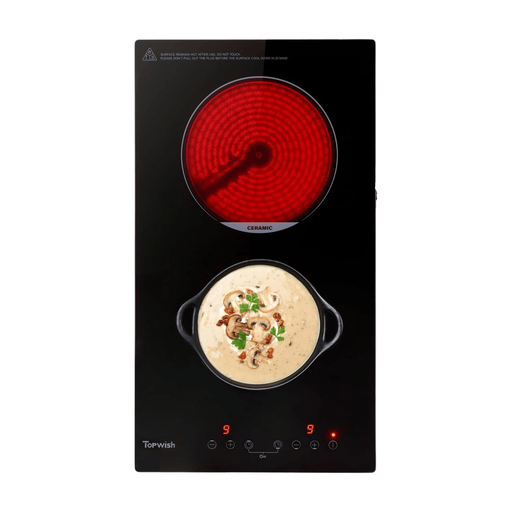
Why this product suits the profile: This compact model is designed for smaller kitchens, single-person households or as an additional cooking station. Two zones allow simple dishes to be prepared at the same time.
The dimensions and cut-out size are clearly specified. The product also lists a child lock, residual heat indicator, overheating protection and a timer ranging from 1 to 90 minutes.
Two cooking zones, nine power levels, 3,000 W total power and touch controls in a compact format.
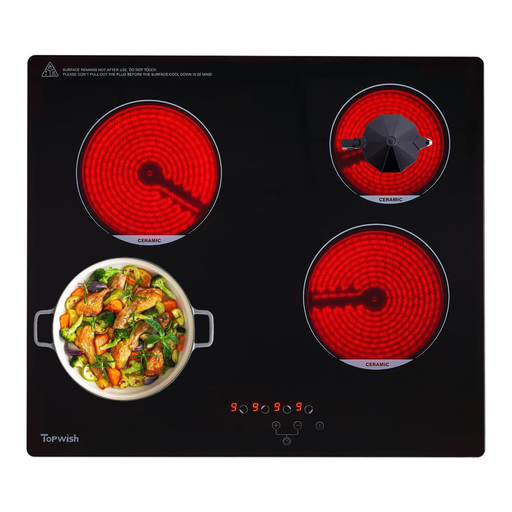
Why this product suits the profile: Four cooking zones and differently sized heating areas are ideal for families and households where several pans are used at the same time.
The installation dimensions, nine power levels and safety features are specified. Before buying, direct connection should be arranged with a qualified electrical contractor.
Four zones, a timer of up to 99 minutes, child lock, residual heat indicator and overheating protection.
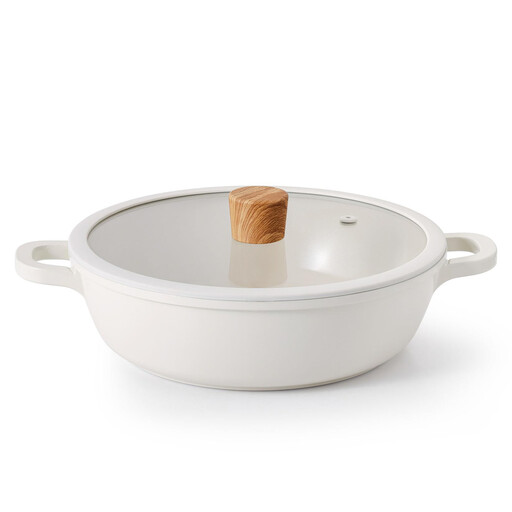
Why this product suits the profile: This versatile ceramic pot is a good choice for households looking for one vessel for braised dishes, stews, pan-fried dishes and various types of hob.
Compatibility with ceramic, electric, gas, halogen and induction hobs is specified. The silicone handle cover must be removed while the pot is being heated.
28 cm diameter, glass lid, ceramic non-stick coating and dishwasher-safe cleaning according to the product information.
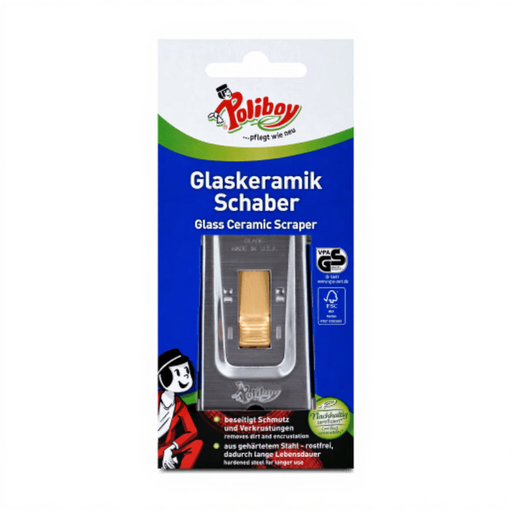
Why this product suits the profile: This scraper complements a glass ceramic hob when burnt-on food or dried-on splashes of grease need to be removed.
The flat design is intended for removing stubborn residue from glass and ceramic surfaces. Before use, the blade should be clean and undamaged.
Hardened stainless-steel blade and versatile use on hard surfaces according to the product description.
A ceramic hob heats the base of the pot through the heating element beneath it. A special induction-compatible pot is therefore not required. What matters instead is:
A ceramic non-stick pot can be practical for delicate foods. Use suitable kitchen utensils and avoid metal turners, abrasive cleaners and metal scourers if the manufacturer advises against them. A non-stick coating is a material feature, but does not indicate any particular health or therapeutic effect.
We have put together a complete, regularly updated list of products that fully meet these strict selection criteria and the safety regulations applicable in the EU.
Pots and pans with a smooth, flat base are suitable. An induction-compatible pot will generally also work on a conventional glass ceramic hob, but it is not essential. The key factors are the right diameter and a clean base.
This depends on the model. Appliances with a plug may be suitable for the intended connection, depending on the manufacturer’s specifications. A permanently wired 4-zone hob with a high total power output must be installed by a qualified electrical contractor. The voltage, connection type and cut-out dimensions should be checked before buying.
There is no single fixed lifespan that applies in every case. It depends, among other things, on daily use, installation, care and how the glass surface is handled. Avoid sliding heavy pots across the surface, strong impacts and abrasive cleaning products. A hob scraper should only be used carefully and with an intact blade.