
Lieferung heute & morgen

Qualitätsgarantie

Willkommens-Angebote freischalten: KOSTENLOSE Lieferung | Bis zu 80 % RABATT | Kostenlose 30-Tage-JoyPlus-Testphase
App herunterladen
A 1.7 l 2200 W glass kettle is ideal for households where several cups of tea, coffee or hot water for soups are needed regularly. Depending on the cup size, the capacity is usually enough for several servings, while power of up to 2200 W enables short heating times. However, it is worth taking a close look at the technical specifications before buying. A transparent jug and blue lighting alone say little about ease of use, safety or cleaning requirements.
2200 W indicates a high power rating, but does not guarantee the same heating time for every model. The amount of water, starting temperature, heating plate design and switch-off point also affect the process. For everyday use, a fast 2200 W kettle is a sensible choice if it also has clear minimum and maximum markings and a concealed heating element.
A kettle with LED lighting primarily indicates that the appliance is switched on. Blue lighting is not a substitute for a temperature display or temperature control. If you prepare different types of tea, check whether the kettle actually offers preset temperatures or simply has a visual operating indicator.
A cordless kettle normally has a removable jug and a separate powered base with a mains cable. The jug itself is not charged. A 360-degree base makes it easier to place the jug on the base from different directions, but does not remove the need for a dry, stable surface. Before buying, you should also check the cable length and whether the cable can be stored neatly.
1.7 l is practical for families, shared houses and regular visitors. For a single cup, however, this size may heat unnecessarily large amounts of water. A clearly readable water-level indicator with a minimum fill level is essential. If you regularly fill the kettle with more water than you need, heating times and electricity consumption will increase.
The specification 1850–2200 W is common among several available models. In German households, the appliance must be designed for 220–240 V at 50/60 Hz. A 2200 W kettle should be operated directly from a suitable socket. Extension leads or multi-socket adaptors may be problematic when handling high power loads.
A borosilicate glass kettle gives you a clear view of the water level and boiling process. Borosilicate glass is used because of its resistance to temperature changes; nevertheless, glass remains vulnerable to impact. Before ordering, check the information provided about cracks, the handle, lid and heating plate.
The materials used for direct contact with water are also relevant. Several models specify stainless-steel heating plates, stainless-steel filters and plastic components described as being in a BPA-free kettle. BPA-free refers to the manufacturer's material specification and should not be understood as a general statement about every component of the product. After buying, check the instructions for use and the labelling on the appliance.
A kettle with an automatic switch-off stops heating when the intended boiling point is reached. A kettle with boil-dry protection switches off when there is too little or no water. These functions reduce the risk of damage, but do not replace safe operation.
Useful features include:
Limescale can affect heating performance and the taste of the water. Regular descaling is particularly important in areas with hard tap water. The jug, base and connection points must not be immersed in water. A glass model should also not be placed in a microwave, oven or dishwasher unless the manufacturer expressly permits it.
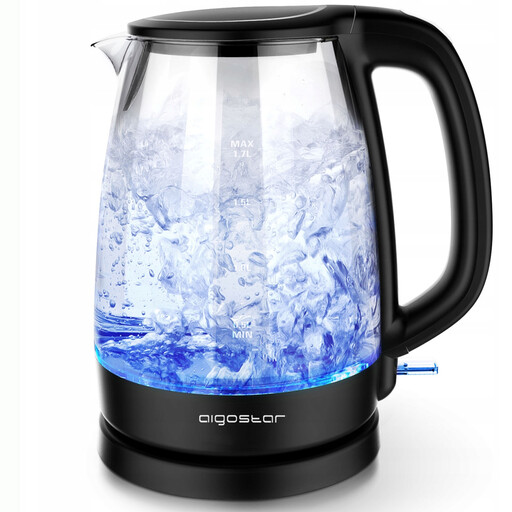
Why this product suits this profile: This model combines a 1.7 l capacity with 1850–2200 W, blue interior lighting and a removable base for everyday use.
The LED indicator is specified as an operating light and is not confused with temperature control. Automatic switch-off and boil-dry protection are listed separately.
Borosilicate glass, SUS304 heating plate, 360-degree base and BPA-free specification according to the product description.
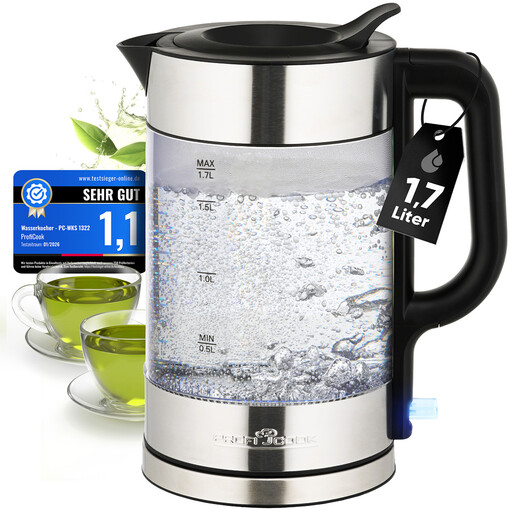
Why this product suits this profile: The glass and stainless-steel body, one-handed operation and cable storage appeal to buyers who value a well-organised kitchen routine.
The specifications mention automatic and manual switch-off, boil-dry and overheating protection, as well as a water-level indicator.
Concealed stainless-steel heating element, 360-degree power connection and illuminated safety glass jug.
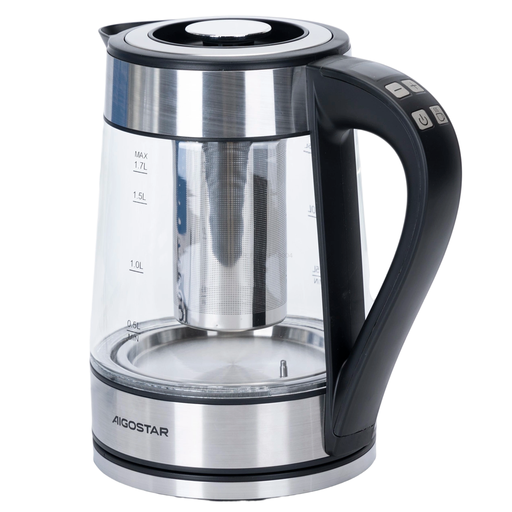
Why this product suits this profile: Tea drinkers and frequent users will appreciate the 13 temperature settings, keep-warm function and digital display.
Temperature selection is explicitly separate from the LED operating indicator. The removable filter can be taken out for cleaning.
13 temperature settings, one-touch keep-warm function, temperature display and tea infuser according to the product data.
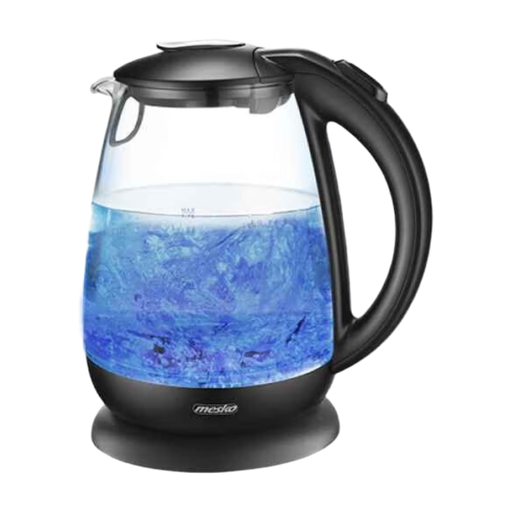
Why this product suits this profile: The combination of 1.7 l, 2200 W, a limescale filter and a 360-degree base is designed for preparing several cups in the household.
Minimum and maximum fill levels are specified. Automatic switch-off and boil-dry protection address common operating errors.
Concealed heating element, anti-limescale filter, cable storage and visible water-level indicator.
We have put together a complete, regularly updated list of products that fully meet these strict selection criteria and the safety regulations applicable in the EU.
2200 W corresponds to a power rating of 2.2 kW. If the appliance is operated for ten minutes, for example, this equates to approximately 0.37 kWh in theory. Actual consumption depends on the amount of water, starting temperature and heating time. If you only need one cup, fill the kettle with only the required amount, up to the minimum marking.
There is no one-size-fits-all answer regarding service life. Regular descaling, placing the kettle down carefully and observing the fill levels can help to extend its useful life. If there are visible cracks in the glass, a damaged cable or a faulty base, the appliance should no longer be used. Safety features such as automatic switch-off and boil-dry protection are important, but they cannot prevent wear caused by improper use.
That depends on the opening, filter and heating plate. A wide opening makes rinsing easier, while a removable limescale filter can be cleaned separately. Limescale deposits should be removed with a descaler suitable for kettles, in accordance with the instructions for use. Any cleaning product residue must then be rinsed off thoroughly.