
Lieferung heute & morgen

Qualitätsgarantie

Willkommens-Angebote freischalten: KOSTENLOSE Lieferung | Bis zu 80 % RABATT | Kostenlose 30-Tage-JoyPlus-Testphase
App herunterladen
A glass kettle is often more than just a kitchen appliance—it's a design statement. The ability to watch the water boil, combined with elegant LED lighting, makes it a centrepiece. However, behind the appealing aesthetics often lie pitfalls that can lead to an unsatisfactory purchase. As your Joybuy Product Recommendation Officer, I'll help you identify the crucial features and distinguish marketing hype from genuine quality.
Many buyers focus on two aspects: appearance and price. This frequently leads to three avoidable disappointments:
To avoid a bad purchase, you should focus on three objective criteria that determine the longevity and functionality of your appliance.
The heart of any glass kettle is its glass body. Look for the specification borosilicate glass. This material is not only extremely heat-resistant and resilient to thermal shock but also taste-neutral. It does not release any chemical substances into the water.
Equally important are the base plate and the heating element. A combination of glass and stainless steel is the standard for durable kettles. A concealed stainless steel heating element (often marked as SUS304 or 18/10) prevents direct contact with the water, simplifies cleaning, and minimises limescale build-up on the element itself. Also, check that all plastic parts that come into contact with water are explicitly designated as BPA-free.
A kettle's power is measured in watts (W) and determines how quickly the water boils. Models with 1850–2200 watts are a good benchmark for rapid heating without excessively burdening your electricity bill.
The capacity should suit your household. A 1.7L kettle is the most common size and is ideal for families or if you regularly prepare multiple cups of tea or coffee. For single-person households, offices, or travel, a more compact model from 0.6L to 1.0L may be more practical.
If you need more than just boiling water, a glass tea kettle with precise temperature selection is a worthwhile investment. Look for models with digital displays and clearly defined temperature levels (e.g., 40°C, 70°C, 80°C, 90°C). A keep-warm function can also be useful.
Indispensable safety features include boil-dry and overheat protection, as well as an automatic shut-off function. A 360° base, which allows for cordless lifting and placement of the jug, is standard today and significantly enhances user convenience.
Here are some models that are suitable for different user profiles based on their objective features.
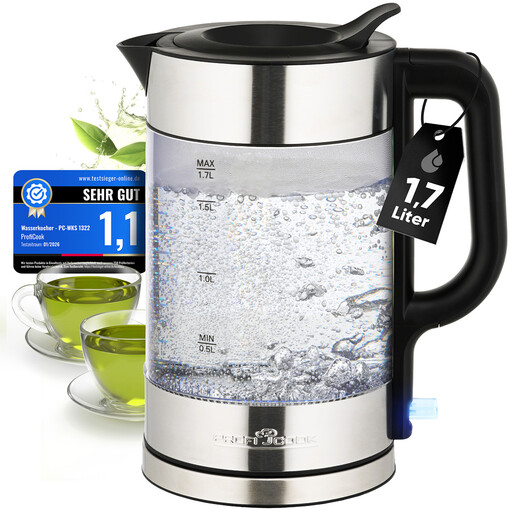
Why This Fits Their Persona: Ideal for anyone looking for a reliable, safe, and straightforward appliance for daily use. It focuses on essential functions without costly extras.
This model avoids complex temperature settings and focuses on a solid material base of heat-resistant safety glass and stainless steel. The BPA-free construction and one-handed operation are practical features, not just marketing points.
1.7-litre capacity and 2200-watt power for rapidly boiling large quantities. The self-closing filling opening in the lid adds to the convenience.
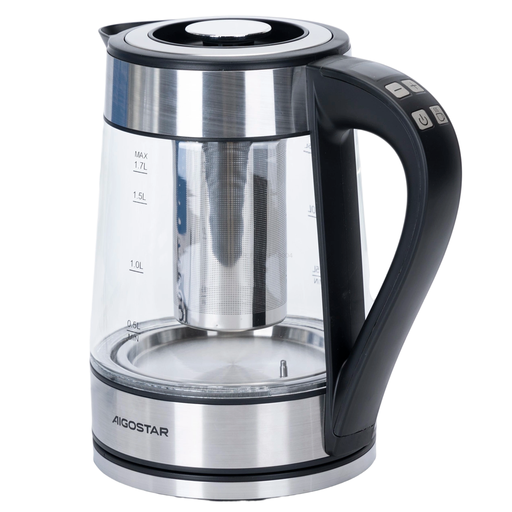
Why This Fits Their Persona: Perfect for users who value precise water temperatures for different types of tea, coffee, or baby formula, and appreciate additional features like a keep-warm function.
This model bypasses the trap of inaccurate settings with a 13-level temperature control and a digital display showing the current temperature. The memory function provides added convenience instead of just advertising with colourful lights.
Precise temperature control with a digital display and a keep-warm function. The removable tea filter makes it a versatile tea maker.
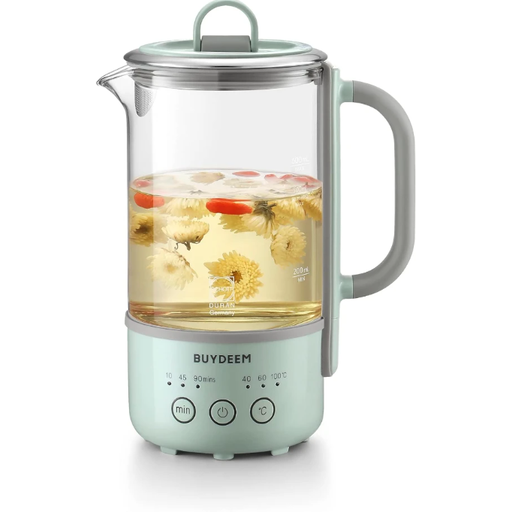
Why This Fits Their Persona: For those who refuse to compromise on style and quality, even on the go, in the office, or in a dorm. Its compact design and premium materials make it the ideal companion.
Instead of focusing on volume, this model prioritises class. It uses demonstrably high-quality materials like Schott Duran glass and 18/10 stainless steel. The iF DESIGN AWARD 2020-winning design is functional, not just a gimmick.
Compact 0.6L format and very lightweight, ideal for travel. The use of Schott Duran glass and an 8-hour keep-warm function set it apart from standard travel kettles.
We've compiled a complete, up-to-date list of products that fully meet these strict selection criteria and rigorous safety regulations.
Cleaning is easier than often assumed. Fill the kettle with a mixture of water and household vinegar (1:1 ratio) or a special descaling solution. Let the mixture sit for about an hour (do not boil, unless recommended by the manufacturer). Then, pour out the liquid and rinse the kettle thoroughly with clean water several times. Repeat the process for stubborn deposits.
Modern glass kettles use borosilicate glass, which is very robust and heat-resistant. It is more resistant to sudden temperature changes than normal glass. However, it is not as impact-resistant as stainless steel. With normal kitchen use, the risk is low. Avoid dropping the appliance or hitting it with hard objects.
Look for a digital display that shows not only the target temperature but also the current water temperature. This gives you more control. Check if the temperature levels are suitable for your needs (e.g., 40°C for baby formula, 70-80°C for green tea, 90°C for coffee). A memory function that remembers the last setting can further enhance user convenience.