
Lieferung heute & morgen

Qualitätsgarantie

Willkommens-Angebote freischalten: KOSTENLOSE Lieferung | Bis zu 80 % RABATT | Kostenlose 30-Tage-JoyPlus-Testphase
App herunterladen
A glass kettle combines a visible boiling process with a modern look. For households, families, tea drinkers and coffee lovers, models holding around 1.0 to 1.7 litres are particularly practical. However, everyday usability depends on more than the glass design alone. Heating power, minimum fill level, lid construction and safety features all affect how convenient the appliance remains over time.
A cordless kettle usually sits on a separate base. The kettle itself can be lifted and poured without a cable attached, but it still needs a mains socket for heating. A 360-degree base makes it easier to position for both right- and left-handed users. Anyone expecting a completely portable kettle could therefore be disappointed by this description.
A 2200-watt kettle can heat water quickly, provided the heating plate, water quantity and design are sensibly matched. However, a large 1.7-litre model is not automatically more efficient for a single cup. If you regularly only need a small amount of water, pay attention to the minimum fill level. Boiling more water than necessary wastes time and energy.
A glass container makes limescale deposits and the water level easy to see. At the same time, marks and limescale are much more noticeable. Models with a concealed heating element are generally easier to clean than appliances with an exposed coil. The body should also be protected from sudden temperature changes: hot glass should not come into direct contact with cold water or a cold surface.
A 1.7-litre kettle is suitable for making several cups of tea or coffee, or preparing instant meals, in one go. This size is a sensible choice for families and shared breakfasts. Compact 1.0-litre models take up less space and are better suited to small kitchens or offices.
The minimum fill marking is also important. It shows how much water must be added at least to ensure that the heating surface is safely covered. Do not exceed the MAX marking, as boiling water could overflow or splash out when poured.
For use in a German household, the appliance should be designed for 220–240 volts at 50/60 hertz. Power ratings of 1850 to 2200 watts are common for conventional models. A concealed stainless-steel heating element makes cleaning easier and prevents limescale from building up directly on a visible coil.
Different priorities apply to multifunction appliances. According to its product description, the IAGREAA glass kettle operates at 800 watts and offers temperature settings as well as various preset programmes. It is therefore intended more for controlled heating and specialised preparation than for bringing large quantities of water to the boil particularly quickly.
A glass and stainless-steel kettle combines a transparent container with a stainless-steel heating plate or stainless-steel components. Borosilicate glass is often used for its resistance to temperature changes; nevertheless, always follow the manufacturer’s guidance regarding impacts and sudden changes in temperature.
When choosing a BPA-free kettle, the product information should state this explicitly. BPA-free does not mean that every component is made from glass or stainless steel. Handles, lids and base components may still contain plastic.
Look out for the following features when buying:
LED lighting primarily serves as an operating indicator and design feature. On many appliances, blue lighting shows that the heating process is under way. It does not replace automatic switch-off and should therefore not be regarded as a safety feature.
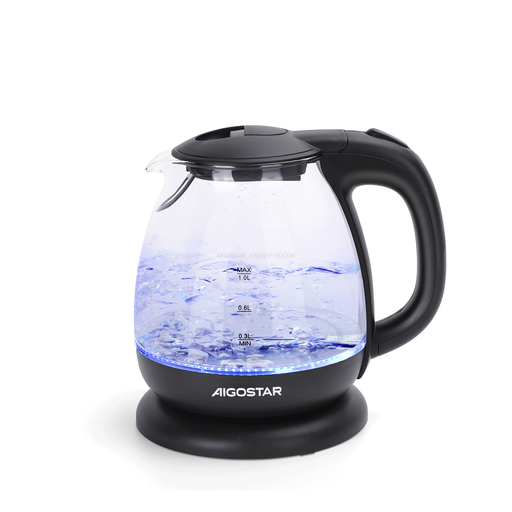
Why this product suits the profile: The compact 1.0-litre capacity is suitable for smaller households, individuals and kitchens with limited worktop space.
The product description lists 1850–2200 watts, automatic switch-off and boil-dry protection. The blue LED indicates the heating process without being promoted as the sole safety feature.
1.0-litre capacity, 360-degree base and BPA-free construction according to the product information.
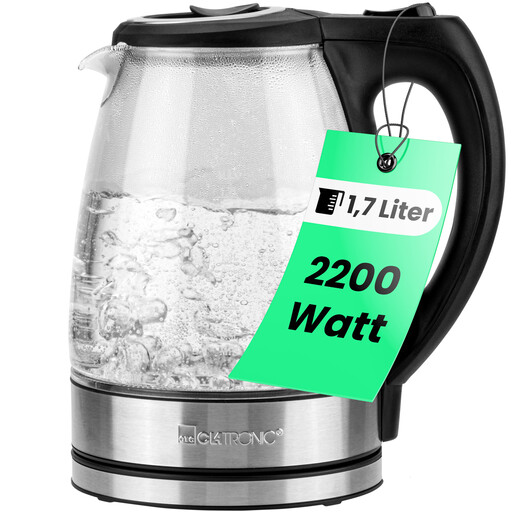
Why this product suits the profile: The combination of safety glass, a stainless-steel body and a large capacity is designed for households with regular demand.
The product description lists a water-level indicator, automatic and manual switch-off, as well as boil-dry and overheating protection.
1.7 litres, 1850–2200 watts, 360-degree plug connection and concealed stainless-steel heating element.
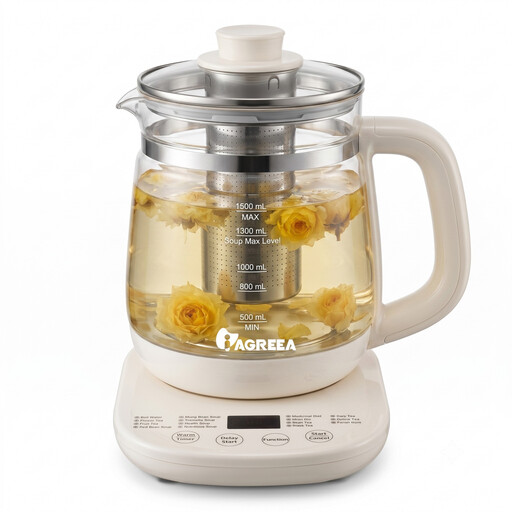
Why this product suits the profile: The 1.5-litre jug with temperature selection and a tea strainer is designed for users who need more than simply boiling water.
The lower 800-watt power rating is complemented by temperature levels, a keep-warm function and various programmes. This makes its intended use clearer than that of a dedicated rapid-boil kettle.
Borosilicate glass, removable stainless-steel strainer and six temperature settings from 40 to 90 °C according to the product description.
We have put together a complete, regularly updated list of products that fully meet these strict selection criteria and the safety regulations applicable in the EU.
Before using the kettle for the first time, rinse it, boil a full amount of water once and then empty it. Follow these simple rules when operating the appliance:
The appliance’s service life depends, among other things, on water hardness, descaling intervals and how the glass container is handled. More frequent descaling may be necessary in areas with hard water. A filter in the spout reduces limescale particles, but it does not replace cleaning the heating surface.
Add as much as you need, but at least enough to reach the MIN marking. For individual cups, a 1.0-litre model is often more convenient. A 1.7-litre kettle makes sense if you regularly need to serve several people.
No. Wattage primarily indicates the maximum power consumption and affects the heating time. Electricity usage depends mainly on the quantity of water and how often the kettle is used. If you are only making one cup, fill it with only that amount.
There is no universal service-life figure. Regular descaling, careful pouring and following the MIN and MAX markings can help prolong its use. If the glass is damaged, the cable is faulty or the automatic switch-off is not working, stop using the appliance for safety reasons.