
Lieferung heute & morgen

Qualitätsgarantie

Willkommens-Angebote freischalten: KOSTENLOSE Lieferung | Bis zu 80 % RABATT | Kostenlose 30-Tage-JoyPlus-Testphase
App herunterladen
A glass kettle with temperature control is more than just a kitchen appliance—it's a precision instrument for the perfect tea, aromatic coffee, or the safe preparation of baby formula. However, the market is flooded with models whose promises often don't match reality. Inaccurate temperature readings or low-quality materials can not only spoil your enjoyment but also pose a safety risk.
As your Joybuy Product Recommendation Officer, I'm here to help you navigate the common pitfalls. This guide will show you what to look for to find a model that is precise, safe, and built to last.
Many buyers regret their decision because they fall for common marketing traps. Pay close attention to these three points to avoid a poor investment:
To avoid the problems mentioned above, you should check three core parameters before buying. These define the quality and functionality of your future kettle.
The material is crucial for safety and taste. Look for a body made of borosilicate glass. Unlike normal glass, it is extremely heat-resistant and impervious to sudden temperature changes. This minimises the risk of cracks or fractures. Furthermore, verify that all parts that come into contact with water (the inner lid, spout, filter) are made of either stainless steel or plastic certified as BPA-free. This ensures that no harmful chemicals get into your water.
A good tea kettle with temperature control offers more than just a "hot" setting. Look for models with clearly defined temperature levels, ideally in 10°C increments or even adjustable to the exact degree. A reliable 40-degree kettle setting is particularly important for preparing baby formula. An integrated kettle with a keep-warm function is also highly beneficial. It maintains the water at the desired temperature for an extended period, saving energy and time by eliminating the need to re-boil.
The capacity should suit your household. A 1.7L glass kettle is a common size and ideal for families or for when you frequently entertain guests. For single-person households or the office, a smaller model with 1.2 to 1.3 litres may suffice. The power, specified in watts, determines how quickly the water heats up. Appliances with 1800–2200 watts bring water to a boil significantly faster than lower-wattage models.
Based on the criteria above, we have identified models that are well-suited for different user profiles.
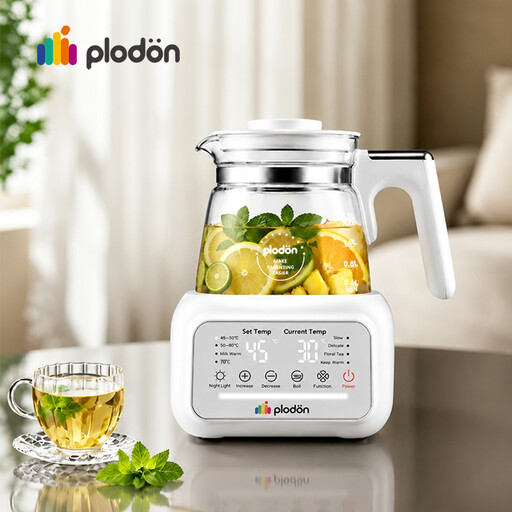
Why This Fits Their Persona: This model is tailored to the needs of parents. It offers precise temperature settings for baby formula, a long keep-warm function for nighttime bottle preparation, and a borosilicate glass body that ensures the purity of the water.
Special presets like "Milk Warming" bypass the trap of inaccurate temperature controls. The thickened borosilicate glass and BPA-free design solve the problem of hidden plastics.
The keep-warm function of up to 72 hours and the integrated dechlorination feature offer significant practical value for health-conscious households.
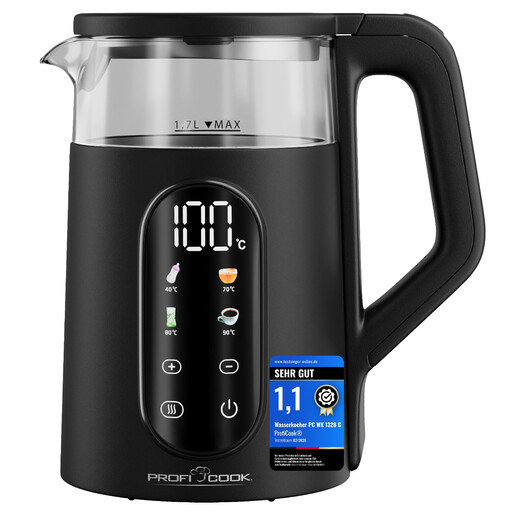
Why This Fits Their Persona: With its wide temperature range from 40°C to 100°C, high power of 2200 watts, and large 1.7-litre capacity, the ProfiCook kettle offers the ideal combination for discerning tea and coffee drinkers who value speed and flexibility.
The sensor-touch operation with a real-time temperature display ensures maximum precision. The device is explicitly designated as BPA-free, and the heat-insulated glass container indicates a well-thought-out design.
The 100°C quick-start function and simple one-handed operation make it particularly convenient for everyday use. The combination of power and precise control is a clear advantage.
We have compiled a complete, up-to-date list of products that fully meet these strict selection criteria and safety regulations.
1. How do I descale a glass kettle correctly? To descale, fill the kettle with a mixture of water and white vinegar (in a 1:1 ratio) or a solution with citric acid. Bring the mixture to a boil, let it sit for about 30 minutes, and then rinse the appliance thoroughly with clean water several times. Avoid using abrasive cleaning agents, as they could scratch the glass.
2. Is borosilicate glass truly shatterproof? Borosilicate glass is not completely shatterproof, but it is extremely resistant to thermal shock. This means it can withstand rapid and extreme temperature changes without cracking—the biggest danger for conventional glass kettles. With normal use and without hard impacts, it is a very durable and safe material.
3. Does a kettle with a keep-warm function use a lot of electricity? The energy consumption of the keep-warm function depends on the insulation of the appliance and the duration of use. Modern kettles are generally well-insulated, so the function consumes significantly less energy than repeatedly boiling cold water. For people who need hot water multiple times over a period of one to two hours, the function is energy-efficient.