
Lieferung heute & morgen

Qualitätsgarantie

Willkommens-Angebote freischalten: KOSTENLOSE Lieferung | Bis zu 80 % RABATT | Kostenlose 30-Tage-JoyPlus-Testphase
App herunterladen
Pasta, rice, flour, coffee and spices can all be stored neatly and reused time and again—provided the storage jar suits both its contents and its intended location. Glass storage jars with wooden lids combine clear visibility of the contents with a natural look. However, not every model is suitable for the same foods, quantities or cleaning routines.
Before buying, households in Germany should pay particular attention to the seal, materials, capacity and care instructions. The following selection by the Joybuy Product Recommendation Officer provides an objective overview of the key features and shows which model may best suit each usage profile.
A wooden or bamboo lid alone does not reliably prevent the exchange of air and moisture. What matters is an integrated silicone seal or a hermetic closure. Without this component, a jar may look attractive but is not automatically an airtight storage container for pasta and rice.
Even an existing seal can only work effectively when the rim of the jar is clean, dry and undamaged. Crumbs or moisture around the rim can compromise the closure.
A container with a higher capacity is not suitable for every kitchen. Tall jars can be impractical beneath wall cabinets, while square shapes often make better use of the available space in a pantry cupboard. Be sure to check the height, width and depth—not just the capacity.
The capacity should also match your consumption habits. Food that is only used occasionally may sit for a long time in a very large jar, while a smaller storage jar is often more practical for spices, tea or coffee beans.
Many glass food containers are dishwasher-safe, but the lid is not. Wood, pine, acacia and bamboo should generally be wiped with a damp cloth and then dried thoroughly. Regularly soaking the lid can cause the material to change and the fit to deteriorate over time.
Transparent glass is practical for everyday kitchen storage because the contents can be identified without opening the jar. Borosilicate glass storage jars are often promoted as offering better resistance to temperature changes than conventional glass. Even so, borosilicate glass should not be exposed abruptly to extreme changes from hot to cold. The manufacturer’s instructions always take precedence.
Pine, acacia, hevea wood and bamboo are different material specifications for lids. “Wooden lid” and “bamboo lid” should therefore not be treated as interchangeable terms. For an airtight seal, the silicone gasket is more important than the type of wood itself.
Look for terms such as silicone seal, hermetic closure or airtight. For products with a clamp or hinged closure, the seal should sit correctly and the mechanism should close without requiring unusual force.
A storage jar with a bamboo lid or a glass container with a wooden lid is intended for dry foods unless the supplier states otherwise. Moist foods, liquids and fermentation require different specifications. If in doubt, check the product information and safety warnings.
As a general guide:
Measure the shelf or worktop before buying. A storage jar set looks especially neat when the containers fit side by side and the lids remain easy to reach.
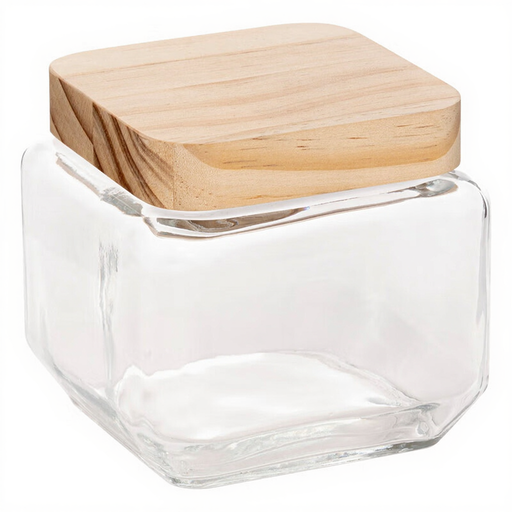
Why does it suit this profile? With a capacity of 0.85 litres, this jar is well suited to smaller households and everyday staples such as coffee, pasta, rice and flour. Its square shape can be used efficiently on worktops and in pantry cupboards.
The product description specifies an airtight bamboo lid while also noting that the lid should be cleaned by hand. This makes the care requirements clear.
Reusable glass, visible contents and a dishwasher-safe glass container. According to the product information, this model is not microwave-safe.
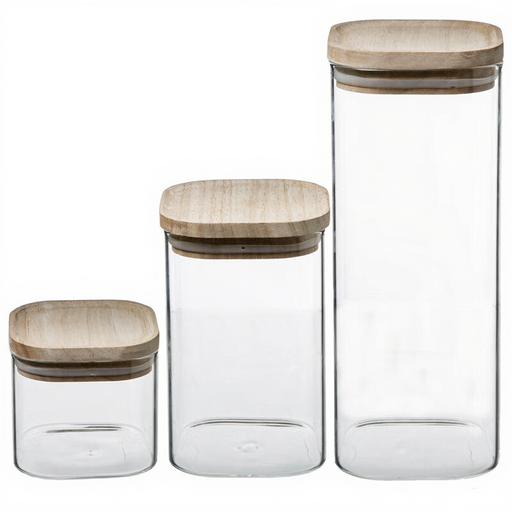
Why does it suit this profile? The set includes three jars, each with a capacity of 1 litre. It is ideal for households that want to store pasta, rice, coffee, flour and tea within a consistent storage system.
The specifications explicitly state borosilicate glass, hevea wood and an integrated silicone seal. The glass and lid have different care requirements.
Three matching 1-litre containers, food-safe glass according to the product information and dishwasher-safe glass bodies.
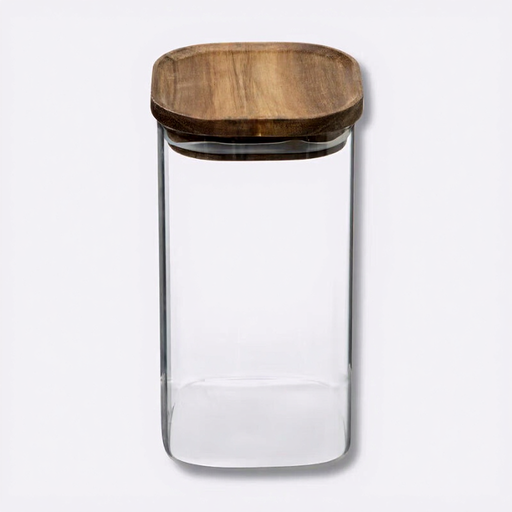
Why does it suit this profile? This square model is designed for larger quantities of dry goods. Before buying, compare its stated dimensions of 11 × 11 × 22 cm with the intended cupboard compartment or shelf.
The product data states that the jar is not dishwasher-safe. This care requirement should be factored in if the jar will be used frequently.
Borosilicate glass, acacia lid, silicone closure and a usable capacity of 1.6 litres according to the product data.
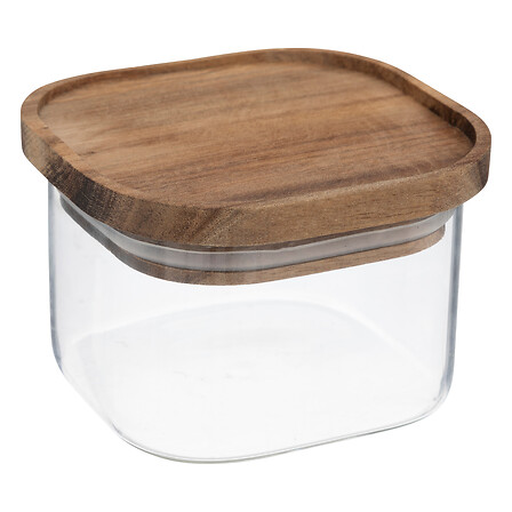
Why does it suit this profile? With a capacity of 0.4 litres and dimensions of 11 × 11 × 7.4 cm, this jar is suitable for small quantities, individual types of tea, spices or nuts.
The specifications limit its use to dry foods and recommend hand washing. This helps prevent unsuitable use with liquids or in the dishwasher.
Borosilicate glass, acacia lid and hermetic closure. The product description states that the jar is designed for long-term reuse.
Glass and lid should be cleaned before first use. Dry foods should only be added once the container is completely dry. This reduces the risk of residual moisture getting into flour, rice or spices.
For a longer service life:
Reusable glass can help reduce single-use packaging in the home, but its manufacture and transport involve additional weight. Sustainable food storage therefore also depends on using jars over the long term and choosing appropriately sized containers rather than unnecessary excess capacity.
The complete selection includes additional models in different sizes, with various closure types and features for kitchen storage.
That depends on the closure. A lid with a suitable silicone seal and hermetic closure can provide an airtight seal for dry foods. Before buying, check the specific product description and ensure that both the rim of the jar and the seal are clean and dry.
With normal use, they can be reused over the long term. Their service life depends primarily on impacts, sudden temperature changes, the condition of the seal and care of the wooden lid. Glass with cracks or chips should be discarded for safety reasons.
There is no universal answer. Some models have a dishwasher-safe glass body, while the wooden lid should be cleaned by hand. Other jars are intended entirely for hand washing. Microwave suitability must be explicitly stated; the wooden lid should never be heated in the microwave.