Ceramic artists documenting glaze tests
If you compare different samples or repeat your shots, consistent lighting and controlled white balance can help. Calibrite Europe explains how changing lighting conditions can affect colour reproduction.


For glaze photos with consistent colour, keep the light position and white balance constant throughout your set-up; a high CRI rating alone does not guarantee accurate colour reproduction. With glossy samples, a repositionable diffuser is often more helpful than extra effects modes: broncolor / Urs Recher points out that more light is not automatically the better solution. Check reflections on your own sample, and confirm what’s included and which compliance requirements apply to the specific listing.
If you compare different samples or repeat your shots, consistent lighting and controlled white balance can help. Calibrite Europe explains how changing lighting conditions can affect colour reproduction.
If bright reflections obscure glaze details, it’s important to position the light modifier to suit your sample. broncolor / Urs Recher’s guidance on photographing glossy surfaces shows why lighting is an important part of your set-up.
If space is tight for your camera, sample and light, or you often need to pack your set-up away, size, secure mounting and power supply are important factors to consider.
First decide what matters most for your glaze photos: comparing colours, controlling reflections, having a white background or keeping your set-up compact. You can then choose a light modifier, mounting option and power supply to suit your photo table.
| What matters to you | What to look for | Who it matters to |
|---|---|---|
| Consistent glaze colours | Check the white-light settings on the specific model and use a neutral reference in your finished set-up. | If I’m documenting glaze tests under comparable conditions, I want to keep the lighting and white balance consistent. Around 31% of consumers put colour comparison first. |
| Reflections on the glaze | Check the size and adjustability of the light modifier, as well as whether a diffuser is included; take a test shot of your own sample. | With a glossy sample, I want to move reflections rather than hide the gloss and texture with too much diffused light. Around 31% of consumers prioritise reflection control. |
| White background | Check whether you can light the background and sample separately, while keeping details visible in the brightest areas of the glaze. | When I’m photographing against white, I want the background to look bright without losing detail in the sample. Around 23% of consumers prioritise a white background. |
| Space, mounting and power | Check the dimensions, mount and what’s included with your chosen version; don’t assume a battery or mains adapter is included. | At a small or frequently rearranged photo space, I want to be able to mount the light securely and power it appropriately. Around 15% of consumers prioritise space and power supply. |
A high CRI rating is a specification of the light, but it doesn’t guarantee accurate colour in your photo. Calibrite Europe explains how changing lighting can affect colour reproduction. So, keep the lighting and camera settings as consistent as possible when comparing a series of shots, and use a suitable neutral reference.
Lighting and white balance also affect the image. A single light specification therefore can’t tell you on its own how a glaze will look in the finished photo.
Compare samples using a suitable neutral reference and keep your set-up as consistent as possible. Calibrite Europe explains how changing lighting conditions affect colour reproduction.
With glossy surfaces, the position of the light modifier can make all the difference to where reflections appear. broncolor / Urs Recher points out that adding more light is rarely the right solution for highly reflective objects.
Try different positions, diffusion and shooting angles with a real glaze sample before planning to add more lights.
What’s included depends on the specific model and package. The documented NEEWER NL660 twin set includes mains adapters, but not NP-F batteries. The Godox LEDP260C is compatible with a battery that, according to the manufacturer’s manual, is sold separately.
Compare the contents list for the exact version with your set-up, and check whether you’ll need to buy a battery, charger or mount separately.
The PavoSlim 60B is a slim bi-colour panel for set-ups where controlling the light is important.
The NL660 range includes options for a single bi-colour panel or a two-panel set-up.
According to the manufacturer’s manual, the LEDP260C is designed for uses including macro and product photography.
The P60x is a bi-colour panel for a more permanent photography set-up.
The P96 Video LED Light 3286 is a small panel for close-up shots or use as an additional light.
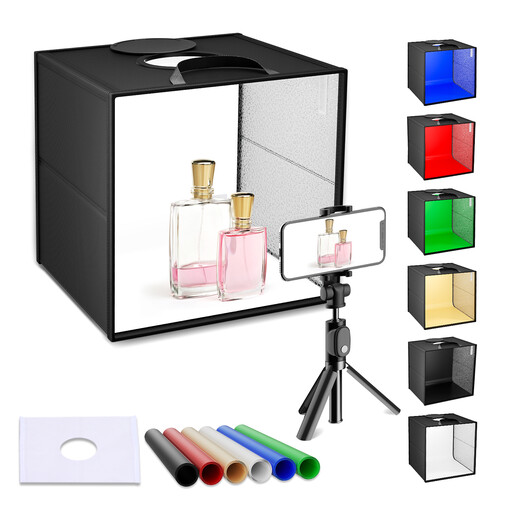
The Joybuy listings below are photo boxes with integrated LED lighting for product photography, not LED panels that you can position freely. They’re worth considering if a compact set-up and white background matter more to you than being able to position a single panel wherever you like.
 No image available
The integrated lighting and white background card are suited to product shots against white; the diffused lighting may change how glossy the glaze looks.
The description lists 120 LEDs, three light colours, 3000–5600 K, nine brightness levels and CRI 95+. Check the effect of the diffusion on your own sample.
 No image available
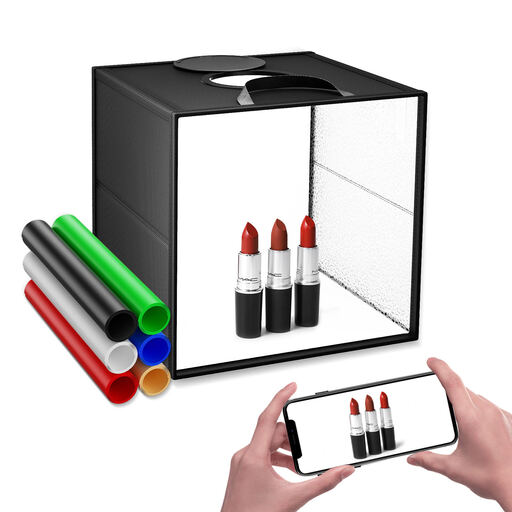
This photo box is described as suitable for a compact product photography set-up and includes a white background card. Its soft, diffused light may change how glossy the glaze looks.
The description lists 120 LEDs, three colour temperature modes, 3000–5600 K, stepless dimming and CRI above 95. It also lists six coloured backgrounds; test the lighting effect with your sample.
Before buying, check which EU conformity requirements apply to the specific electrical product, and whether the listing includes the required markings and documentation. The European Union notes that CE marking is only required for products covered by relevant harmonised EU rules.
No. A CRI rating alone doesn’t guarantee an accurate photo, as lighting and white balance also affect the image. Photograph a suitable neutral reference under the light you’ll actually be using, and keep your set-up consistent throughout the series.
Start with a diffused light positioned to one side, then adjust the angle or distance based on test shots. More lights aren’t automatically the answer; if reflections still obscure details, a suitable polarising set-up may be another option.
It depends on the model and package. The documented NEEWER NL660 twin set doesn’t include NP-F batteries; the compatible battery for the Godox LEDP260C is sold separately, according to the manufacturer’s manual. Check the battery, charger and mains adapter requirements for the exact version you’ve chosen.
Follow the instructions for the specific model. For the PavoSlim 60B, Nanlite requires the ventilation openings to be kept clear and warns that surfaces may become hot during extended use. These model-specific instructions don’t automatically apply to other panels.
Check which EU requirements apply to the specific electrical product; CE marking is only required when relevant harmonised EU rules say it is. When monitoring the market, the Bundesnetzagentur lists factors including labelling, product identification, manufacturer details and conformity documentation. Your statutory rights against the seller and a voluntary guarantee are separate entitlements.