
Lieferung heute & morgen

Qualitätsgarantie

Willkommens-Angebote freischalten: KOSTENLOSE Lieferung | Bis zu 80 % RABATT | Kostenlose 30-Tage-JoyPlus-Testphase
App herunterladen
The nightly search for a dropped pacifier is a scenario many parents know all too well. Fumbling in the dark not only disrupts your own sleep but also your child's. A glow-in-the-dark pacifier can be a simple and practical solution. These models, often called night pacifiers, are equipped with a safe, luminous material that charges in daylight and glows softly in the dark.
This article serves as a guide. We will introduce a selection of glow-in-the-dark pacifiers and explain the key features to look for, helping you make an informed decision for your child.
Choosing the right pacifier goes beyond just its ability to glow. Three key aspects are crucial for your child's health and comfort.
An orthodontic pacifier is designed to support the natural development of the jaw, palate, and teeth. Look for a flat, thin, and symmetrical teat. This shape gives the tongue enough space for its natural sucking motion and exerts minimal pressure on the jaw and teeth. Models developed in collaboration with dentists or orthodontists often feature a particularly well-thought-out design.
Most modern pacifiers are made of silicone. A silicone pacifier is taste-neutral, particularly temperature-resistant, and hygienic, as the material is smooth and non-porous. It is crucial that the pacifier is free from harmful substances like BPA and BPS and complies with the European safety standard EN 1400. This standard ensures the pacifier is tear-resistant and that the ventilation holes in the shield are large enough to not impede breathing if the pacifier were to end up fully in the mouth.
Practical details can make daily life much easier. A pacifier with a steriliser box is a great example. These travel cases allow for quick and hygienic sterilisation in the microwave. This not only saves time but, according to manufacturers, also saves energy compared to conventional boiling. The case also doubles as clean storage for when you're on the go.
Based on the criteria above, we have compiled a selection of models that stand out for their features and solve the problem of "finding the pacifier at night".
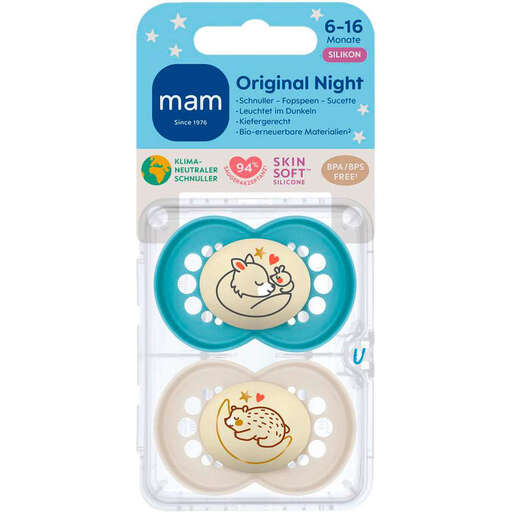
Why it stands out: The MAM Original Night is distinguished by its glowing button, which makes it easy to find in the dark. The teat, made of SkinSoft Silicone, is exceptionally soft and, according to a MAM market study, is instinctively accepted by 94% of babies. The manufacturer also emphasises sustainability: the shield and button are made from bio-renewable materials, and the product is certified as climate-neutral.
Benefits:
Who it's for: Parents of babies aged 6 to 16 months who are looking for a functional, orthodontic, and sustainably produced MAM Night pacifier.
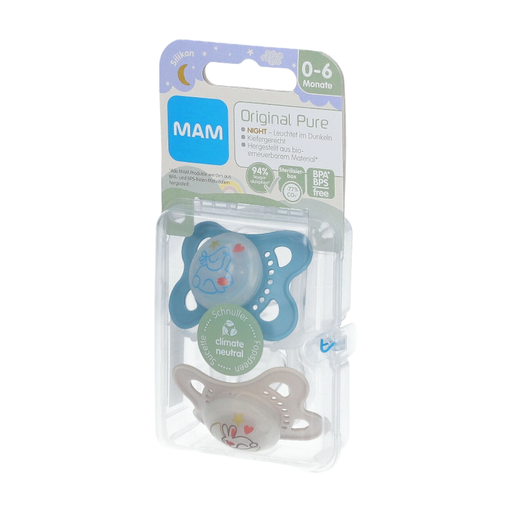
Why it stands out: This model offers all the benefits of the MAM Night pacifier but is specially tailored to the needs of newborns and infants up to 6 months. As MAM's first climate-neutral pacifier, it combines safety with environmental consciousness. The extra-soft SkinSoft silicone ensures a high acceptance rate.
Benefits:
Who it's for: Expecting parents and parents of newborns who want an especially gentle, jaw-friendly, and safe first night pacifier.
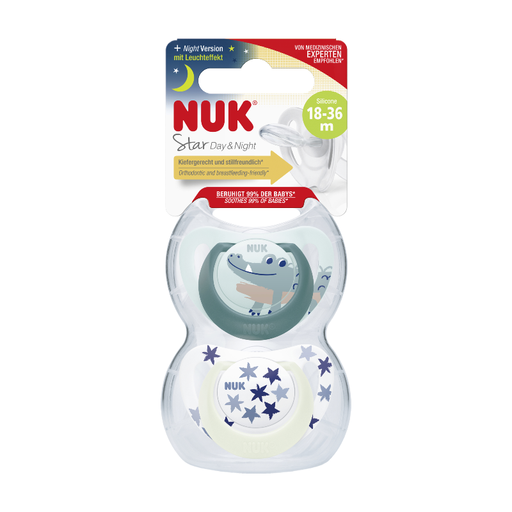
Why it stands out: The NUK Night pacifier is specially designed for toddlers. Its original orthodontic shape is narrow and flat to support the natural development of the jaw and teeth, even at this older age. The material's glow effect is subtle and helps the child find their pacifier independently.
Benefits:
Who it's for: Parents of toddlers aged 18 to 36 months who need a robust, age-appropriate, and orthodontically sound pacifier that glows in the dark.
If the models presented here don't quite meet your needs, or if you'd like to compare a wider range of shapes and designs, you can find more products in our main category.
? Discover more orthodontic pacifiers
1. How long does a night pacifier glow? The glow duration depends on the model and the intensity of its prior charge from daylight or lamplight. Typically, the pacifiers glow gently for several hours, which is long enough to find them in the crib during the night. The luminosity gradually fades over time.
2. Is the luminous material in pacifiers safe for babies? Yes. Manufacturers use special, safe luminous pigments that are integrated into the pacifier material (usually the button). These materials are non-toxic and do not release any substances. All pacifiers sold in the EU must meet the strict EN 1400 safety standard, which also covers material safety.
3. How do you properly clean a pacifier with a steriliser box? The process is simple: add the specified amount of water to the box, place the pacifier inside, and close the lid. Then, place it in the microwave at the recommended wattage for the time indicated by the manufacturer (usually a few minutes). Let the box cool briefly before opening. After cleaning, squeeze out any remaining water from the teat. Always follow the manufacturer's exact instructions.