Households shopping for someone with coeliac disease
If you pack bars for school, work or days out, first look for clear gluten-free labelling on the specific pack. It only makes sense to compare flavour and quantity after that.


When shopping for someone with coeliac disease, start with a multipack whose specific packaging is labelled gluten-free. Then consider the number of bars, the type of bar and any other ingredients. The MadeGood multipack listed by REWE contains six 24 g granola bars, while Schär and Alnavit offer smaller three-packs of wafer bars rather than classic cereal bars. Schär Melto also contains hazelnuts, milk and soya.
If you pack bars for school, work or days out, first look for clear gluten-free labelling on the specific pack. It only makes sense to compare flavour and quantity after that.
Several portions can be spread across different days or shared between people. The MadeGood product listed by REWE contains six bars weighing 24 g each; Schär Melto comes in a three-pack of 30 g bars. Check separately whether the bars are individually wrapped.
If you also need to avoid milk, nuts or soya, or want a vegan recipe, check each variety separately. Schär lists hazelnuts, milk and soya in Melto; REWE describes the MadeGood bar mentioned above as vegan and lactose-free.
If you have coeliac disease, first check the gluten-free labelling on the current pack. Then consider whether the product type, number of portions and other ingredients suit how you plan to use it.
| Criteria | What to check when buying | Who it matters most to |
|---|---|---|
| Gluten-free labelling | Does the specific pack say “gluten-free”? If you switch varieties, check the labelling and ingredients again. | When packing bars for someone with coeliac disease, I don’t want to have to infer suitability from a product name such as “free”. Clear labelling is likely to be the top selection criterion for around 50 % of shoppers. |
| Portions and type of bar | Compare the number of bars, the weight of each bar and whether you’re buying a cereal bar or a wafer bar. | For several lunchboxes, I need enough bars to cover the planned days or people. Around 30 % of shoppers are likely to put this portion requirement first. |
| Other ingredients | Read the ingredients and allergen information for each variety, especially if you need to avoid nuts, milk or soya. | If I also need to avoid certain ingredients or choose a vegan recipe, gluten-free labelling alone isn’t enough. For around 20 % of shoppers, an additional dietary requirement is likely to be the main consideration after checking that the product is gluten-free. |
REWE lists barley and wheat flakes among the ingredients of Corny free Schoko 6 × 20 g. The name doesn’t make this multipack a gluten-free option for the selection covered here.
Look for explicit gluten-free labelling on the current pack, then read the ingredients list.
Three wafer bars and six granola bars won’t meet the same preference for a particular type of bar. The number also tells you nothing about other ingredients.
First decide which type of bar you want to pack, then compare the number of bars and portion size of suitable products.
Schär Melto is described as gluten-free, but Schär says it contains hazelnuts, milk and soya. Any additional dietary requirement could therefore affect your choice.
Check the ingredients and allergen information for every variety in the pack, especially if it contains a selection of different bars.
A multipack planned for lunchboxes is only useful if the variety and pack size you want are actually available when you shop. ALDI SÜD notes that some items in its bar range are available in limited quantities.
Before buying, check the variety, pack size and labelling of the product on offer.
REWE lists MadeGood Bio Chocolate Chip Granola Bars in a pack of six 24 g portions.
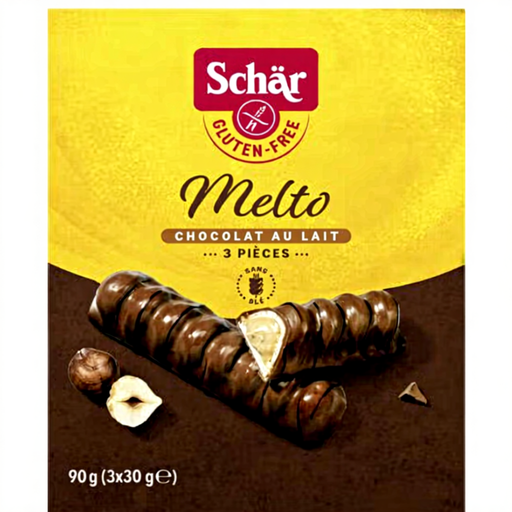
Schär offers Melto, a gluten-free chocolate wafer bar, in a three-pack containing three 30 g bars.
Alnavit describes its Schoko Waffel Riegel as a gluten-free, vegan three-pack.
Hammermühle makes gluten-free oat bars, including the Bio Oat Bar Sour Cherry & Chocolate.
The three-pack below is an option if you’re looking for gluten-free-labelled wafer bars to share or enjoy as a snack on a few occasions. It isn’t the same type of product if you’re looking for classic cereal bars.
 No image available
This three-pack makes a handy small supply if you’d prefer wafer bars to cereal bars.
The product description calls Melto gluten-free and lists three bars weighing 30 g each. Check separately whether each bar is individually wrapped if you plan to share them between several lunchboxes.
Melto contains hazelnuts, milk and soya. Before buying, check the gluten-free labelling and the ingredients and allergen information on the specific pack.
No. Under EU Implementing Regulation (EU) No 828/2014, the “gluten-free” claim is intended for foods containing no more than 20 mg/kg of gluten; it doesn’t mean an absolute zero. When shopping, look for the claim on the specific pack.
No, the name “free” doesn’t prove that it is. The ingredients list for Corny free Schoko 6 × 20 g shown by REWE includes barley and wheat. For someone with coeliac disease, explicit gluten-free labelling on the specific pack is what matters.
Not just because they contain oats. Check the gluten-free labelling on the pack, even for oat bars. Hammermühle notes that people with coeliac disease may tolerate gluten-free oats differently in its information about the gluten-free Bio Oat Bar.
Not for this lunchbox snack: Knack & Back offers gluten-free pizza and puff pastry for baking. These are different products from portioned cereal or wafer bars.