Who is this guide for?

Runners with coeliac disease

If you have coeliac disease, an explicit gluten-free label is your first check. Under Commission Implementing Regulation (EU) No 828/2014, food sold to the final consumer can only be labelled ‘gluten-free’ if it contains no more than 20 mg/kg of gluten. Also check the pack for any other ingredients that may be relevant to you.

Long-distance runners trying out snacks

You may want to take a biscuit with you, but you’ll need to match the carbohydrates in your portion to your running plan. Try out the amount and timing on training runs, rather than for the first time during a race.

People checking for other ingredients or allergens

‘Gluten-free’ doesn’t automatically answer questions about milk, egg or other allergens. For example, Coppenrath Feingebäck lists cow’s milk butter and egg in its gluten-free, lactose-free Butter Cookies, and warns that they may contain traces of soya and nuts.

What should you look for when buying?

First, check the label on the specific pack. If you plan to eat the biscuits while running, you’ll also need to consider the carbohydrates in the portion you actually eat and try them out during training.

Criteria What to check when buying Who it matters most to
Gluten-free labelling Does the specific pack say ‘gluten-free’? Check the label again if the pack or recipe changes. If I have coeliac disease, I need a clear label and can’t rely on ‘wheat-free’ alone. Around 36% of consumers would consider this their top priority when buying.
Carbohydrates and tolerance Compare the carbohydrates per 100 g and in the portion you’ll actually eat; try out the amount and timing during training. For a long run, I want to know how much my portion of biscuits contributes to my planned carbohydrate intake and whether I tolerate it. About 29% of consumers would look at this first.
Portability and portioning Look for individually wrapped or freshness packs, and consider how much you’ll actually take with you. If I’m packing a snack for training or travelling to an event, I want to be able to carry a separate portion. This would be the main consideration for around 21% of consumers.
Other ingredients and allergens Read the ingredients list and allergen advice for every variety; ‘lactose-free’ does not mean ‘dairy-free’. If I also need to avoid milk or egg, a gluten-free label isn’t enough. Around 14% of consumers would make other ingredients and allergens their first selection criterion.

Common selection mistakes

  • Assuming ‘wheat-free’ means ‘gluten-free’

    Commission Implementing Regulation (EU) No 828/2014 sets a maximum of 20 mg/kg of gluten in food sold to the final consumer for the ‘gluten-free’ claim. ‘Wheat-free’ is not the same label.

    If you have coeliac disease, look specifically for ‘gluten-free’ on the current pack.

  • Treating a biscuit as a complete running plan

    A pack doesn’t tell you how many carbohydrates you’ll actually consume during a run or whether you’ll tolerate the amount you choose.

    Compare the nutritional information with your portion, and try the snack on training runs rather than for the first time on race day.

  • Assuming ‘lactose-free’ means ‘free from milk and egg’

    According to the ingredients information, Coppenrath Feingebäck’s gluten-free, lactose-free Butter Cookies contain cow’s milk butter and egg. The product may also contain traces of soya and nuts.

    If you have other allergies, check the ingredients list and trace warnings for the specific variety.

  • Assuming a multipack portion is automatically right for your run

    Individually wrapped biscuits and freshness packs make snacks easier to carry, but they don’t determine a carbohydrate intake that suits your running plan.

    Work out the nutritional values based on the amount you actually plan to eat from the individual pack.

Brands to consider

Schär

Schär describes its gluten-free Petit-Beurre butter biscuits as individually wrapped; EDEKA24 lists the product as gluten- and wheat-free.

  • Individual wrapping can make it easier to carry a separate portion.
  • For eating while running, the nutritional values for the amount you eat and the ingredients on the current pack are still what matter.

Hammermühle

Hammermühle describes its gluten-free organic butter biscuits as coming in three freshness packs.

  • The freshness packs let you carry separate portions.
  • The packaging alone won’t tell you how many carbohydrates are in the portion you eat or whether you’ll tolerate it.

Alnavit

Alnavit describes its gluten-free organic butter biscuits as a 100-g pack containing 15% butter, with no added flavourings.

  • The pack size and butter content are specified for this particular variety.
  • Because it contains butter, this product isn’t dairy-free; plan your running portion using the nutritional information.

Coppenrath Feingebäck

Coppenrath Feingebäck also describes its gluten-free Butter Cookies as lactose-free.

  • The additional lactose-free claim may be useful if you’re looking for this type of product.
  • According to the ingredients information, the cookies contain cow’s milk butter and egg; possible traces of soya and nuts are also listed.

Butter biscuits at Joybuy

This selection features a gluten-free butter biscuit you can take with you. Whether it suits your running plan depends on the labelling, the carbohydrates in your portion and how it goes when you try it during training.
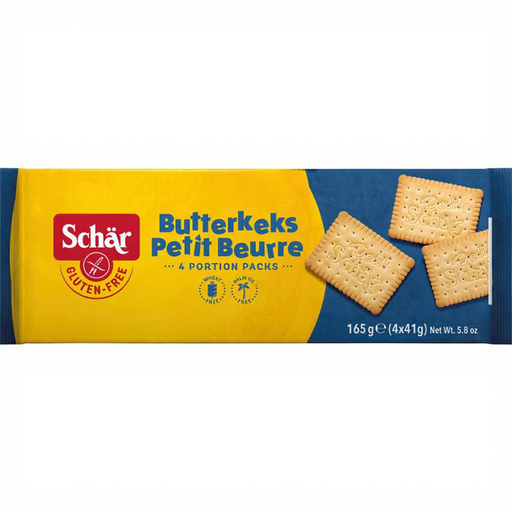
Schär Gluten-Free Petit Beurre butter biscuits, 165 g

Schär Gluten-Free Petit Beurre butter biscuits, 165 g

These individually wrapped butter biscuits could be a good choice if you want to take a gluten-free labelled snack with you.

The pack contains 165 g. For a planned running portion, check the carbohydrates on the current nutritional label and try out your chosen amount during training.

If you need to avoid milk or egg, also check the ingredients and allergen advice on the specific pack.

View at Joybuy

Frequently asked questions

What does ‘gluten-free’ mean on biscuits?

Under Commission Implementing Regulation (EU) No 828/2014, food sold to the final consumer can only be labelled ‘gluten-free’ if it contains no more than 20 mg/kg of gluten. Check the label on the pack of the biscuits you’re planning to buy.

Can I eat gluten-free butter biscuits during marathon training?

You can try them as a training snack, but don’t treat them as a substitute for your running plan without working out your portion first. Compare the carbohydrates in the amount you eat with your plan, and check whether you tolerate the snack during similar runs.

Are lactose-free, gluten-free butter biscuits also dairy-free?

No, the two claims don’t mean the same thing. According to the ingredients information, Coppenrath Feingebäck’s gluten-free, lactose-free Butter Cookies contain cow’s milk butter and egg. If you have other allergies, check each specific pack.

Should I try a new biscuit for the first time on marathon day?

It’s better to try a new biscuit on a training run first. That way, you can test your planned portion, when to eat it and how it works with drinks in similar conditions.