Carnival-goers with coeliac disease
If you have coeliac disease or are shopping for someone who does, you need a biscuit that’s explicitly labelled gluten-free. At a buffet, keep the packaging visible so the label and ingredients can be checked.


If you’re buying butter biscuits for someone with coeliac disease to enjoy at Cologne Carnival, first look for the explicit ‘gluten-free’ label on the retail packaging – don’t rely on a familiar brand or the shape of the biscuit. Under EU Implementing Regulation No 828/2014, this claim may only be used on foods sold to consumers if they contain no more than 20 mg/kg of gluten. Individually wrapped biscuits can be practical for taking along or serving at a buffet. If there are other allergies to consider, also check the ingredients and allergen information on the specific pack.
If you have coeliac disease or are shopping for someone who does, you need a biscuit that’s explicitly labelled gluten-free. At a buffet, keep the packaging visible so the label and ingredients can be checked.
You may want to serve gluten-free butter biscuits separately from other baked goods. Individually wrapped packs can make it easier to serve them. The German Coeliac Society recommends checking in advance with the people responsible if you have questions about gluten-free food when eating out.
If ingredients such as milk or lupin are also a concern, the ‘gluten-free’ label alone isn’t enough. The ingredients list and allergen information on the specific pack will show whether it meets individual requirements.
When buying butter biscuits for Cologne Carnival, first check that the current pack is labelled gluten-free. Then check for any other relevant allergens, and consider how you’ll take the biscuits with you or serve them.
| What to check | What to look for when buying | Who this matters most to |
|---|---|---|
| Gluten-free labelling | Does the current retail pack explicitly say ‘gluten-free’? Check the ingredients list too. | If I’m shopping for someone with coeliac disease, I want to be able to see the label on the pack myself. Around 50% of consumers put this clear statement first. |
| Other allergens | Compare the ingredients and allergen information for the specific variety with individual requirements, for example when milk or lupin is a concern. | Gluten-free on its own isn’t enough for me if a Carnival guest also needs to avoid other ingredients. For around 30% of consumers, checking for additional allergens is the priority. |
| Taking them along and serving at a buffet | Check the pack format and whether the original labelling will remain readable when the biscuits are served separately. | For a parade or Carnival event, I want to be able to take biscuits along and serve them at a buffet in a way that makes their suitability clear. This is the main concern for around 20% of consumers. |
Alongside wheat, the German Coeliac Society lists spelt, rye, barley and ordinary oats as grains where gluten needs to be considered. So a wheat-free impression or familiar butter biscuit design is no substitute for a gluten-free label.
Check that the pack you buy is explicitly labelled ‘gluten-free’ and read the ingredients list.
Gluten-free butter biscuits can contain other relevant ingredients. Poensgen, for example, lists anhydrous butterfat and sweet lupin flour in its butter biscuits; REWE notes that Alnavit Organic Butter Biscuits contain butter and may contain traces of other allergens.
Compare the ingredients and allergen information on the specific pack with the requirements of the person you’re shopping for.
Without the packaging, guests can’t check the gluten-free label or other allergen information for themselves. With a mixed selection, it can also be harder to tell which biscuits are suitable for whom.
Serve the gluten-free biscuits separately and leave the original pack or a readable ingredients label beside them.
The information below applies to the specific biscuit varieties mentioned, not to each brand’s entire range. The label on the pack you actually buy is what matters when making your choice.
REWE lists Leibniz Minis Gluten-Free as a gluten-free biscuit variety in a 100-g pack.
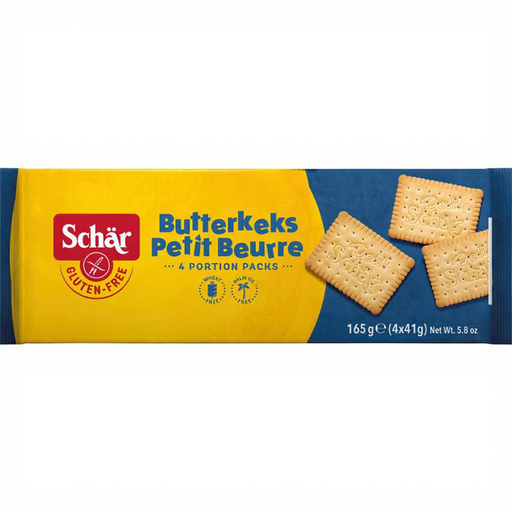
Schär offers gluten-free Petit-Beurre butter biscuits.
Hammermühle describes its organic butter biscuits as gluten-free.
Poensgen publishes ingredients and allergen information for its gluten-free butter biscuits.
REWE lists Alnavit Organic Butter Biscuits as ‘gluten-free’.
This Petit-Beurre butter biscuit is an option if you’re specifically looking for a biscuit labelled gluten-free for Carnival. If you’re choosing biscuits for someone with coeliac disease or other allergies, the label on the pack delivered is what matters.
 No image available
A butter-biscuit-style Carnival snack, provided the pack you receive is explicitly labelled gluten-free.
Pack size according to the product name: 165 g. Before buying, check the ingredients and allergen information, as well as the pack format if you’d like to hand out the biscuits individually.
Under EU Implementing Regulation No 828/2014, this claim may only be used on foods sold to consumers if they contain no more than 20 mg/kg of gluten. When buying, look for this explicit statement on the current pack.
No. ‘Wheat-free’ doesn’t mean the same as ‘gluten-free’. The German Coeliac Society also notes gluten in connection with spelt, rye, barley and ordinary oats, so check the gluten-free label and ingredients on the specific pack.
Not automatically. Poensgen lists ingredients including anhydrous butterfat and sweet lupin flour in its gluten-free butter biscuits; REWE lists butter and possible traces of other allergens for Alnavit. Always compare the information on the pack you choose with the ingredients that matter to you.
Serve them separately from other baked goods and keep the original pack or a readable ingredients label beside them. If you have questions about gluten-free food when eating out, try to check in advance with the people responsible, as recommended by the German Coeliac Society.
First check the current label on the pack and clear up any questions about the product before serving it. The German Coeliac Society offers additional product-selection information in its ‘Shopping with coeliac disease’ guide. For questions about a specific pack, you can also contact the company responsible, as named on the packaging.