Hosts welcoming a guest with coeliac disease
You want to offer a biscuit explicitly labelled gluten-free and serve it without it coming into contact with crumbs from gluten-containing baked goods.


If a guest has coeliac disease, choose a butter biscuit explicitly labelled gluten-free for your coffee get-together, rather than a standard biscuit or one simply marketed as wheat-free. Then check the ingredients and allergen information: gluten-free varieties may still contain milk and eggs. Individually wrapped or freshness packs can make it easier to serve them separately, but they’re no substitute for clear labelling or clean crockery.
You want to offer a biscuit explicitly labelled gluten-free and serve it without it coming into contact with crumbs from gluten-containing baked goods.
As well as checking the gluten-free label, you’ll need to check the ingredients and allergen information: gluten-free butter biscuits can still contain milk or eggs, for example.
You want to offer biscuits to several people without opening everything at once. Individually wrapped biscuits and freshness packs can make it easier to serve them separately, but you’ll still need to check the ingredients.
If a guest with coeliac disease is on the guest list, start by checking that the specific pack is labelled gluten-free. Then consider any other allergies and the pack format you’d prefer to find the right option for your coffee get-together.
| What matters | What to check before buying | Who it matters most to |
|---|---|---|
| Gluten-free for coeliac disease | Check that the specific pack says “gluten-free”; use a separate clean plate and separate cutlery when serving. | If a guest has coeliac disease, I want to offer a labelled gluten-free biscuit without it coming into contact with crumbs from other baked goods; this is the top priority for around 50% of consumers. |
| Other allergies and lactose | Read the current ingredients list and highlighted allergens; don’t assume “lactose-free” means “dairy-free”. | If the biscuit also needs to suit another allergy or a preference for lactose-free food, I need to check more than the gluten-free label. This further check is the top priority for around 30% of consumers. |
| Pack format and preferences | Compare individually wrapped biscuits or freshness packs, along with the product features you want; if needed, compare nutritional information per 100 g. | For serving at the coffee table, I want to choose portions that suit the occasion and a variety I enjoy; this is the main consideration for around 20% of consumers. |
A standard butter biscuit may contain wheat flour. EDEKA’s GUT&GÜNSTIG butter biscuit lists wheat flour among its ingredients, so it isn’t a gluten-free option for a guest with coeliac disease.
Choose a pack explicitly labelled gluten-free for this guest, and serve the biscuits separately from standard baked goods.
The gluten-free label doesn’t tell you whether a butter biscuit contains milk or eggs. Depending on the product, information about possible traces of other allergens may also be relevant.
Before buying, read the current ingredients list and allergen information on the specific pack. If someone has a known allergy, you’ll need to take their individual requirements into account.
Crumbs from gluten-containing baked goods can get onto gluten-free biscuits while you’re arranging them. The German Coeliac Society advises avoiding this kind of contact.
Open the pack in a clean area and use a separate plate and cutlery for the gluten-free biscuits.
“Organic” and “lactose-free” describe different product features. On their own, they don’t tell you whether a biscuit is gluten-free.
First check that the pack says “gluten-free”, then check the ingredients and allergens. You can narrow down your choice afterwards based on preferences such as organic ingredients or a particular pack format.
Schär offers a butter biscuit called Petit Beurre, described as gluten-free and wheat-free.
Hammermühle describes its organic butter biscuit as gluten-free and wheat-free.
LEIBNIZ Minis gluten- & laktosefrei are a specific mini variety to consider if you’re looking for both labels.
For a coffee get-together with a guest who has coeliac disease, this selection includes a Petit Beurre butter biscuit described as gluten-free. If there are other allergies to consider, check the information on the current pack and serve it separately from gluten-containing baked goods.
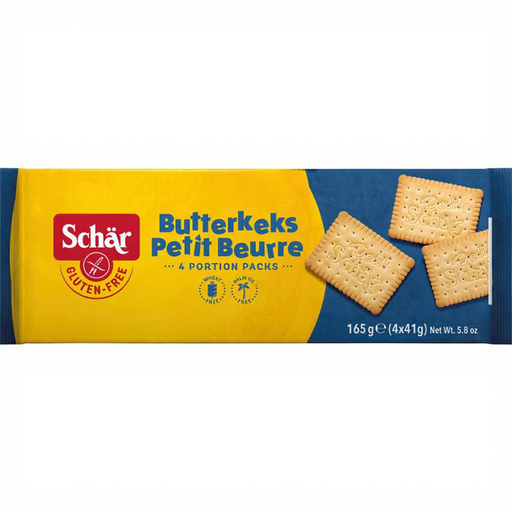 No image available
A butter biscuit described as gluten-free, for sharing at a coffee get-together with a guest who has coeliac disease.
The product description lists butter, eggs and milk as ingredients. If there are other allergies to consider, check the ingredients and trace information on the current pack.
In the EU, a food can be labelled “gluten-free” if it contains no more than 20 mg of gluten per kg of finished product, as set out in Implementing Regulation (EU) No 828/2014. If you’re buying for a guest with coeliac disease, check this label on the specific pack.
No. “Wheat-free” is not a substitute for the “gluten-free” label. Gluten can also come from other gluten-containing cereals, so choose a pack explicitly labelled gluten-free.
Not necessarily: according to its product information, Schär Butterkeks Petit Beurre contains butter, eggs and whole milk powder. LEIBNIZ Minis, which are described as gluten-free and lactose-free, also contain clarified butterfat, egg and a milk product. If there are other allergies to consider, check the current labelling on the pack.
Keep them separate and serve them on a clean plate with their own cutlery. This helps avoid contact with crumbs from gluten-containing baked goods while serving, as advised by the German Coeliac Society.
Compare the nutritional information per 100 g if, for example, you want to compare the sugar or fat content of two butter biscuits. Portion information can also be useful, but the portions may not be the same size.