Guests with coeliac disease
For them, it’s essential that the specific biscuit is labelled ‘gluten-free’. If they have other allergies, the ingredients and precautionary allergen information on the current packaging must also be suitable for them.


If someone with coeliac disease is joining your football get-together, the only suitable gluten-free butter biscuit is one specifically labelled ‘gluten-free’. Before serving, you should also check the ingredients and allergen information on the current packaging. Then consider what the rest of the group needs: Schär offers Petit Beurre in individually wrapped portions, Hammermühle has snack packs, Leibniz Minis are labelled lactose-free, and Alnavit uses an organic recipe. None of these features automatically means that a biscuit is free from milk, eggs or other relevant allergens.
For them, it’s essential that the specific biscuit is labelled ‘gluten-free’. If they have other allergies, the ingredients and precautionary allergen information on the current packaging must also be suitable for them.
If you’re sharing biscuits with several guests, consider the pack size and portion format as well as the relevant labelling. Schär lists individually wrapped Petit Beurre biscuits, while REWE describes Hammermühle’s as snack packs.
Organic certification, butter content and added flavourings may all influence your choice. Consider these separately from the gluten-free labelling and allergen information.
First, check that the specific butter biscuit is labelled ‘gluten-free’ and that its allergen information is suitable for your guests. Then compare the portion format, pack size and any other ingredient preferences.
| What matters | What to check when buying | Who it matters most to |
|---|---|---|
| Gluten-free choice | Check the ‘gluten-free’ labelling on the current packaging, as well as the ingredients, allergens and precautionary allergen information. | If a guest with coeliac disease is joining us, I don’t want to assume a butter biscuit is suitable just from its appearance or name. Around 36% of consumers prioritise a gluten-free option. |
| Sharing and portioning | Match the pack weight and any stated individual or snack packs to the number of people eating. | For a get-together with several guests, I need a quantity and portion format that’s easy to share. This is the top priority for around 29% of consumers. |
| Organic and ingredients | Compare the organic labelling, ingredients list and information about other allergens with your requirements. | Even with gluten-free biscuits, I want to know which ingredients they contain and whether any additional allergens matter to my guests. Around 21% of consumers put these checks first. |
| Lactose-free option | Check the specific lactose-free claim as well as the ingredients list; lactose-free does not mean dairy-free. | If lactose matters alongside gluten, I look for a suitably labelled option without overlooking milk ingredients. This is the main concern for around 14% of consumers. |
The butter biscuits covered here may contain milk or eggs; some products also list possible traces of other allergens. Gluten-free labelling does not answer these additional questions.
If any guests have other allergies, compare the ingredients and precautionary allergen information on each current pack with the substances they need to avoid.
An ordinary butter biscuit isn’t a gluten-free option simply because of the type of product it is. Under EU Regulation 828/2014, the claim ‘gluten-free’ applies to foods containing no more than 20 mg of gluten per kg.
For guests with coeliac disease, choose a biscuit specifically labelled ‘gluten-free’ and check the packaging before serving.
The packs covered here contain 100 g, 130 g or 165 g, depending on the product. Individual wrappers and snack packs also offer a different way to serve biscuits than choosing by total weight alone.
Before you shop, match the quantity and portion format to the number of guests and the other snacks you’ll be serving.
The Leibniz Minis Glutenfrei described by REWE are a 100-g option if a lactose-free claim is also important to you.
Schär describes its gluten-free Petit Beurre butter biscuits as a 165-g option in individual wrappers.
The organic butter biscuits from Hammermühle described by REWE are a gluten-free 130-g option in snack packs.
The gluten-free organic butter biscuits sold by REWE are a 100-g option for people who pay close attention to the ingredients list.
If you’re looking for individually wrapped portions for a football get-together, Schär Petit Beurre is listed here as a gluten-free butter biscuit option. For guests with other allergies, always check the information on the pack you actually buy.
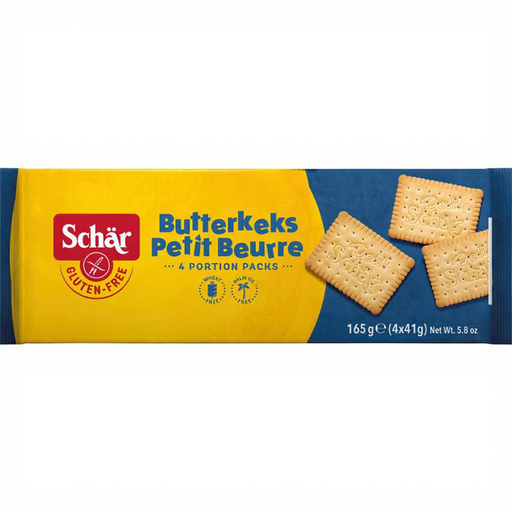 No image available
A handy option to share at a football get-together if you’re looking for gluten-free butter biscuits in individual wrappers.
Pack size: 165 g. Schär lists milk and eggs in Petit Beurre, as well as possible traces of soya and lupin. If anyone has other allergies, check the current packaging.
Not as a gluten-free option. Choose a butter biscuit specifically labelled ‘gluten-free’ and check the current packaging. Under EU Regulation 828/2014, ‘gluten-free’ means a gluten content of no more than 20 mg per kg of food, not necessarily zero.
No. Gluten-free labelling doesn’t mean that they are. For example, the Leibniz Minis described by REWE contain butterfat and whole egg; Schär lists milk and eggs in Petit Beurre. If anyone has other allergies, check the ingredients and precautionary allergen information on the specific pack.
Schär lists Petit Beurre in individual wrappers in a 165-g pack, while REWE describes Hammermühle’s 130-g butter biscuits as snack packs. The pack size you need will depend on how many people are eating and what other snacks you’re serving.
Follow the storage instructions on the pack you buy. Product information for Leibniz, Alnavit and Hammermühle says to store the biscuits in a dry place; for Alnavit and Hammermühle, it also says to keep them away from heat.