What to look for when buying
If you have coeliac disease, first check that the specific product is labelled gluten-free. Only then should nutritional values, other ingredients and pack size help you decide which biscuit is right for your post-workout snack.
| Criterion |
What to check when buying |
Who it matters to |
| Gluten-free labelling |
Check that the current packaging explicitly says ‘gluten-free’. The product name ‘butter biscuit’ alone isn’t enough: EDEKA lists GUT&GÜNSTIG Butterkeks as containing wheat flour. |
If I’m packing a biscuit for after my workout because I have coeliac disease, it must be clearly suitable for a gluten-free diet; this is the top priority for around 42% of consumers. |
| Nutritional values for your snack |
Compare carbohydrates, sugar and protein per 100 g, and bear in mind how much you’ll actually eat. Product information from REWE, Schär and Hammermühle gives protein values of 1.1 to 2.7 g per 100 g for the biscuits described. |
If you’re planning a meal that’s high in protein after exercise, you won’t want to mistake a butter biscuit for one. Around 33% of consumers put the purpose of the snack first. |
| Other ingredients and pack format |
Check the ingredients and precautionary allergen statements for milk, egg and any other allergens relevant to you. If you’re taking biscuits with you, consider whether you’d prefer individually wrapped biscuits, a freshness pack or a particular total pack weight. |
I want the biscuits to be easy to take with me and may need to avoid other ingredients; this additional requirement is a priority for around 25% of consumers. |
Gluten-free butter biscuits at Joybuy
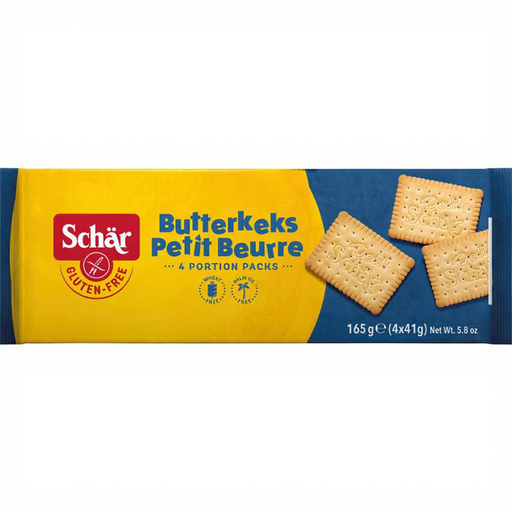
This selection features a Petit Beurre butter biscuit described as gluten-free, suitable for a post-workout snack. Check the current packaging to see whether its other ingredients and nutritional values meet your needs.
 No image available
Schär Gluten-Free Petit Beurre Butter Biscuits, 165 g
Petit Beurre could be a sweet post-workout snack if you’re looking for a gluten-free butter biscuit. The product description lists egg and milk; if you have other requirements, check the full ingredients and precautionary allergen information, as well as the nutritional values per 100 g on the current packaging.
View at Joybuy
Frequently asked questions
If I have coeliac disease, is a butter biscuit with no visible wheat flour suitable?
No. Check for the explicit ‘gluten-free’ label on the current packaging rather than judging by the appearance of the biscuit. The German Nutrition Society says that a strictly gluten-free diet is essential for people with coeliac disease; for example, the GUT&GÜNSTIG Butterkeks listed by EDEKA contains wheat flour.
Can a gluten-free butter biscuit replace a meal that’s high in protein after a workout?
No, you shouldn’t treat the butter biscuits described here as a substitute for a meal that’s high in protein. REWE, Schär and Hammermühle list 1.1 to 2.7 g of protein per 100 g for their respective products; compare the figures with the portion you plan to eat.
Are gluten-free butter biscuits automatically lactose-free or dairy-free?
No, the gluten-free label doesn’t answer either of those questions. REWE describes Leibniz Minis Glutenfrei as lactose-free, but lists butterfat and a milk product among the ingredients; Schär lists butter and whole milk powder in Petit Beurre.
Which pack is best for a gym bag?
If you don’t want to take the whole pack with you, look for individually wrapped biscuits or freshness packs. Schär offers individually wrapped Petit Beurre biscuits, while Hammermühle offers freshness packs for its organic butter biscuits. Whatever you choose, check the ingredients and nutritional values of the product.


