Fair organisers with a child with coeliac disease
You need butter biscuits with clear, verifiable gluten-free labelling, and must prevent them from coming into contact with crumbs from gluten-containing baked goods during storage or serving.


For a school fair offering food to children with coeliac disease, the current packaging should explicitly state that the butter biscuits are ‘gluten-free’. According to Lebensmittelklarheit, this claim is only permitted for foods containing no more than 20 mg of gluten per kg; ‘wheat-free’ or the term ‘butter biscuit’ is no substitute. If gluten-containing baked goods are also being sold, it’s important to store them separately and clearly distinguish them when serving; other allergens must be checked separately.
You need butter biscuits with clear, verifiable gluten-free labelling, and must prevent them from coming into contact with crumbs from gluten-containing baked goods during storage or serving.
For them, ‘gluten-free’ on its own isn’t enough. Ingredients such as milk and eggs, as well as warnings about possible traces, must also be suitable for the person concerned.
You want to make sure the gluten-free biscuits are clearly identifiable at the point of sale and have the original packaging to hand for questions about ingredients and allergens.
When buying gluten-free butter biscuits for a school fair, start by checking the labelling on the actual pack you’re buying. Then make sure the serving format, other allergens and quantity are right for your plans.
| What to consider | What to check | Who it matters to |
|---|---|---|
| Gluten-free labelling | Check that the current packaging explicitly says ‘gluten-free’; ‘wheat-free’ on its own isn’t enough. | If a child with coeliac disease is going to eat them, I need a clear statement rather than having to guess from the product name. For around 36% of consumers, this labelling is their top priority when choosing. |
| Separate serving | Store sealed packs separately and make sure they’re clearly distinguished when serving alongside gluten-containing baked goods. | If different baked goods are being sold at the same fair table, I want to avoid crumbs coming into contact with them and prevent mix-ups. Separate serving is the main concern for around 29% of consumers. |
| Other allergens | Check the ingredients list and trace allergen warnings on the specific product for allergens that matter to the person concerned. | If there are additional allergies, I also need to know what else a gluten-free biscuit contains. Around 21% of consumers consider this their most important priority when choosing. |
| Quantity and portion size | Plan how many portions you need, then check the pack size and the packaging format. | I want to have enough biscuits for the expected number of fair visitors, in a format that’s easy to keep separate. This is the most important buying consideration for around 14% of consumers. |
The type of product doesn’t tell you reliably whether it’s gluten-free. According to EDEKA, its EDEKA GUT&GÜNSTIG butter biscuits contain wheat flour, so they aren’t a gluten-free alternative.
For a gluten-free offering at your fair, check that every pack you actually buy says ‘gluten-free’.
Crumbs from gluten-containing baked goods and mix-ups can undermine your plans for separate serving. The German Coeliac Society treats avoiding this kind of contact as an issue for nurseries and schools.
Store gluten-free products separately, label them clearly and, if possible, serve them in their original sealed packaging or as individually wrapped portions.
According to the manufacturer, Schär Petit Beurre gluten-free butter biscuits contain milk and eggs; they may also contain traces of soya and lupin. A trace warning is not the same as an ingredient.
Before buying, check what other requirements need to be met, then read the ingredients and trace warnings on the specific pack.
EDEKA points out that the information on the packaging is the one to rely on. ALDI SÜD also notes that local availability of special-buy products can change at short notice.
Check the specific product you buy and keep its original packaging to hand in case anyone has questions at the fair.
Schär sells its Petit Beurre butter biscuits in a 165-g pack and describes them as gluten-free.
The butter biscuits described by EDEKA are an example of a standard, non-gluten-free product.
Bahlsen says its Butterblätter biscuits are made with wheat flour.
ALDI SÜD lists gluten-free butter biscuits as a possible product category in its general biscuit guide.
This product matches a search for gluten-free butter biscuits for a separate offering at a school fair. Check the pack you receive to make sure its labelling, ingredients and packaging format are right for the way you plan to serve it.
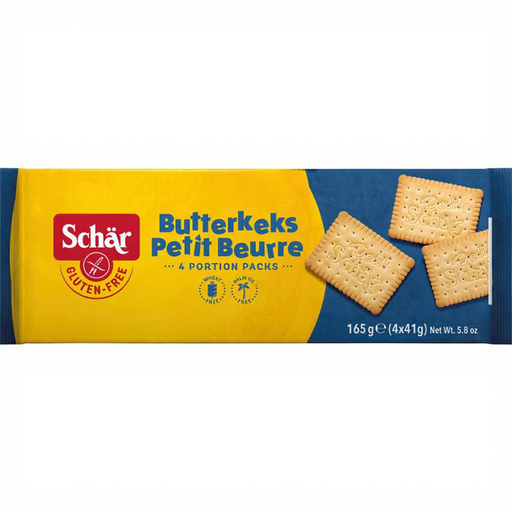 No image available
Designed for a separate gluten-free butter biscuit offering at a school fair.
The pack weighs 165 g. Schär says its butter biscuits come in individual wrappers; check the packaging format of the product you buy before serving.
According to Schär, Petit Beurre butter biscuits contain milk and eggs; they may also contain traces of soya and lupin. If there are other allergy requirements, check the current packaging.
Look for the words ‘gluten-free’ on the current packaging of the specific product. According to Lebensmittelklarheit, this claim may only be used if the food contains no more than 20 mg of gluten per kg; ‘wheat-free’ on its own isn’t a substitute.
Not necessarily: according to the manufacturer, Schär Petit Beurre butter biscuits contain milk and eggs, and may also contain traces of soya and lupin. Check the ingredients and trace warnings on the product you actually buy to make sure it’s suitable for the person concerned.
Store and display gluten-free biscuits separately from gluten-containing baked goods, and make sure they’re clearly distinguished when serving. Keeping them sealed in their original packaging or serving individually wrapped portions can help; the German Coeliac Society also covers preventing contamination in schools and nurseries.
Keep the ingredients and allergen information for the products you’re selling to hand in case anyone asks. The organising team should check with the relevant food safety authority which labelling requirements apply to that particular fair and the way food is being served. Guidance from Verbraucherzentrale on school kitchens and caterers doesn’t automatically apply to every individual fair.