What should you look for when buying?
First, check that the specific pack is labelled gluten-free and look out for any other relevant allergens. Then you can decide which type of packaging and other product features are best suited to the school day.
| Criterion | What to check | Who it matters to |
|---|
| Gluten-free claim and avoiding crumbs |
Check that the pack you buy says ‘gluten-free’; agree with the school or after-school club how the snack will be stored separately and handed out. |
If my child has coeliac disease, their snack needs to be clearly labelled and handed out without coming into contact with crumbs containing gluten. This is likely to be the top priority for around 36% of consumers. |
| Portion size and transport |
Check whether the specific variety comes in individual or freshness packs, and make sure the packaging is intact. |
If the biscuit is going to be in my child’s school bag regularly, I want to be able to pack a suitable portion without transferring it to another container. Around 29% of consumers would put portion size first. |
| Other allergens and lactose |
Check the ingredients and precautionary allergen statements against the allergens that matter to you; don’t assume that ‘lactose-free’ means ‘dairy-free’. |
If I need to consider milk, egg or lupin as well as gluten, the gluten-free claim alone isn’t enough. For around 21% of consumers, this additional check would be the main priority. |
| Organic and preferred variety |
Check the organic label and your preferred variety only after checking the gluten-free claim and allergens. |
Once I’ve confirmed the necessary labelling, I may also want to choose an organic option or a particular variety. This preference would be the most important additional selection criterion for around 14% of consumers. |
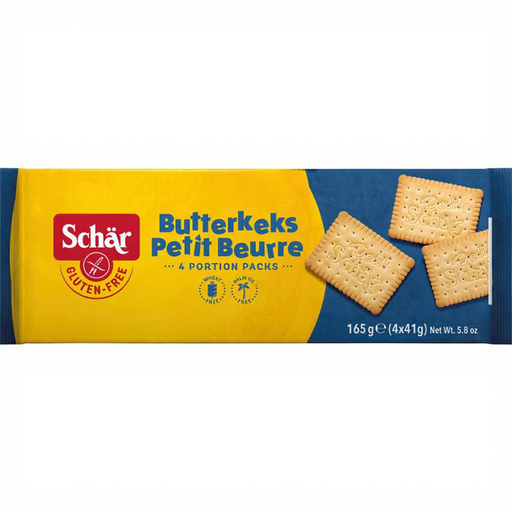
Butter biscuit option at Joybuy
This Petit-Beurre variety is worth considering if you’re looking for a gluten-free butter biscuit for the start of the school year. Before buying, check that the specific pack and its allergen information are suitable for your child.
 No image available
Schär Petit Beurre butter biscuits, 165 g
If you’re looking for a butter biscuit labelled gluten-free for the start of the school year, this variety may be suitable; check the label on the pack you buy. The product description lists egg and milk. Before buying, also check the packaging format, full ingredients list and precautionary allergen statements for the specific pack.
View at Joybuy
Frequently asked questions
When can a biscuit be labelled gluten-free?
Under the EU rules explained by the consumer advice centre, the ‘gluten-free’ claim means no more than 20 mg of gluten per kg of food. If your child has coeliac disease, the specific variety you buy should carry this claim; you can’t determine this from the ingredients list alone.
Are ordinary butter biscuits suitable for someone with coeliac disease?
Not unless the specific variety is labelled gluten-free. For example, the GUT&GÜNSTIG butter biscuit listed by EDEKA contains wheat flour, so the term ‘butter biscuit’ isn’t a useful guide when choosing food for a gluten-free diet.
Is an individually wrapped portion enough for school?
A sealed portion makes the biscuit easier to take along, but it doesn’t replace an agreement on how it will be stored and handed out. For nursery and school, the German Coeliac Society highlights the need for procedures that prevent contact with crumbs containing gluten.
Is a lactose-free biscuit also dairy-free?
No. Although the Leibniz Minis gluten-free biscuit variety described by REWE is listed as containing no more than 0.01 g of lactose per 100 g, it contains butterfat and a dried milk product. If your child has a milk allergy, the full ingredients list on the specific pack is what matters.


