People with coeliac disease
If you’re buying butter biscuits for someone with coeliac disease, you need a pack that is explicitly labelled ‘gluten-free’. A claim such as ‘wheat-free’ is not a substitute for this label.


For people with coeliac disease, the first thing to check on butter biscuits is that the specific pack you’re buying is labelled ‘gluten-free’. Then check separately for any other ingredients you need to avoid: gluten-free or lactose-free biscuits may still contain milk ingredients and egg. Organic ingredients and multipacks address different preferences.
If you’re buying butter biscuits for someone with coeliac disease, you need a pack that is explicitly labelled ‘gluten-free’. A claim such as ‘wheat-free’ is not a substitute for this label.
Once you’ve checked that the product is gluten-free, look at the ingredients and allergens on the specific pack. ‘Lactose-free’ does not mean dairy-free or egg-free.
If you want to take biscuits with you or open only part of a pack, look for individually wrapped biscuits or multipacks. Organic labelling and the recipe are additional considerations, not a substitute for checking allergens.
If you have coeliac disease, start by checking that the current pack is labelled gluten-free. Then you can compare other allergens, packaging and ingredient preferences.
| What matters | What to check | Who it matters most to |
|---|---|---|
| Gluten-free labelling | Look for the words ‘gluten-free’ on the current pack; don’t assume ‘wheat-free’ means the same thing. Under EU Implementing Regulation No. 828/2014, a ‘gluten-free’ claim means the finished product contains no more than 20 mg/kg of gluten. | When I’m buying biscuits for someone with coeliac disease, I need a clear label rather than a guess based on the recipe. This is the top priority for around 42% of consumers. |
| Other allergens and lactose | Check the ingredients and allergen information on the pack against the ingredients you need to avoid. Don’t interpret ‘lactose-free’ as ‘dairy-free’. | If someone also has a milk or egg allergy, the gluten-free claim alone isn’t enough. Around 25% of consumers give this additional check their highest priority. |
| Portioning | Check whether the pack contains individually wrapped biscuits or several smaller packs, and see what pack sizes are available. | When I’m out and about, I want to open just some of the biscuits at a time. Portioning comes first for around 17% of consumers. |
| Organic options and ingredients | Once you’ve checked for any ingredients that need to be avoided, compare the organic labelling and the specific ingredients in each variety. | Once my gluten and other allergen requirements are met, I choose based on the organic label or recipe. Around 16% of consumers put this preference first. |
Gluten-free butter biscuits may still contain milk ingredients or egg. The gluten-free label doesn’t tell you whether these other allergens are present.
First check the current pack for the ‘gluten-free’ label, then check the ingredients and any allergens highlighted on the pack.
REWE lists Leibniz Minis Glutenfrei as lactose-free, but its published ingredients list still includes anhydrous butterfat, a dried milk product and egg.
If you have a milk or egg allergy, check the full ingredients and allergen information instead of choosing based on the lactose-free claim alone.
Organic labelling and convenient packaging describe other product features. They don’t tell you whether a product is suitable for someone with coeliac disease or other allergies.
Compare these features only once you’ve checked the label on the specific pack and confirmed it meets your individual requirements.
REWE lists Leibniz Minis Glutenfrei as gluten-free, lactose-free butter biscuits.
Schär describes its gluten-free Petit Beurre butter biscuits as individually wrapped.
Hammermühle sells gluten-free organic butter biscuits in a pack containing three freshness packs.
Alnavit describes its gluten-free organic butter biscuits as coming in a 100-g pack.
REWE lists Poensgen butter biscuits as a gluten-free product in a 100-g pack.
This selection features a Petit Beurre butter biscuit variety labelled gluten-free. If you’re buying for someone with coeliac disease or other allergies, check the label, ingredients and allergen information on the specific pack before you buy. Individual portion packaging is not assumed for this variety.
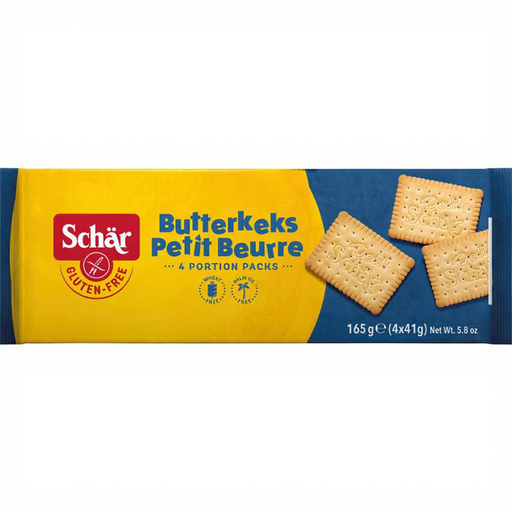 No image available
A Petit Beurre variety for anyone looking for butter biscuits explicitly labelled gluten-free. If you have coeliac disease or other allergies, check the label and the full ingredients and allergen information on the current pack.
No. The specific pack you buy should be explicitly labelled ‘gluten-free’. Under EU Implementing Regulation No. 828/2014, this claim means the finished product contains no more than 20 mg/kg of gluten; ‘wheat-free’ does not confirm that it meets this limit.
Not necessarily: the gluten-free label says nothing about milk or egg. For example, the ingredients list published by REWE for Leibniz Minis Glutenfrei includes anhydrous butterfat, whole hen’s egg and a dried milk product. Always check the information on the pack you’re buying.
The claim refers to lactose, not to the absence of all milk ingredients. If you have a milk allergy, check the ingredients and allergen labelling, even if the biscuits are also described as gluten-free and lactose-free.
Yes, especially if you need to avoid ingredients other than gluten. Always go by the label and the ingredients and allergen information on the pack you’re actually buying.