If someone with coeliac disease will be eating too, the first thing to check when buying ready-made butter biscuits is the gluten-free label on the specific pack intended for the German market. Ready-made biscuits are convenient for serving straight away or taking with you. If you want to cut out and decorate biscuits, you can bake them yourself, but you’ll need to consider all the ingredients and work surfaces. Check for other allergens and precautionary statements separately whichever option you choose.
Who should choose which option?
Shopping for someone with coeliac disease
If you’re choosing biscuits for yourself or guests with coeliac disease, check the label on the specific pack you’re buying. If there are other intolerances or allergies to consider, check the ingredients list and precautionary statements too.
Anyone who wants to make their own biscuits
If rolling, cutting out and decorating biscuits is part of your festive baking, you’ll need a suitable gluten-free dough rather than ready-shaped butter biscuits.
Hosts and guests bringing a treat
If you want biscuits you can serve or take with you without baking, ready-to-eat products are convenient. Individually wrapped portions may be useful, but the shape and recipe are already decided for you.
What should you look for?
For festive baking, first decide whether you need ready-to-eat butter biscuits or biscuits you can cut out yourself. If you’re choosing for someone with coeliac disease, the gluten-free label on the specific ingredients and products remains essential in either case.
Ready-made gluten-free butter biscuits
A good choice if: You want biscuits to serve straight away or take with you; Schär describes its gluten-free Petit Beurre biscuits as individually wrapped.
What to bear in mind: You can’t choose the shape or recipe yourself, and a gluten-free label doesn’t mean the product is free from other allergens.
Bake your own gluten-free butter biscuits
A good choice if: Cutting out and decorating biscuits is part of the fun; the REWE recipe uses a gluten-free flour mix.
What to bear in mind: As well as the flour mix, you’ll need to check that the other ingredients and equipment are suitable. The recipe also includes chilling time.
| Criteria |
What to check when buying |
Who it matters most to |
| Gluten-free labelling |
Check for the words “gluten-free” and read the ingredients list on the pack intended for the German market. According to EUR-Lex, the EU limit for a “gluten-free” claim is 20 mg of gluten per kg of finished product. |
When I’m shopping for someone with coeliac disease, I want to rely on the label on the specific pack. For around 33% of consumers, this is the top priority. |
| Cutting out and decorating |
Choose a flour mix explicitly labelled gluten-free, and allow time for the other ingredients, chilling, rolling and baking. |
If you want to make your own shapes and decorations, you’ll need dough rather than ready-made biscuits. For around 27% of consumers, this takes priority. |
| Serving straight away |
Check that the pack size and, where relevant, individual wrapping suit your plans for serving or taking the biscuits with you. |
When I have guests or want to take biscuits with me, I want to serve them without any baking preparation. Around 20% of consumers put this convenience first. |
| Other ingredients and allergens |
Read the full ingredients list and any relevant precautionary statements on the specific pack, such as those relating to milk, egg, lupin or tree nuts. |
If I need to avoid certain ingredients as well as gluten, a gluten-free label on its own isn’t enough. For around 20% of consumers, this additional check is the most important selection criterion. |
Common mistakes when choosing
-
Assuming “gluten-free” means “free from other allergens”
Gluten-free butter biscuits may contain milk, egg or lupin, and precautionary statements may also be relevant depending on the product. The gluten-free label doesn’t answer these other questions.
Read the ingredients list and precautionary statements for each product if other ingredients, as well as gluten, affect your choice.
-
Choosing classic butter biscuits based on the brand name
The ingredients list for Leibniz Minis butter biscuits shown by EDEKA24 includes wheat flour. This version is therefore not a gluten-free option for the needs described here.
Check the gluten-free label on the specific pack rather than assuming a product is suitable based on its brand or category.
-
Relying on information from another country
The German Coeliac Society limits the validity of its shopping database to products sold in Germany. Information about a product with the same name in another market should therefore not be used in place of checking the German pack.
Check the label and ingredients list on the product actually being offered.
-
Planning to use ready-made biscuits for cut-out shapes
Ready-made butter biscuits already have their shape. You’ll need suitable dough to make your own stars or other shapes.
Before you shop, decide whether you’re planning to serve biscuits or bake together, then choose your biscuits or gluten-free baking ingredients accordingly.
Baking your own also means preparing the other ingredients, allowing time for chilling and working with the dough and decorations.
Brands and product ranges to consider
Schär
Schär offers a Petit Beurre butter biscuit labelled gluten-free, ready to eat. According to the manufacturer, the 165-g pack contains individually wrapped biscuits.
- Gluten-free butter biscuits in individual wrappers.
- Contains milk and egg; according to the product information, it may also contain soya and lupin.
Poensgen
Poensgen offers butter biscuits labelled gluten-free in a 100-g pack.
- The manufacturer describes the product as free from egg, gluten, tree nuts and sesame.
- It contains gluten-free wheat starch, milk ingredients and sweet lupin flour, among other ingredients. According to the manufacturer, egg, tree nuts and sesame are also handled at the production site.
Hammermühle
REWE lists Hammermühle organic butter biscuits as a gluten-free product in a 130-g pack.
- The product information lists maize and tapioca starch and an organic label.
- The product contains butterfat and may contain traces of egg and tree nuts, according to REWE.
REWE frei von
The gluten-free flour mix in this range is an ingredient in REWE’s recipe for homemade butter biscuits, not a ready-made butter biscuit.
- Baking them yourself lets you roll, cut out and decorate the biscuits.
- The recipe requires other ingredients, including butter and eggs; check the ingredients for the decorations separately too.
LEIBNIZ
Here, LEIBNIZ is included as a comparison brand for classic butter biscuits, not as a gluten-free option across the range.
- The Leibniz Minis butter biscuits listed by EDEKA24 contain wheat flour and aren’t suitable for a gluten-free diet when you have coeliac disease.
Gluten-free butter biscuits at Joybuy
This is a ready-to-eat butter biscuit labelled gluten-free, suitable for serving or taking with you. For biscuits you can cut out yourself, you’ll need suitable gluten-free dough instead.
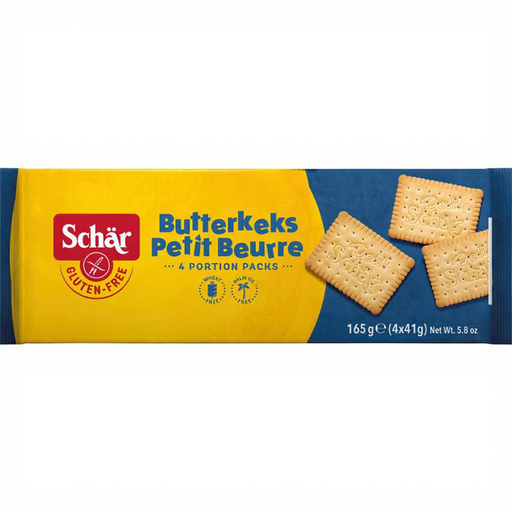 Image unavailable
Schär Petit Beurre butter biscuits, gluten-free, 165 g
These ready-to-eat biscuits are convenient for serving straight away; Schär describes this product as individually wrapped.
The product information lists milk and egg as ingredients and says it may also contain soya and lupin. You’ll need dough to make biscuits you can cut out yourself.
View at Joybuy
Frequently asked questions
What does “gluten-free” mean on a pack of butter biscuits?
According to EUR-Lex, the EU limit for a “gluten-free” claim is 20 mg of gluten per kg of finished product. If you’re choosing for someone with coeliac disease, check the label on the specific pack sold in Germany.
Does gluten-free wheat starch mean a butter biscuit can’t be gluten-free?
No. “Gluten-free” and “wheat-free” mean different things. Poensgen lists gluten-free wheat starch in its butter biscuits labelled gluten-free. If you also need to avoid wheat as an ingredient, check the ingredients list separately.
Are Leibniz Minis butter biscuits suitable for a gluten-free biscuit base?
The version listed by EDEKA24 isn’t suitable: its ingredients list includes wheat flour. For a gluten-free biscuit base, you’ll need biscuits explicitly labelled gluten-free, and you should check the other ingredients too.
How should you store homemade gluten-free butter biscuits?
The REWE recipe recommends storing the baked biscuits in an airtight container. If they’re for someone with coeliac disease, keep them separate from gluten-containing baked goods and use clean utensils to serve them.


