Households with coeliac disease
For these households, the gluten-free labelling on the specific bar matters more than the pack size. The German Coeliac Society describes a strictly gluten-free diet as necessary for life.


If you have coeliac disease, only stock up on a bar whose specific packaging is labelled “gluten-free”. Then consider the ingredients, any other allergens and how much you can realistically use before the best-before date. A three-pack of gluten-free wafer bars can make a small stock, but it is not a substitute for a cereal bar if that is specifically what you’re looking for.
For these households, the gluten-free labelling on the specific bar matters more than the pack size. The German Coeliac Society describes a strictly gluten-free diet as necessary for life.
If you buy bars to keep in stock, check the number of bars and best-before date against how many you usually get through. A larger quantity is of little use if you still need to try the product first.
A bar labelled gluten-free may still contain oats, nuts, milk or soya. If you need to avoid these ingredients, or are unsure whether you can tolerate gluten-free oats, check each bar individually.
First check the gluten-free labelling and any other ingredients that matter to you. Then choose a pack size that suits how much you use.
| What to check | What to look for when buying | Who it matters most to |
|---|---|---|
| Gluten-free labelling | The current packaging must explicitly say “gluten-free”; “wheat-free” alone is not enough. | If I’m stocking up on bars because I have coeliac disease, I need clear labelling on each specific product. For around 50% of consumers, this check is their top purchase priority. |
| Quantity to stock | Check the number of bars, portion size and best-before date against how much you plan to use. | I want to have bars on hand regularly, but not buy a pack I won’t get through in time. The right quantity is the top priority for around 30% of consumers. |
| Ingredients and allergens | Read the ingredients list, highlighted allergens and, where relevant, any information about gluten-free oats. | If I also need to avoid certain ingredients, or am unsure whether I can tolerate gluten-free oats, this will determine what I choose. For around 20% of consumers, this individual check is the top priority. |
For someone with coeliac disease, a wheat-free statement does not answer whether other ingredients contain gluten or whether cross-contamination may have occurred during manufacturing.
Check the gluten-free labelling on the current packaging instead of relying solely on the product name or brand.
Depending on the product, the gluten-free bars mentioned here may contain nuts, milk or soya, among other ingredients. If you have additional allergies, you’ll need to consider these separately.
Before each stock-up, check the ingredients list, highlighted allergens and any precautionary allergen information for the specific product.
Hammermühle notes that people with coeliac disease may tolerate gluten-free oats differently.
If you’re unsure whether they’re suitable for you, speak to a qualified medical or nutritional professional before buying a larger quantity.
Otherwise, you may end up with stock you can’t use.
Hammermühle offers, among other products, a Bio Oat Bar Peanut & Chocolate described as gluten-free. According to Hammermühle, its range focuses on gluten-free products.
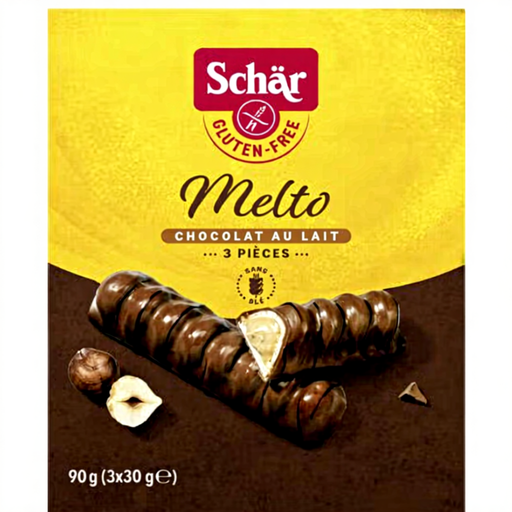
Schär’s range includes the Cereal Bar, a cereal bar described as gluten-free, and Melto, gluten-free wafer bars sold in a three-pack. These are different types of snack to suit different preferences.
Alnavit describes its gluten-free Hafer Riegel Schoko and gluten-free Schoko Waffel Riegel three-pack as vegan products.
The gluten-free three-pack below contains wafer bars. It could work as a small stock if you’re not specifically looking for cereal bars and the ingredients suit you.
 No image available
This three-pack is described as gluten-free and is suitable for keeping a small stock if you’d prefer wafer bars to cereal bars.
Contains hazelnuts, milk and soya; may contain traces of peanuts and other nuts. If you have additional allergies, check the details on the current packaging.
No. Check that the specific bar is labelled “gluten-free”. “Wheat-free” alone doesn’t tell you whether other gluten-containing ingredients or cross-contamination during manufacturing may be an issue.
Yes, a bar labelled gluten-free can contain oats. However, Hammermühle notes that people with coeliac disease may tolerate gluten-free oats differently. If you’re unsure whether they’re suitable for you, speak to a qualified professional.
Choose a quantity that suits how much you actually use and the best-before date. If you’re not yet sure whether you’ll like the taste or tolerate the ingredients, a small multipack limits how much could go unused at first.
No. Gluten-free labelling tells you nothing about these other allergens. For each product, check the current ingredients list, highlighted allergens and any precautionary allergen information.