Families managing coeliac disease
For a snack packed for someone else, look for an explicit gluten-free label on the current packaging. “Wheat-free” or the appearance of a biscuit is no substitute for this claim.


For a school holiday outing where coeliac disease is a consideration, choose a chocolate biscuit whose current packaging is clearly labelled “gluten-free”. Under EUR-Lex rules, this claim in the EU means the finished product must contain no more than 20 mg/kg of gluten. A resealable bag can be handy if you’re planning several snack breaks. If you need to account for other allergies too, check the ingredients and allergen information on the specific pack.
For a snack packed for someone else, look for an explicit gluten-free label on the current packaging. “Wheat-free” or the appearance of a biscuit is no substitute for this claim.
If you’ll be using a pack throughout the day, look for a resealable bag. Individually wrapped biscuits are another option if you need to hand them out separately.
Gluten-free chocolate biscuits can vary in their milk, lactose, soya, egg or lupin content. So even if the gluten-free claim is right for you, the ingredients and allergen list must also meet your specific requirements.
For a snack for someone with coeliac disease, start by checking for a gluten-free label. Then you can consider any other dietary requirements, the packaging for your outing and the type of biscuit you’d prefer.
| What matters | What to check when buying | Who it matters most to |
|---|---|---|
| Gluten-free labelling | Look for the explicit claim “gluten-free” on the current pack; don’t assume “wheat-free” means the same thing. Under EUR-Lex rules, the EU claim requires the finished product to contain no more than 20 mg/kg of gluten. | If I’m buying biscuits for a family member with coeliac disease, I want to be able to spot the relevant claim on the pack. This is likely to be the main concern for around 36% of consumers. |
| Other dietary requirements | Check the ingredients and highlighted allergens on the specific pack; don’t confuse “lactose-free” with “dairy-free”. | If I need to consider milk, soya or egg as well as gluten, the gluten-free claim alone isn’t enough. These additional requirements are likely to be a priority for around 29% of consumers. |
| Taking them along and portioning | Check whether a resealable bag or individually wrapped biscuits will work for how you plan to hand them out. | For several breaks, I want to be able to reseal the pack; if I’m handing them out separately, I need handy portions. Around 21% of consumers are likely to focus mainly on this. |
| Type of biscuit | Choose between cookies, chocolate-coated shortbread biscuits and filled sandwich biscuits; then check the labelling on the version you’ve chosen. | Once I’ve checked the ingredients I need to avoid, I want to choose something my fellow travellers will enjoy too. The type of biscuit is likely to be the deciding factor for around 14% of consumers. |
For a snack for someone with coeliac disease, the explicitly regulated gluten-free claim is what matters. EUR-Lex sets the EU limit at no more than 20 mg/kg of gluten in the finished product.
Check the gluten-free label on the actual pack you’ll be taking with you.
Recipes vary: REWE lists milk, lactose and soya among the allergens in Schär Chocolate O’s, while Poensgen Brot lists ingredients including whole milk chocolate, soya lecithin and sweet lupin flour in its chocolate biscuits.
If you need to consider other allergies, check the ingredients and allergen information for each option against your individual requirements.
A resealable bag of cookies and individually wrapped biscuits suit different ways of carrying and handing them out. REWE also describes Hammermühle Schoko Madeleines as soft little cakes, not crunchy biscuits.
Before you shop, decide whether you’ll use one pack over several breaks or hand out each biscuit separately.
EDEKA notes that product information shown online may differ from what’s on the packaging.
Before handing them out, check the label and the ingredients and allergen information on the pack you receive.
Schär offers a range of chocolate biscuits labelled gluten-free, including cookies, chocolate-coated shortbread biscuits and filled sandwich biscuits.
REWE describes its Bio Chocolate Cookies as gluten-free and lactose-free shortcrust biscuits with dark chocolate.
For a different kind of treat, Hammermühle offers chocolate Madeleines labelled gluten-free.
Poensgen Brot offers chocolate biscuits labelled gluten-free in a 150-g pack.
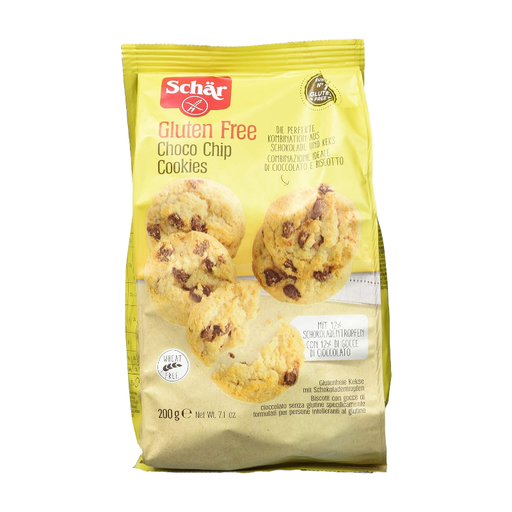
This cookie option may be suitable if you’re looking for a chocolate biscuit explicitly labelled gluten-free. Before your outing, check whether the specific pack meets any other dietary requirements and suits how you plan to carry it with you.
 No image available
A chocolate biscuit for a school holiday snack if you’re looking for an option explicitly labelled gluten-free.
Pack size: 200 g. If you have additional requirements around soya or egg, check the allergen information on the current pack. If you’re planning several snack breaks, also check whether the pack can be resealed.
Look for the explicit claim “gluten-free” on the current pack. According to EUR-Lex, this claim may be used in the EU for a finished product containing no more than 20 mg/kg of gluten; “wheat-free” doesn’t mean the same thing.
No, the gluten-free claim doesn’t tell you either of those things. REWE lists milk and lactose in Schär Chocolate O’s, while REWE frei von Bio Chocolate Cookies are also explicitly described as lactose-free. Check the ingredients and allergen information on the pack for each option; lactose-free doesn’t mean dairy-free.
A resealable bag can work well for several snack breaks; Schär lists this feature for its Choco Chip Cookies. Individually wrapped options can be handier if you’re giving out separate portions, such as the Hammermühle Schoko Madeleines described by REWE – although these are little cakes, not classic biscuits.