People with coeliac disease
For a mid-morning snack, they need crackers that are explicitly labelled gluten-free. The product type or a familiar brand alone doesn’t tell you whether a particular variety is suitable.


If you have coeliac disease, the first thing to check on a pack of crackers is the explicit ‘gluten-free’ label on the current packaging. Under EU Regulation No. 828/2014, this claim may only be used on foods sold to consumers if they contain no more than 20 mg/kg of gluten. Your choice will then depend on the format you want and any other ingredient or allergen requirements. A handy cracker works well as a snack with no preparation, while you’ll also need to choose a suitable dip or topping.
For a mid-morning snack, they need crackers that are explicitly labelled gluten-free. The product type or a familiar brand alone doesn’t tell you whether a particular variety is suitable.
For the office, school or the journey there, they’re looking for a handy format that’s ready to eat. If they take a dip or topping with them, they’ll need to check it separately.
They may also look for vegan or lactose-free varieties, or avoid certain ingredients. These properties apply to the specific product, not automatically to every cracker from a brand.
If you have coeliac disease, start by checking the gluten-free label on the specific pack. Then compare the format, ingredients and where to buy it for your mid-morning snack.
| Criteria | What to check | Who it matters to |
|---|---|---|
| Gluten-free labelling | Check the current pack for the words ‘gluten-free’. Under EU Regulation No. 828/2014, this claim means the food contains no more than 20 mg/kg of gluten when sold to consumers; it doesn’t necessarily mean 0 mg/kg. | If I have coeliac disease, I don’t want to rely on the word ‘crackers’ alone. For around 38% of consumers, a clearly labelled variety is the top priority. |
| Handy format | Compare pack sizes and cracker formats. Consider whether you’ll eat them on their own or take a separately checked gluten-free dip with you. | When there’s hardly any time between appointments, I need a snack that requires no preparation. That’s why around 31% of consumers focus above all on a format that’s easy to take with them. |
| Other ingredients and properties | If you have additional requirements, read the ingredients and allergen information for the specific variety. Check claims such as ‘vegan’ or ‘lactose-free’ on the product itself. | If I need to avoid ingredients other than gluten or want a plant-based variety, the gluten-free claim alone isn’t enough. For around 23% of consumers, these additional checks come first. |
| Choice when shopping | Use a gluten-free filter to narrow down your options, then compare the specific variety, pack size and availability in your area. | If you want to compare several suitable varieties as part of your usual shop, you need a clear selection. For around 8% of consumers, this is the main consideration when buying. |
Even if crackers look similar, you can’t assume a particular variety is gluten-free based on its category or brand.
If you have coeliac disease, choose a variety explicitly labelled ‘gluten-free’ and check the current packaging.
A gluten-free claim doesn’t tell you whether a cracker contains other ingredients that matter to you. Other properties vary from one variety to another.
Check the ingredients, allergen information and, where relevant, the ‘vegan’ or ‘lactose-free’ claims on the specific product.
A product-specific claim about protein or fibre doesn’t automatically apply to other gluten-free crackers or to your whole mid-morning snack.
If you’re interested, compare the nutritional information for suitable varieties using the same serving basis, such as per 100 g.
A filter can help you search, but the range and specific product information depend on the item you choose and your location.
Before buying, check the variety you’ve selected and the current information on its packaging.
These examples show a range of different crackers. Don’t assume that information about one variety applies to a brand’s entire range.
Schär sells gluten-free crackers for a savoury snack and also offers a smaller pocket-sized format.
Alnavit offers a range that includes gluten-free seed crackers and Mini Crackers.
Hammermühle sells savoury crackers that the brand also recommends for eating on the go or with a dip.
For a snack that needs no preparation, you can choose salted crackers or, as a different type of product, gluten-free crispbread. If you have coeliac disease, check the gluten-free labelling on the current pack before buying.
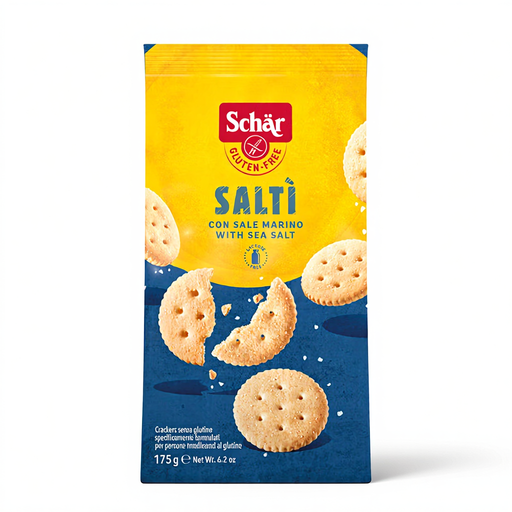 No image available
These salted crackers make a quick snack on their own or with a separately chosen gluten-free topping.
Pack contents according to the product name: 175 g. If you need to avoid soya or lupin, check the ingredients and allergen information on the current packaging.
 No image available
This crispbread is a crunchy alternative for a snack with a topping, but it isn’t a cracker.
Pack contents according to the product name: 125 g. Check the current gluten-free labelling and, if you have a soya allergy, the ingredients and allergen information.
No. Under EU Regulation No. 828/2014, the claim ‘gluten-free’ may be used on foods sold to consumers if they contain no more than 20 mg/kg of gluten; it doesn’t necessarily mean 0 mg/kg. Check the labelling on the specific pack.
For packaged crackers, first look for the explicit ‘gluten-free’ claim and read the current ingredient and allergen information. You can then compare the format and flavour of varieties with suitable labelling.
No. ‘Gluten-free’ doesn’t tell you whether a product is vegan or lactose-free. For example, Alnavit describes its Mini Crackers as vegan, while Schär describes its ‘Crackers’ variety as lactose-free. Always check the information for the specific variety.
Yes, as long as the dip or topping also meets your dietary requirements. If you have coeliac disease, check its gluten-free information separately and avoid contact with gluten-containing foods when preparing it.