Parents of a toddler with coeliac disease
You need a breakfast base that is explicitly labelled gluten-free. When storing and preparing it, you should also take care to prevent it coming into contact with foods containing gluten.


For breakfast for a toddler with coeliac disease, only a product explicitly labelled gluten-free is suitable; ‘organic’ or ‘children’s muesli’ is not enough. If your child cannot yet chew hard pieces safely, a soft base of gluten-free fine flakes is easier to adapt than crunchy granola. For ready-made mixes, parents should also check the size of the pieces, the ingredients and the sugar content on the current packaging.
You need a breakfast base that is explicitly labelled gluten-free. When storing and preparing it, you should also take care to prevent it coming into contact with foods containing gluten.
You want to serve food with a soft texture until your child can safely chew hard nuts, seeds or crunchy pieces. kindergesundheit-info.de explains the risk of choking on small, hard foods.
You compare the nutritional information and ingredients in different gluten-free mueslis. The Verbraucherzentrale notes that muesli mixes can contain sugar too.
For a child with coeliac disease, the gluten-free label is essential. After that, whether fine flakes or a ready-made mix is right for your child depends above all on the texture they need and the specific recipe.
A good choice if: You want a soft breakfast and to choose the ingredients and the size of the pieces yourself.
The trade-off: You’ll need to add suitable accompaniments and soak or cook the flakes to achieve the texture you want.
A good choice if: You want a ready-made mix and its ingredients and texture are suitable for your child.
The trade-off: The gluten-free label tells you nothing about hard pieces or the sugar content of the mix.
| Criterion | What to check when buying | Who it matters most to |
|---|---|---|
| Gluten-free for coeliac disease | Does the current packaging explicitly say ‘gluten-free’? For oats, check the labelling on the specific oat product too. Under Implementing Regulation (EU) No 828/2014, products sold to end consumers can only be labelled ‘gluten-free’ if they contain no more than 20 mg/kg of gluten. | When choosing breakfast for a child with coeliac disease, I want to avoid gluten-containing ingredients and cross-contact; safe gluten-free products are the top priority for around 42% of consumers. |
| Age-appropriate texture | Does the mix contain whole nuts, seeds or hard pieces? Check whether you can prepare the chosen base to a softness that’s right for your child. | If my child can’t yet chew hard pieces safely, I need a serving option I can adapt; around 33% of consumers prioritise finding the right texture. |
| Sugar and ingredients | Compare the sugar per 100 g in the nutritional information, as well as ingredients such as chocolate or dried fruit. ‘No added sugar’ does not mean ‘sugar-free’. | With ready-made mixes, I want to be able to assess the recipe rather than relying on the product name alone; for around 25% of consumers, sugar and ingredients are the main consideration. |
These descriptions do not confirm that a product is gluten-free. For example, Alnatura lists spelt and wheat in its Knusper-Bär Müsli, and barley, wheat and rye among the ingredients in its Maxi Müsli.
If your child has coeliac disease, check that the current packaging explicitly says gluten-free and read the ingredients list.
The gluten-free label does not tell you about the rest of the ingredients. You should assess the nutritional information for any gluten-free fruit or chocolate mix too.
Compare the sugar per 100 g and read the ingredients list. If needed, choose a gluten-free flake base and add suitable soft accompaniments yourself.
According to kindergesundheit-info.de, toddlers can easily choke on nuts, seeds and other small or hard foods. Even granola explicitly labelled gluten-free can contain these ingredients.
Consider the size of the pieces and your child’s chewing ability. If necessary, chop hard ingredients into age-appropriate pieces or avoid them, and prepare suitable flakes until soft.
Product information on retailers’ websites may differ from the packaging, as EDEKA explains on its online product pages.
Before serving, check the current packaging for the gluten-free label, ingredients, allergens and nutritional information.
Seitenbacher offers its fruit muesli #107, which is labelled gluten-free.
Kölln offers gluten-free fine and jumbo oats, as well as gluten-free chocolate oat muesli.
REWE’s ‘frei von’ range includes gluten-free fine oats and a gluten-free crunchy oat option.
Alnatura offers a range of organic mueslis, but ‘organic’ does not mean gluten-free.
EDEKA provides information about gluten-free products under its own brand.
H. & J. Brüggen KG describes its production of traditional and crunchy mueslis, including products for retailer own-label brands.
These products offer two soft alternatives to crunchy granola: fine oats that you can use to make your own mix, and a rice cereal. The cereal is not muesli. For both products, check the current gluten-free labelling and prepare them in a way that’s suitable for your child.
 No image available
An oat base for parents who want to choose the texture and accompaniments themselves.
The product name specifies fine oats and 500 g. For a child with coeliac disease, check the gluten-free label on the current packaging and prepare the oats to suit your child’s chewing ability.
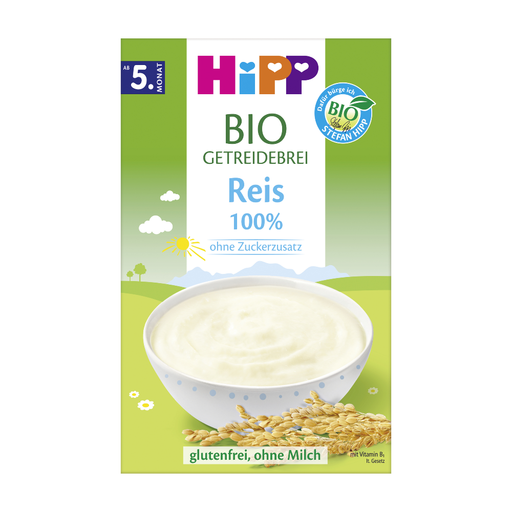 No image available
A cereal alternative if you’re looking for a soft breakfast instead of granola.
The product name specifies ‘from 5 months’, seven packs of 200 g each and ‘no added sugar’. Prepare the cereal according to the packaging and check the current gluten-free label to make sure it meets the requirements for coeliac disease.
Products sold to end consumers can only be labelled ‘gluten-free’ if they contain no more than 20 mg/kg of gluten; this is set out in Implementing Regulation (EU) No 828/2014. It does not mean that a product contains absolutely no gluten, and it does not tell you whether the ingredients and piece size are suitable for a toddler.
No. Neither ‘organic’ nor the absence of wheat alone replaces an explicit gluten-free label. Other gluten-containing cereals may be present, so always check the ingredients list and labelling on the current packaging.
Gluten-free oat products may be suitable if they have not been contaminated with gluten-containing cereals and do not cause symptoms when eaten, according to the German Coeliac Society. If your child experiences individual symptoms, discuss whether to use them with a medical professional.
There is no general age-based recommendation for a specific mix. What matters is your child’s chewing ability and the pieces it contains; kindergesundheit-info.de specifically warns about choking on small or hard foods such as nuts and seeds.
If your child has coeliac disease, agree on the ingredients and preparation with the nursery to prevent the portion coming into contact with foods containing gluten. The German Coeliac Society suggests talking to the childcare and kitchen staff, and bringing food in separate packaging as possible approaches.