People shopping gluten-free because of coeliac disease
You need to be able to check the gluten-free labelling on the pack, as well as the current ingredients and allergen information.


If you have coeliac disease, first check the gluten-free labelling on the specific pack when choosing rice cakes. You should also check the ingredients and any other allergens. If you’re looking for a lower-calorie snack, plain varieties offer a useful basis for comparison, but neither the product name nor the figures per 100 g tell you how much energy you’ll get from the portion you actually eat. EDEKA lists 379 kcal per 100 g for its plain rice cakes and 487 kcal per 100 g for its dark chocolate variety. That’s a difference between these two products, not all rice cakes.
You need to be able to check the gluten-free labelling on the pack, as well as the current ingredients and allergen information.
You compare the nutritional values of plain and sweet varieties, and think about how many rice cakes you’ll actually eat, including any toppings.
A small portion size can be handy. If you’re considering fruity varieties, check the ingredients and any warnings about other allergens too.
If you have coeliac disease, check the labelling on the pack first. Then compare nutritional values using the same basis and take your actual portion into account.
| Criteria | What to check when buying | Who it matters most to |
|---|---|---|
| Gluten and other allergens | Gluten-free labelling, ingredients and allergen information on the specific pack. | If I’m shopping because of coeliac disease, I want to be able to check the labelling clearly before eating the product. If I have other allergies, other ingredients and ‘may contain’ warnings matter too. For around 46% of consumers, this check is the top priority. |
| Energy and sugar | Compare kcal and sugar per 100 g, then take the portion you’ll eat and any toppings into account. | If I want a calorie-conscious snack, I don’t want to judge plain, fruit and chocolate varieties by their names alone. Around 36% of consumers prioritise energy and sugar when making their choice. |
| Format and flavour | Check the pack size, how much you plan to eat, and the ingredients in fruity or chocolate-coated varieties. | If I’m looking for something for on the go or for the family, I want a format that’s easy to portion and a flavour everyone will enjoy. For around 18% of consumers, this is their top priority when choosing. |
Rice as an ingredient alone doesn’t answer every question about a particular pack of processed rice cakes. The German Coeliac Society recommends checking ingredient lists for relevant products.
Before eating, check the pack for gluten-free labelling, ingredients and allergen information.
Figures per 100 g make it easier to compare different products, while figures per rice cake can help you plan a portion. Kallo lists both 394 kcal per 100 g and 27 kcal per rice cake for Organic Unsalted.
Use the same basis when comparing products, then take into account how many rice cakes you’ll eat and any toppings.
Nutritional values vary by variety: EDEKA lists 0.6 g of sugar per 100 g for its plain rice cakes, 9.5 g for its apple variety and 28 g for its dark chocolate variety.
If energy or sugar affects your choice, compare the nutritional information for the specific varieties.
EDEKA notes that pack information may differ from the details on its product page. For one variety of rice cakes, ALDI SÜD mentions that nutritional values may vary between suppliers.
Check the gluten, ingredient, allergen and nutritional information on the pack you’re actually buying.
EDEKA provides product information for plain, apple and chocolate-coated rice cakes.
ALDI SÜD uses these names for products including salted rice cakes and mini apple rice cakes.
Kallo publishes information about plain and lightly salted wholegrain rice cakes.
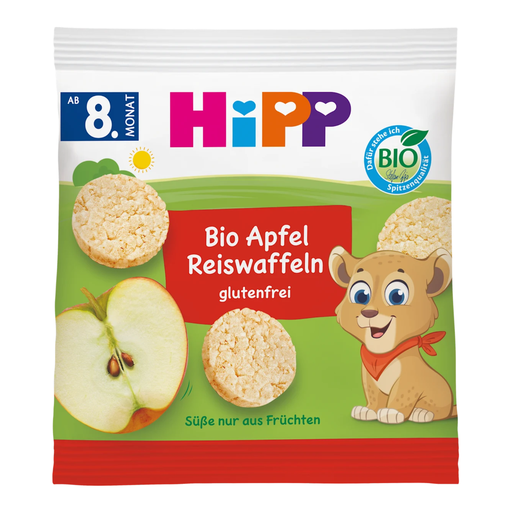
If you’re looking for fruity rice cakes in a small pack, an apple product for babies aged 8 months and over is listed here. If you’re shopping because of coeliac disease, the labelling on the pack you actually buy is what matters.
 No image available
These apple rice cakes may suit you if you’re looking for a fruity product in a small format. If you have coeliac disease, check the gluten-free labelling, ingredients and allergens on the pack before eating.
The product description warns of a choking hazard: supervise children while they eat and do not give them the product when they are lying down.
No. Rice as an ingredient alone isn’t enough to determine whether a processed product is suitable. Check the gluten-free labelling and ingredients on the specific pack. If you have other allergies, check the relevant allergen information too.
You can’t make that generalisation about all products. For the two EDEKA varieties mentioned, the plain rice cakes contain 379 kcal and the dark chocolate ones 487 kcal per 100 g. Compare other products using their own nutritional information and take the portion you eat into account.
Yes, if other allergens besides gluten are relevant to you. EDEKA’s plain variety may contain traces of sesame. Soya is listed as an ingredient in EDEKA’s dark chocolate variety, which may also contain traces of milk, tree nuts and sesame. Always check the current pack.
Use product pages to narrow down your choices, but check the details against the pack before eating the product. EDEKA notes that information on its website may differ from the packaging; for one variety of rice cakes, ALDI SÜD mentions that nutritional values may vary between suppliers.