Families managing coeliac disease
For your child’s school lunchbox, the specific waffle must be clearly labelled gluten-free. If there are other allergies, check the ingredients and allergen information too.


If your child has coeliac disease, only waffles specifically labelled gluten-free are suitable for their school lunchbox. Then consider the ingredients and format: ready-to-eat soft waffles and crispy wafer slices differ in how easy they are to handle and in the allergens they contain, while homemade waffles need to be prepared in advance.
For your child’s school lunchbox, the specific waffle must be clearly labelled gluten-free. If there are other allergies, check the ingredients and allergen information too.
Ready-to-eat soft waffles and flat wafer slices are different options for a break-time snack that needs no heating or cutlery. Pack size and storage instructions matter too.
If your child is allergic to milk, egg, lupin, soya or tree nuts, a gluten-free label alone is not enough. Check the information for each specific product.
For a school lunchbox, you can choose ready-to-eat soft waffles or wafer slices. Homemade waffles are another option if you have time to prepare them. With all three, a gluten-free label is more important than the format or flavour.
A good choice if: You want a soft, ready-to-eat waffle for the lunchbox.
Bear in mind: The Poensgen and Schär varieties described contain egg, milk ingredients and lupin.
A good choice if: A flat, ready-to-eat format matters more than a soft waffle.
Bear in mind: Hammermühle’s lemon cream variety contains soya and milk ingredients. Store it in a dry place, away from heat.
A good choice if: You want to choose the ingredients and portion size yourself.
Bear in mind: Baking takes time, and if your child has coeliac disease, all the ingredients you use must be suitable for gluten-free cooking.
| Criterion | What to check | Who should take note |
|---|---|---|
| Gluten-free labelling | Check that the specific pack says ‘gluten-free’. If it contains oats, look for an explicit gluten-free label too. | If my child has coeliac disease, I don’t want to choose a waffle based on its grain alone. Around 46% of consumers put an explicit gluten-free label first. |
| Easy to eat during break | Check that the pack and portion size will fit in the lunchbox. Look at the instructions for eating and storage too. | For a short school break, I’m looking for something that’s ready to eat and easy to take along. Around 36% of consumers make this their top priority. |
| Other ingredients and nutritional values | Compare the ingredients, allergen and may-contain information, and nutritional values per 100 g with the portion you plan to pack. | If my child has another allergy, I need to check the other ingredients. Sugar content may also influence my choice. Around 18% of consumers put this extra product comparison first. |
Depending on the variety, the gluten-free waffles described contain egg, milk ingredients, lupin or soya. Some products also carry may-contain warnings.
If there are other allergies, check the ingredients and may-contain information on every new pack instead of assuming that the gluten-free label tells you about other allergens.
The Lotus Biscoff sandwich biscuit described contains wheat. It therefore doesn’t meet the gluten-free requirement for this lunchbox and isn’t a waffle either.
Check the specific product type, gluten-free label and ingredients—not just the brand or pack format.
‘Gluten-free’ doesn’t tell you how much sugar a waffle contains. The amount per 100 g and the portion you actually pack answer different questions.
Read the nutritional information for the variety you’ve chosen and compare it with the portion you plan to pack.
It’s the specific variety that matters: a gluten-free waffle from one brand doesn’t mean that the brand’s other products are automatically gluten-free.
REWE lists Poensgen soft waffles as gluten-free in a 100-g pack.
Schär describes its Soft Waffles as gluten-free; the pack reviewed contains 100 g.
Hammermühle describes its lemon cream wafers as crispy slices that are free from gluten and wheat.
The Lotus Biscoff sandwich biscuit reviewed is not a gluten-free waffle alternative.
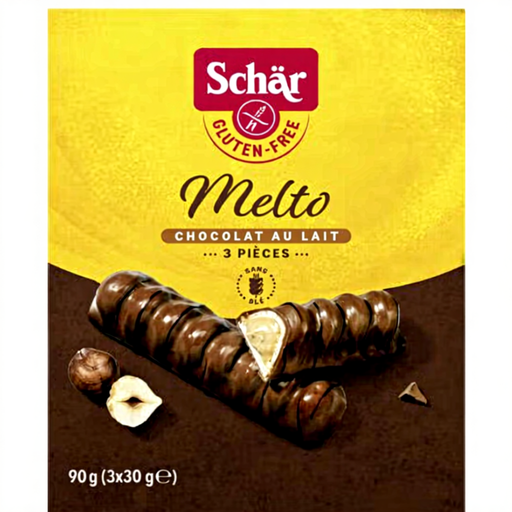
This wafer bar is an option if you’re looking for a filled wafer format labelled gluten-free for a school lunchbox. Check that the pack size suits the portion you have in mind before buying.
 No image available
A good fit for a lunchbox if you want a filled wafer bar labelled gluten-free. The pack contains 3 × 30 g. If there are additional allergies, check the ingredients and may-contain information. Also check whether the bars are individually wrapped before packing them to take along.
No. The specific waffle should be explicitly labelled ‘gluten-free’. EU Implementing Regulation No. 828/2014 sets a limit of no more than 20 mg of gluten per kg of food for this claim. An explicit label is important for waffles containing oats too.
No. The Poensgen and Schär soft waffles described contain egg, milk ingredients and lupin flour. If there are other allergies, check the ingredients and may-contain information on the specific pack.
If snacks are served loose, ask for the allergen information for the specific item. For a pre-packed waffle brought from home, check the information on the pack instead.
Hammermühle recommends keeping this variety in its packaging in a dry place, away from heat, until the best-before date. When packing the snack for a school day, follow the instructions on the specific pack.