Students with coeliac disease
Your first priority is the gluten-free labelling on the specific waffle product. If you have other allergies too, check the ingredients and precautionary allergen statements for each variety.


If you have coeliac disease and want a waffle snack for a study break, look for an explicit ‘gluten-free’ statement on the specific pack rather than relying on a description such as ‘made without flour’. Under EU Implementing Regulation (EU) No 828/2014, this statement is only permitted if the food contains no more than 20 mg/kg of gluten when sold to the final consumer. Packaged waffles are ready to eat, making them easy to fit into a study break; homemade waffles give you more control over the ingredients, but you need to prepare them in a way that avoids cross-contamination. Check for other allergens and precautionary allergen statements separately, even when a product is labelled gluten-free.
Your first priority is the gluten-free labelling on the specific waffle product. If you have other allergies too, check the ingredients and precautionary allergen statements for each variety.
You want a waffle you can eat without a waffle maker or any preparation. Pack size, portion information and storage instructions can help you choose something to enjoy over several study breaks.
You want to choose the ingredients and toppings yourself, and can set aside time to prepare them. If you have coeliac disease, you’ll need a suitable gluten-free recipe and to avoid cross-contamination.
A good choice if: You want something ready to eat during a short break or while you’re out and about.
Things to consider: The ingredients are fixed, so check that the gluten-free statement and any other allergen information apply to the specific pack.
A good choice if: You want to choose the ingredients and toppings yourself, and prepare the waffles before your study break.
Things to consider: They take time to make; if you have coeliac disease, you’ll also need to protect work surfaces and equipment from cross-contamination.
| Criteria | What to check when buying | Who it matters most to |
|---|---|---|
| Gluten-free labelling | Check for a ‘gluten-free’ statement on the current pack. Under EU Implementing Regulation (EU) No 828/2014, food sold to the final consumer must contain no more than 20 mg/kg of gluten to carry this statement. | If I’m choosing waffles to enjoy while studying because I have coeliac disease, I need clear gluten-free labelling. This is the top priority for around 50% of consumers. |
| Suitable for study breaks | Compare the portion information and storage instructions on each pack. REWE lists three portions for Schär Waffeln Snack 105 g and four for Schär Soft Waffeln 100 g. | During short study breaks, I want something I can eat without preparation and plan to enjoy the pack over several breaks. This is the top priority for around 30% of consumers. |
| Other ingredients and allergens | Read the ingredients list and precautionary allergen statements for each variety. If you’re baking your own, also consider every ingredient you use and how you prepare the waffles. | If I also want to avoid certain ingredients or choose my own toppings, a gluten-free statement alone isn’t enough. This is the main priority for around 20% of consumers. |
A recipe made without flour doesn’t confirm that a packaged waffle is labelled gluten-free. ‘Low carb’ doesn’t answer this question either.
If you’re buying a ready-made product for someone with coeliac disease, look for a ‘gluten-free’ statement on the current pack.
Gluten-free doesn’t mean free from other allergens. REWE lists possible traces of soya, nuts and sesame in Schär Soft Waffeln.
Check the ingredients and precautionary allergen statements for the exact variety you want to buy.
Regular oat products shouldn’t be treated as equivalent to oats labelled gluten-free. The Nutrition Advice Service of Rhineland-Palatinate also points out that gluten-free oats may only be suitable for people with coeliac disease under certain conditions.
For waffles containing oats, check the product’s gluten-free labelling and take your individual tolerance into account.
Schär offers a range of gluten-free waffle products, including Soft Waffeln and cocoa-filled waffles.
REWE lists product information for several Schär waffle varieties, making it useful for comparing pack and portion details.
EDEKA describes a flour-free, low-carb waffle recipe as gluten-free. It’s an idea for homemade waffles, not a statement about a packaged product.
Lidl Kochen shares a recipe for gluten-free pancakes. Pancakes aren’t waffles, so the recipe doesn’t confirm the availability of a comparable packaged waffle product.
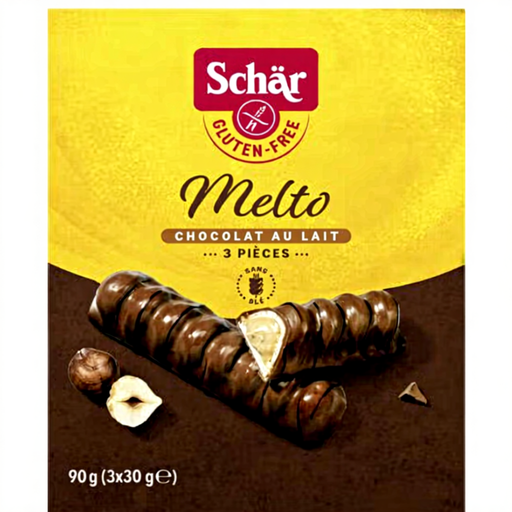
Here you’ll find a packaged wafer bar that’s ready to enjoy during a study break. If you have coeliac disease, the gluten-free statement on the specific pack will determine whether it’s suitable for you.
 No image available
A wafer bar that’s ready to enjoy during a study break; if you have coeliac disease, check for an explicit gluten-free statement on the current pack before choosing it.
Pack size: 3 × 30 g. If you have additional allergies, also read the ingredients list and precautionary allergen statements on the pack.
No. These descriptions don’t replace a ‘gluten-free’ statement on a pack of waffles. Under EU Implementing Regulation (EU) No 828/2014, a food may only be labelled ‘gluten-free’ if it contains no more than 20 mg/kg of gluten when sold to the final consumer.
No. Check the gluten-free labelling on both the waffles and the oats used. According to the Nutrition Advice Service of Rhineland-Palatinate, gluten-free oats are only suitable for most people with coeliac disease under certain conditions; individual tolerance matters too.
Yes. A gluten-free statement doesn’t tell you whether a product contains other allergens. For example, REWE notes that Schär Soft Waffeln may contain traces of soya, nuts and sesame. Always read the information on the specific pack.
Packaged waffles are a good choice if you want something ready to eat; baking your own lets you choose the ingredients and toppings. If you have coeliac disease, you’ll need suitable gluten-free ingredients or an appropriately labelled pack, and must avoid cross-contamination when baking.